
Featured · Nov 18Science
Ole Rømer's Bet on a Late Eclipse
In the summer of 1676, a Danish astronomer in Paris made a very specific forecast about a moon of Jupiter, and waited to see if the sky would agree with him.

Listen
Read by Finch · 8 min
A Forecast for the Sky to Judge
By August 1676, Ole Rømer had done something unusual for an astronomer of his time: he had put a number on the future. He predicted that an eclipse of Io, Jupiter's innermost large moon, expected on 9 November 1676, would arrive about ten minutes later than the time calculated from the moon's regular orbital period4,5. It was not a vague hunch. It was a date, a moon, and a margin of error, stated months ahead of the event.
The prediction turned on geometry rather than guesswork. In August, Earth and Jupiter sat relatively close together; by November, Earth would have swung farther along its orbit, putting more distance between the two planets. If light took time to cross that extra distance, the eclipse should look late. If light arrived instantly, as nearly everyone since Descartes assumed, it should arrive right on schedule7. Either way, the sky would soon render a verdict nobody could argue with.
To understand why a moon's shadow could settle a question about the nature of light, you have to go back to 1610, when Galileo Galilei spotted four satellites circling Jupiter, Io among them. Astronomers quickly realized that Io's shadow passages, regular enough to predict, might work as a kind of cosmic clock, useful for the very practical problem of finding longitude at sea.
That clock needed careful keepers. Giovanni Domenico Cassini, the Italian-born director of the newly opened Paris Observatory, had already built tables predicting Io's eclipses and used them for longitude work1. Jean Picard, sent north to the site of Tycho Brahe's old observatory at Uraniborg on the island of Hven, took a young Danish assistant along: Ole Rømer, fresh out of the University of Copenhagen, whose skill impressed Picard enough that he arranged for Rømer to come work in Paris1,2.
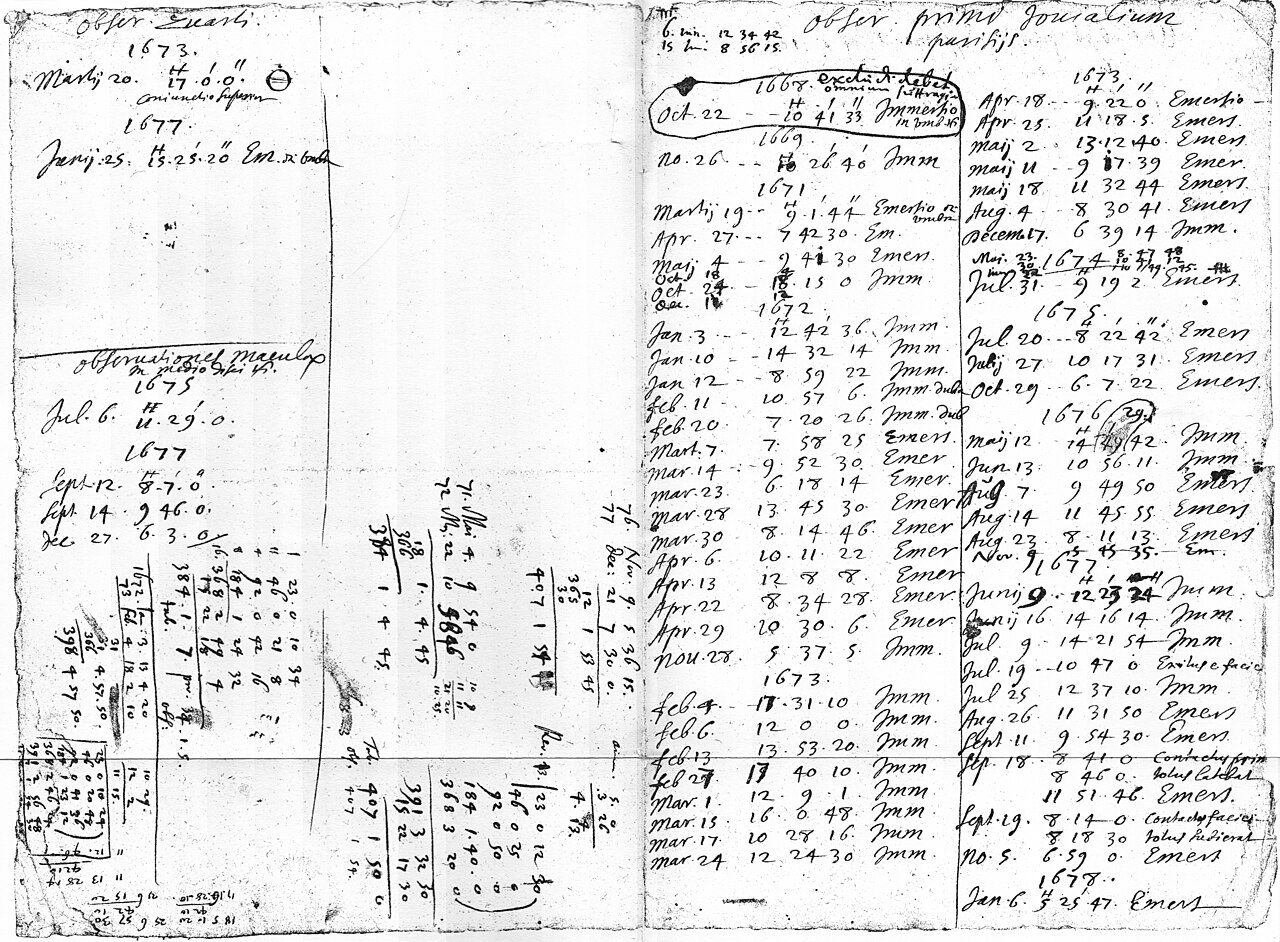
Between 1671 and 1673, Picard and Rømer logged eclipse after eclipse at Hven while Cassini recorded the same events in Paris, around thirty useful observations in all8. A pattern emerged that the existing tables could not explain away. As Earth moved toward Jupiter, the gaps between eclipses shrank; as Earth moved away, the gaps stretched1,2. Io's orbit itself had not changed. Something about the distance the light had to cross seemed to be adding or subtracting time from what observers on Earth actually saw.
Rømer floated the idea to the Royal Academy of Sciences in Paris, by some accounts as early as 22 November 1675, framing it as the reason behind the irregular timings9. That was an explanation after the fact, persuasive to some, unconvincing to others. The August 1676 prediction changed the stakes, because it asked the universe to confirm something before anyone had seen it happen.
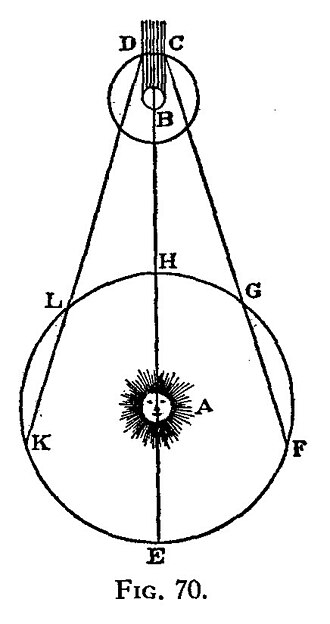
On 9 November 1676, the eclipse of Io appeared roughly when Rømer had said it would: about ten minutes later than the old tables demanded10,4. No surviving account describes the scene in the observing room that night, the instruments in hand, or a word anyone said when the moon finally slipped into shadow. What survives is the astronomical record of a forecast that had matched reality in both direction and size10.
It still did not win over everyone. Cassini, the observatory's director and the man whose own tables had made the prediction possible in the first place, never fully accepted Rømer's account of what was happening, reportedly doubting it partly because the same irregularities were less obvious for Jupiter's other three moons1,7. Christiaan Huygens and Isaac Newton, by contrast, came around to it fairly quickly1.
Rømer laid out the full argument to the Academy later that November, on either the 21st or the 22nd depending on the source3,10, and the result reached print on 7 December 1676 in the Journal des Sçavans, written up anonymously under a title usually translated as "A Demonstration Concerning the Motion of Light Found by M. Rømer"6,7. The article gave no speed in familiar units. It simply said light needed about 22 minutes to cross the diameter of Earth's orbit, which worked out, in the terms of the day, to roughly 11 minutes from Sun to Earth3,10. An English translation ran in the Philosophical Transactions of the Royal Society on 25 July 1677, carrying the claim across the Channel8.
Measured against the modern figure, Rømer's number falls short, something near 200,000 to 227,000 kilometers per second against the real 299,7921,3. The forecast he staked on that August evening, though, had already done its job: it let the sky itself answer a question about whether light takes time to travel at all.
Who Was Watching the Sky
- Ole Rømer: Danish astronomer who worked at the Paris Observatory and made the 1676 prediction and argument for light's finite speed1,2.
- Giovanni Domenico Cassini: Director of the Paris Observatory, whose eclipse tables of Io made the longitude method and Rømer's test possible, though he never fully accepted Rømer's explanation1.
- Jean Picard: French astronomer who observed Io's eclipses from Hven alongside Rømer while Cassini observed in Paris1,2.
- Christiaan Huygens: Correspondent of Rømer who debated the finding by letter and came to accept it1,7.
- Io: Jupiter's innermost large moon, whose regular eclipses served as the natural clock at the center of the whole investigation1.
The Figures That Mattered
- About 22 minutes: the time Rømer said light takes to cross the diameter of Earth's orbit1,3.
- About 11 minutes: the implied travel time from Sun to Earth, in the terms used in 167610.
- About ten minutes: the delay Rømer predicted, in August 1676, for the 9 November eclipse of Io4,5.
- Roughly 200,000 to 227,000 km/s: Rømer's result translated into modern units, against today's accepted 299,792.458 km/s1,3.
- About thirty eclipse observations from 1671-1673 underpinned Rømer's calculation1,8.
What the Record Doesn't Settle
Sources disagree on exactly when Rømer first floated his explanation to the Academy, with some giving 22 November 1675 as the first announcement and others treating the 1676 predictive test as the real turning point9.
The date of the final November 1676 presentation is also recorded differently, as either 21 or 22 November, and the original Academy record has not survived; what we have is an anonymous write-up in the Journal des Sçavans3,10,8.
Later analysis has questioned how solid Rømer's underlying data really were. One physics-history review found that of the observations Rømer built his case on, only one clearly succeeded, one clearly failed, and two others were doubtful, even though the method itself was sound11.
Most of Rømer's personal papers burned in the Copenhagen Fire of 1728, so much of what is known about his working notes survives only through a later aide-mémoire and secondhand accounts from his assistant Peder Horrebow2,1.
Timeline
- 1610Galileo discovers Jupiter's four large moons, including Io.
- 1671-1673Rømer and Jean Picard observe Io's eclipses at Hven while Cassini observes in Paris, logging the discrepancy.
- 22 November 1675Rømer presents an early version of his explanation to the Paris Academy, according to some accounts.
- 22 August 1676Cassini announces to the Academy that he will change the basis for his eclipse tables.
- 23 August 1676Rømer predicts the 9 November eclipse of Io will run about ten minutes late.
- 9 November 1676The eclipse occurs roughly ten minutes late, as predicted.
- 21 or 22 November 1676Rømer presents the full argument to the Academy in Paris.
- 7 December 1676An anonymous account is published in the Journal des Sçavans.
- 25 July 1677An English translation appears in the Philosophical Transactions of the Royal Society.
Pictures


Sources
- Rømer's determination of the speed of lightWikipedia
- Ole RømerWikipedia
- [PDF] www.osa-opn.org 42 | OPN July/August 2009 Ole Rømer (1644 ...opn-web-afd-d3bfbkd5bcc5asbs.z02.azurefd.net
- 340 years ago, Rømer showed that light has a finite speedobservatoiredeparis.psl.eu
- Ephemerides Bononienses Mediceorum syderum ex ...sophiararebooks.com
- University of Copenhagen history - Ole Rømeruniavisen.dk
- INTRODUCTIONarXiv
- Leave a Reply Cancel replyscihi.org
- Rømer and the Speed of Light | History | Research Starters - EBSCOebsco.com
- Navigating the Fourth Day of Creation by means ...vaticanobservatory.org
- Ole Ro/mer, the speed of light, the apparent period of Io, the Doppler effect, and the dynamics of Earth and JupiterAmerican Journal of Physics · 1998
Researched and written by Lorelet from the sources above. It cites as it goes, but it can still get things wrong, so check the sources for anything that matters.
Report a problem
More featured lorelets
See all
Today · Food
The Turkey Surplus That Became the TV Dinner
A company drowning in frozen birds found an answer on an airline food cart, or so the story goes for fifty years.

Today · Space
Why Is Jupiter's Great Red Spot Actually Red?
Jupiter is built almost entirely of colorless gas, yet its most famous storm glows orange-red. Scientists have spent decades in the lab trying to fig…

Today · Art & Design
The Aztec Labret Whose Golden Tongue Still Moves
A small gold serpent made for a pierced lip somehow ended up with a tongue that flicks side to side. No one alive has ever seen it worn.