
Featured · TodaySpace
Why Is Jupiter's Great Red Spot Actually Red?
Jupiter is built almost entirely of colorless gas, yet its most famous storm glows orange-red. Scientists have spent decades in the lab trying to figure out why.

Listen
Read by Wren · 9 min
The Experiment That Didn't Work
At the Jet Propulsion Laboratory in Pasadena, Robert Carlson aimed ultraviolet light at a sample of ammonium hydrosulfide, trying to recreate what sunlight does to a cloud material thought to exist deep in Jupiter's atmosphere3. Ammonium hydrosulfide was a reasonable suspect: it is one of the compounds expected to form the cloud decks beneath Jupiter's visible haze1,8. The idea was simple enough, irradiate the stuff and see if it turns the color of the Great Red Spot.
It didn't3. The result failed to reproduce the storm's color in any convincing way, which left the team's most direct chemical guess sitting in the trash, and the oldest question in Jovian meteorology no closer to an answer3.
That question is harder than it sounds because of what Jupiter is actually made of. The planet's atmosphere is overwhelmingly molecular hydrogen and helium, both essentially colorless in visible light, with everything else present only in small amounts: methane, ammonia, hydrogen sulfide, water1. Whatever paints the belts, zones, and the Great Red Spot has to be a minor ingredient doing a lot of visual work.
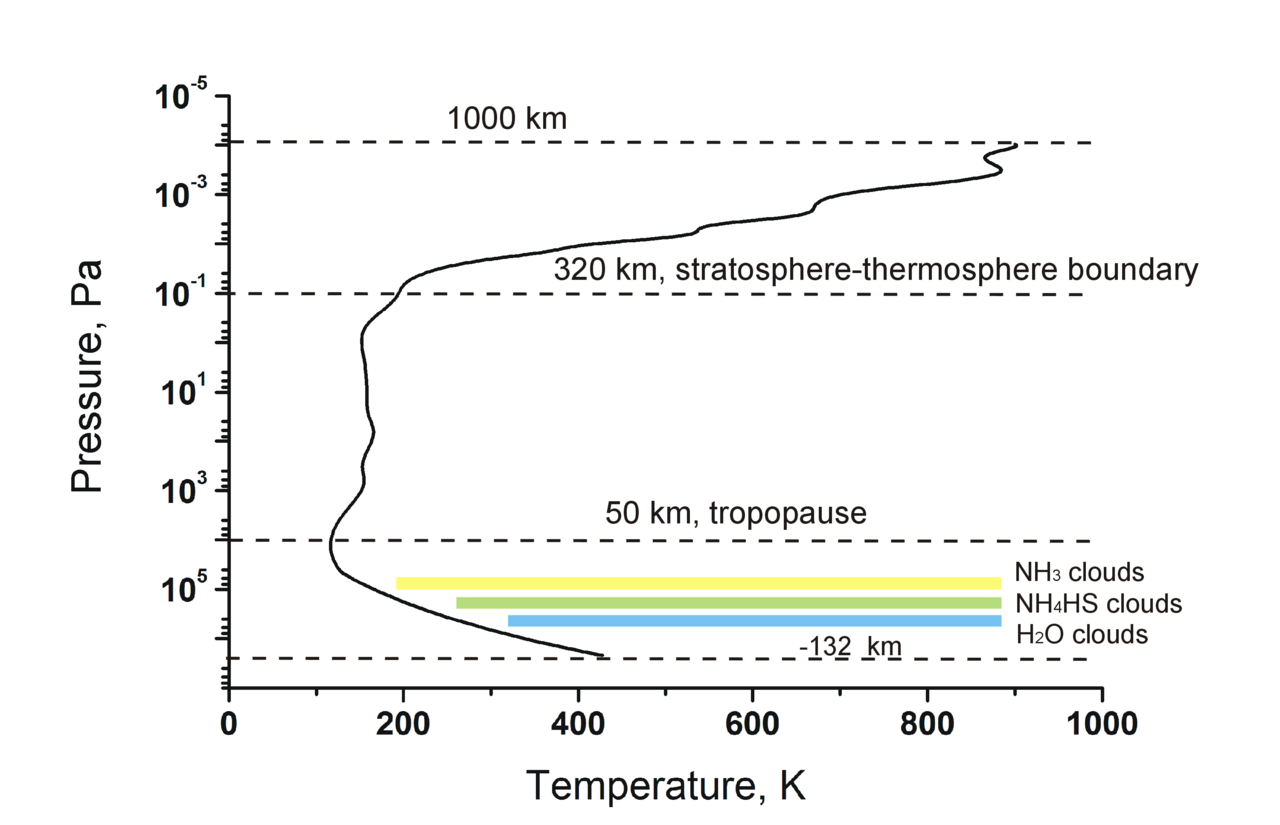
The atmosphere is thought to be layered in clouds: water clouds deepest, ammonium hydrosulfide clouds above that, and ammonia-ice clouds higher still8. Pure ammonia ice and ammonium hydrosulfide are both expected to look bright or whitish on their own, not orange-red, so neither explains the Great Red Spot by itself9. Scientists gave the missing ingredient a placeholder name, chromophore: something that absorbs blue and ultraviolet light more than red, without anyone having pinned down exactly what it is.
By the 1970s there were three competing families of candidates. A 1976 review proposed organic molecules formed when ultraviolet light breaks apart simple atmospheric gases, red phosphorus compounds from the breakdown of phosphine, and sulfur compounds drawn up from the lower atmosphere10. Each could be made reddish under laboratory conditions. None had been shown to actually survive, form, and absorb light the right way at the altitude where Jupiter's color lives.
Carlson's team, working with Kevin Baines and Thomas Momary at JPL, changed tactics after the hydrosulfide experiment failed3. Instead of guessing from deep-cloud chemistry, they irradiated a mixture of ammonia and acetylene, both of which are known to exist in Jupiter's atmosphere4. This time the ultraviolet light produced a genuinely reddish residue, a complex mix of carbon, hydrogen, and nitrogen compounds loosely written as HxCyNz because its exact composition varies with conditions3.
The real test came later, when the lab product's spectrum was compared against the Great Red Spot itself, as measured by Cassini's Visible and Infrared Mapping Spectrometer during the spacecraft's 2000-2001 flyby4,5. The match was reported as strong enough to support the idea that this ammonia-acetylene chemistry, or something very like it, is what tints the storm4,5. NASA summarized the mechanism as a kind of sunburn: the Great Red Spot's own circulation lifts ammonia higher than usual, into stronger ultraviolet light, where it reacts with acetylene near the cloud tops and the products darken toward red4,6.

That still left open how far the explanation stretched. Researchers using the MUSE instrument on the Very Large Telescope later modeled Jupiter's belts and the Great Red Spot with the same chromophore, provided it had a steeper rise in blue-light absorption than the original Carlson group's version, an idea published in Icarus and nicknamed the universal chromophore7,4. A related model, called Crème Brûlée, pictures ammonia rising from below and acetylene sinking from above, meeting and reacting in a thin sun-processed layer over brighter clouds beneath, the same idea in different packaging9. None of it amounts to a scientist holding a vial of the actual Jovian pigment. What exists is a laboratory stand-in whose spectrum lines up with the Great Red Spot's, well enough that it has become the leading explanation, not yet good enough to call the question closed4,5.
What the Bands Are Made Of
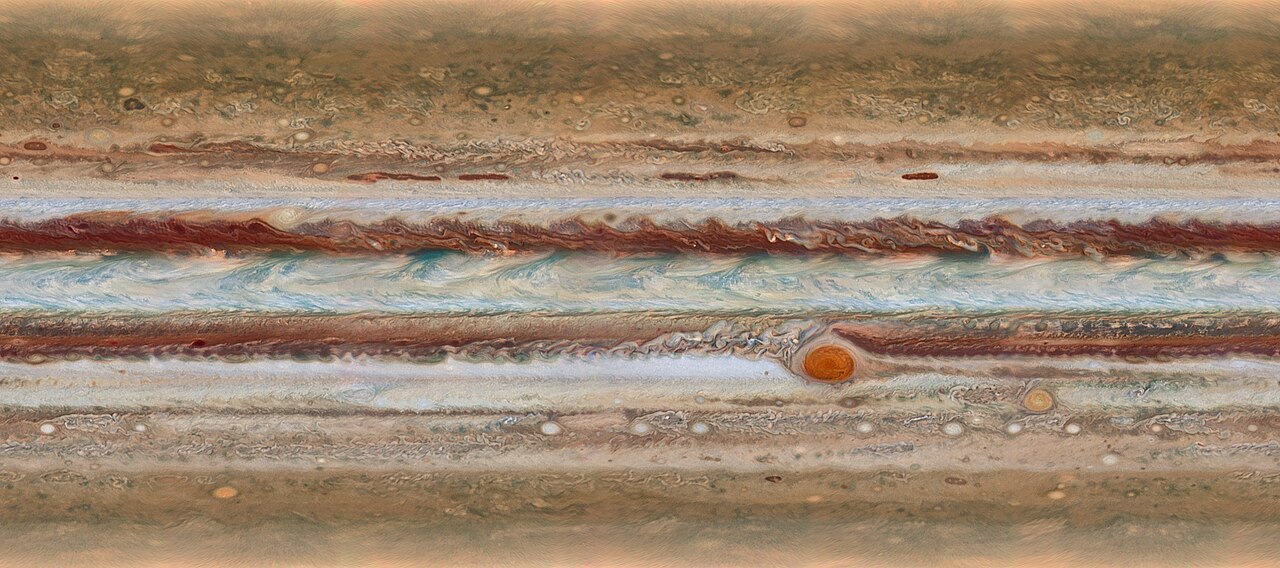
Jupiter's visible surface is organized into alternating zones and belts running parallel to the equator. Zones are colder, lighter, and associated with rising gas; belts are warmer, darker, and associated with sinking gas1. The zones' pale color is generally credited to ammonia ice, but what colors the belts has never been nailed down1.

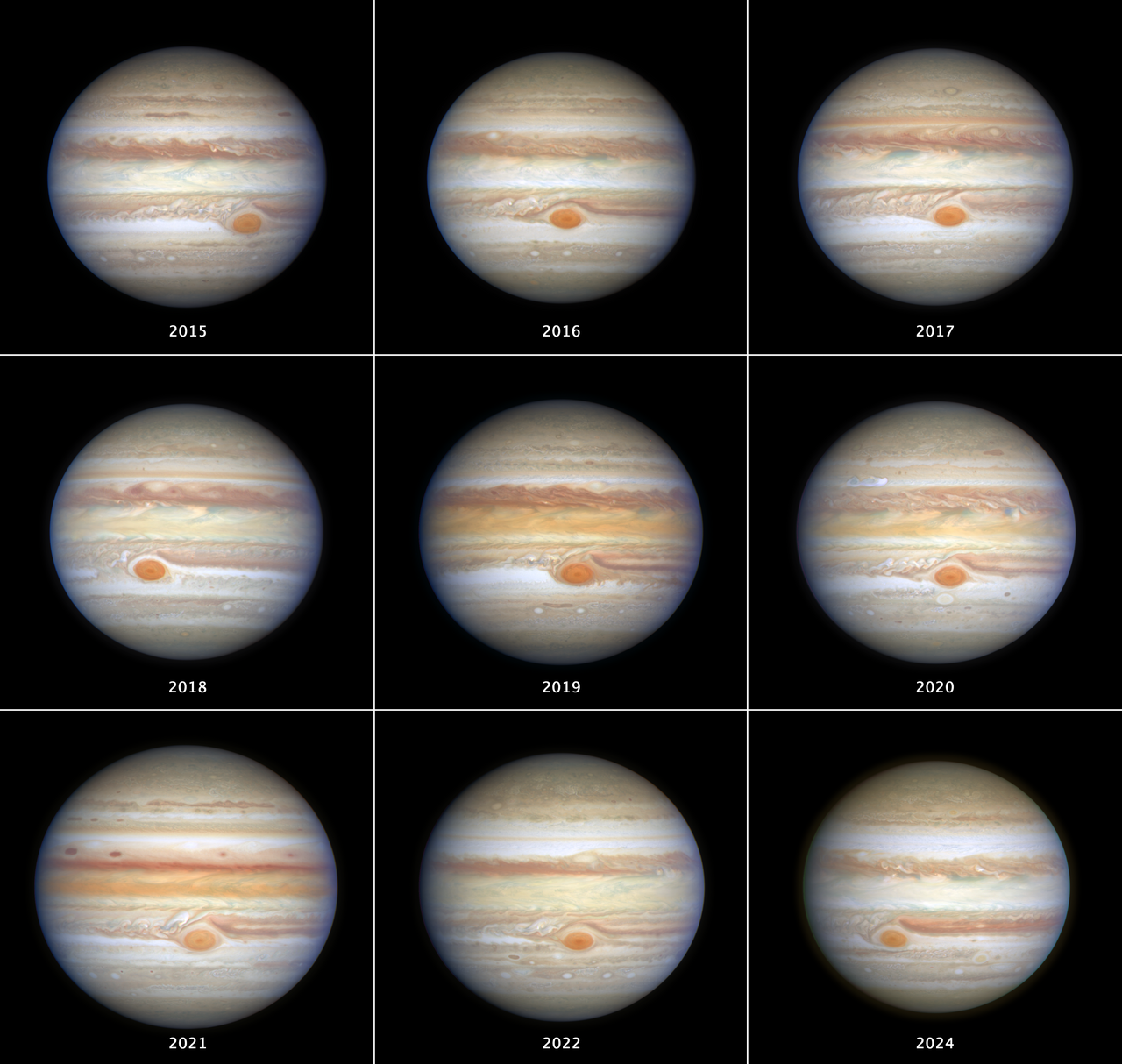
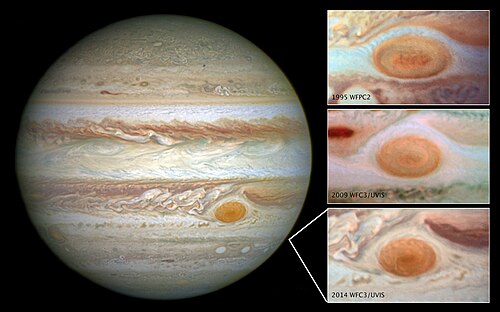
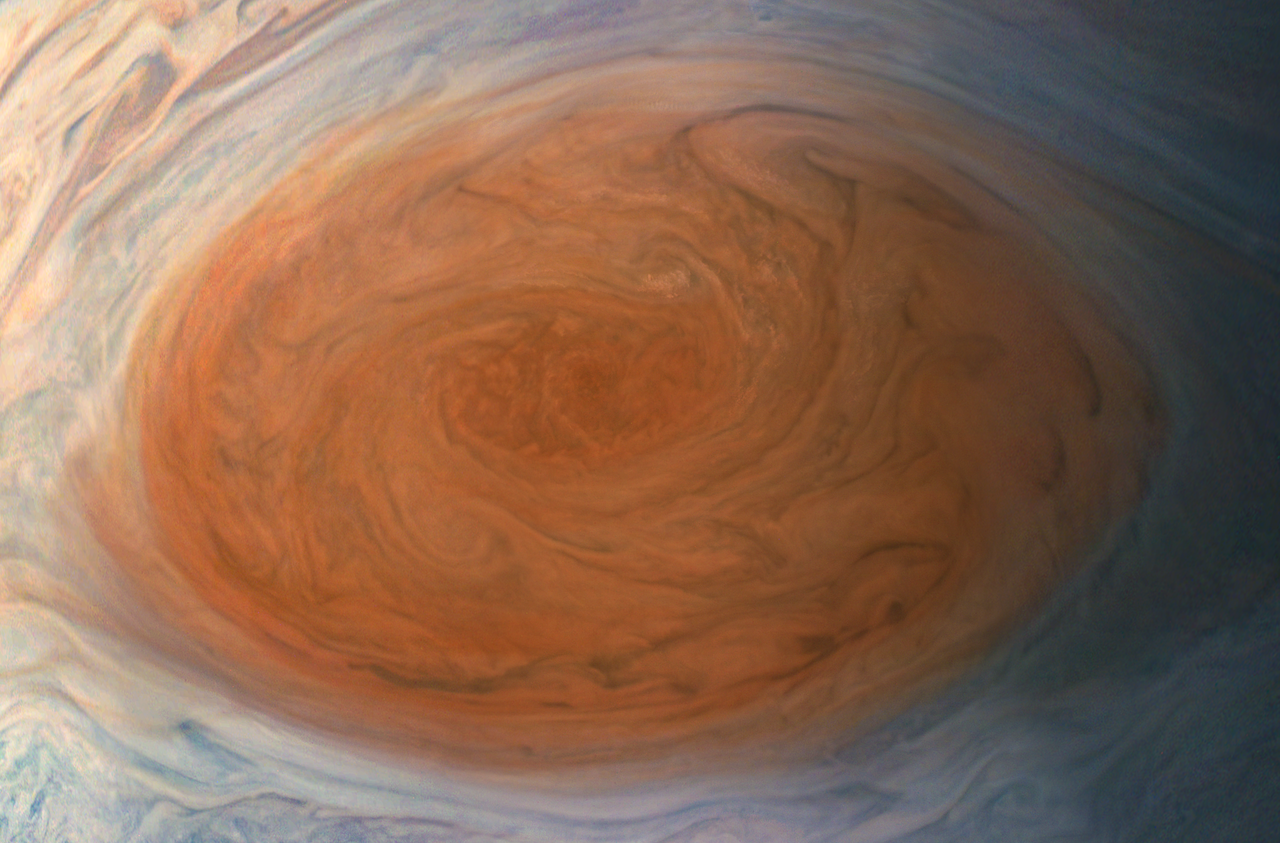
The Great Red Spot sits inside this banded system as a giant anticyclone 22 degrees south of the equator, large enough to have engulfed two or three Earths at its peak and persistent enough that some form of it may have been seen as early as 166411. It has been shrinking for over a century: it was about 40,000 kilometers across a hundred years ago and roughly half that by 2004, a trend that if it continues is projected to leave it circular by around 204011. A 2024 study of historical records raised the possibility that the storm seen in the 1660s and 1700s was not the same feature observed continuously since 1831, meaning the Great Red Spot people watch today may be a separate storm that formed later11.
Color and size appear to move together in a way nobody fully understands. Researchers have noted that the Great Red Spot's reddening has coincided with its shrinking in recent decades, and that other features, like the North Temperate Belt, go through their own color cycles over time4. That pattern suggests the chromophore's visibility is tied to the storm's physical structure, not just its chemistry.
What's Settled and What Isn't
The ammonia-acetylene residue remains the best laboratory match for the Great Red Spot's spectrum, tested against Cassini data4,5. But it is a model, not a sample returned from Jupiter, and researchers describe the chromophore's origin, composition, and altitude as still unknown in precise terms4.
Competing ideas have not been ruled out. Earlier proposals invoking red phosphorus or sulfur compounds were never confirmed, but neither were they definitively eliminated10. Some studies propose two separate chromophores, one in an upper haze and one in a lower haze layer, rather than a single universal compound12.
Even the storm's age is disputed. Robert Hooke's 1664 sighting and a spot recorded from 1665 to 1713 may or may not be the ancestor of the Great Red Spot watched today; a 2024 analysis argues they are probably not the same feature, which would make the modern spot at least 193 years old rather than over 35011,13.
Timeline
- 1664Robert Hooke records an early sighting of a spot on Jupiter11.
- 1665-1713A 'Permanent Spot' is observed at the Great Red Spot's latitude by Giovanni Cassini and others; later analysis questions whether it is the same storm seen today11,13.
- 1831Continuous observation of the modern Great Red Spot effectively begins11.
- 1976A review paper outlines organic, phosphorus, and sulfur chromophore hypotheses for Jupiter's color10.
- 2000-2001Cassini's Visible and Infrared Mapping Spectrometer measures the Great Red Spot's spectrum during its Jupiter flyby, later used to test lab chromophore candidates4,5.
- 2016Baines, Carlson, and colleagues report laboratory results showing ultraviolet-irradiated ammonia and acetylene produce a chromophore-like red residue3.
- 2017Sromovsky and colleagues propose a 'universal chromophore' that could explain color across Jupiter's disk4,12.
- 2019-2020MUSE/VLT observations refine the universal chromophore model and the 'Crème Brûlée' layered structure is proposed4,9,12.
- 2024A historical study questions whether the 17th-century 'Permanent Spot' is the same storm as the modern Great Red Spot11,13.
Pictures


Sources
- Atmosphere of JupiterWikipedia
- Organic Molecules and the Coloration of Jupiter - NatureNature · 1967
- [PDF] Why is Jupiter's Great Red Spot Red?lpi.usra.edu
- Colour and Tropospheric Cloud Structure of Jupiter from MUSE/VLT: Retrieving a Universal ChromophorearXiv
- Optical constants of laboratory-generated analogs of the red chromophores in Jupiter’s atmospheremeetingorganizer.copernicus.org
- Is Jupiter's Great Red Spot a Sunburn?NASA
- Citizen science reveals that Jupiter's colorful clouds are not made of ...phys.org
- Evidence of pure ammonia clouds in Jupiter's Northern ...academic.oup.com
- Clouds and Ammonia in the Atmospheres of Jupiter and Saturn Determined From a Band-Depth Analysis of VLT/MUSE Observationsonlinelibrary.wiley.com
- The organic chemistry and biology of the atmosphere of the planet ...sciencedirect.com
- Great Red SpotWikipedia
- Understanding the Great Red Spot of JupiterScholarly work (preprint) · 2026
- On the origin of Jupiter’s Great Red SpotScholarly work (preprint) · 2024
Researched and written by Lorelet from the sources above. It cites as it goes, but it can still get things wrong, so check the sources for anything that matters.
Report a problem
More featured lorelets
See all
Today · Food
The Turkey Surplus That Became the TV Dinner
A company drowning in frozen birds found an answer on an airline food cart, or so the story goes for fifty years.

Today · Art & Design
The Aztec Labret Whose Golden Tongue Still Moves
A small gold serpent made for a pierced lip somehow ended up with a tongue that flicks side to side. No one alive has ever seen it worn.

Nov 21 · Music
The Affidavit Alan Freed Wouldn't Sign
A one-page statement asking New York's biggest disc jockey to swear he'd never taken a dime from a record company. He refused to put his name on it.