Featured · TodayHistory
The Diary That Came Out of a Stourbridge Tip
A boy scavenging for toys among the bottles and cans found a small green book with a hole through it. It took thirty years, and a museum curator's obsession, to learn whose it was.

Listen
Read by Finch · 7 min
A Green Book in the Rubbish
Alan Southall was twelve, picking through bottles and cans at a rubbish tip in Stourbridge, England, when he and his friends spotted something small and green turning in the wind among the trash: a nearly four-inch volume with a hole punched through its corner and what looked like dried blood on its pages1. It was 1965. The entries inside were dated 19181.
Southall kept the diary for thirty years without resolving what he suspected about its owner1. He later put it plainly: "There was a bullet hole and it was blood stained and it didn't look good for the guy."2
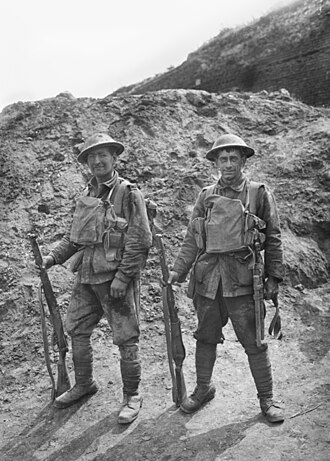
The writer turned out to be Corporal Claude Milton Rich Nuttall, born in 1895 in Cheltenham, Victoria, the eldest of four children of a storeman and a shopkeeper3. He went to Cheltenham State School, worked as a brass-finisher in a foundry, and played football for a local team before enlisting in the Australian Imperial Force on 12 July 1915, a few days after his twentieth birthday3,4. He joined the 23rd Battalion in Egypt in early 1916, after it had already fought at Gallipoli and suffered heavily at Lone Pine3.
By April 1916 the battalion was in the trenches of northern France, and at Pozieres and Mouquet Farm it lost close to ninety percent of its original men3. On his twenty-first birthday, in July 1916, Nuttall and three other soldiers crawled into no man's land at four in the morning, in full daylight, to rescue two wounded men of the 14th Battalion stranded near the German lines. All four were later decorated with the Military Medal by King George V3,5.
Nuttall was wounded, reportedly in the thigh, and sent to recover at a hospital in Stourbridge, in England's West Midlands4,6,3. There he met an eighteen-year-old local girl, Violet Palfreyman, who brought sweets and cigarettes around to the patients3. They married on 25 March 1918 in the parish church at Wordsley. "All excited," he wrote in his diary. "Married 12:30 p.m. All went well."7 They had a little more than thirty days together before he was ordered back to his battalion4,3.
From 1 January 1918 Nuttall had kept a small daily diary, a green-covered book recording the ordinary texture of a corporal's war: lectures and parades, breakfasts of chips and bacon, a cathedral visit on a Sunday, billiards, films, and a steady traffic of letters to and from Violet4. On 9 May he noted his good fortune when a German shell landed two feet from him and failed to explode3. His last entry, dated 10 August 1918, during the Battle of Amiens, described "heavy bombardment by our guns," a push still in progress, and that he had started a letter to Vi and packed up ready to move forward again4,7,8.
Three days later, on 13 August 1918, Nuttall was killed in action9,4. One local account, attributed to a Private Standing, says he was shot through the body by a German sniper at about nine in the morning during a daylight raid; other accounts describe him attacking a German machine-gun post during the advance at Amiens3,6,8. The accounts do not agree on the exact circumstances, and none of them confirms whether the bullet that tore through his diary was the one that killed him3.
The diary did not go to the Australian War Memorial or to Nuttall's family after his death. It ended up, decades later and by a route nobody has fully explained, in a Stourbridge rubbish tip, where Southall found it4,1. He held onto it, carefully kept inside a plastic bag, until 1996, when he carried it into the Dudley Museum and asked the curator, Colin Reid, if he wanted to put it on display9,1. Reid did, with a single red rose beside it9.
Reid could not let it go. "The more I learned, the more I wanted to learn," he said9. He searched Australian military service records, eventually identifying the diarist as Claude Nuttall and learning the fate that Southall had quietly dreaded for thirty years7,8. The research became a book, The Digger's Diary, and in 2018 Reid, Southall, and Nuttall's Australian relative Arthur Thomas stood together at Nuttall's grave in Heath Cemetery in France4. The diary itself, bullet hole and bloodstains intact, was later passed back to the Nuttall family, who plan to give it to the Australian War Memorial4.
Timeline
- 12 July 1915Claude Nuttall enlists in the Australian Imperial Force, joining the 23rd Battalion.
- July 1916Nuttall helps rescue two wounded soldiers from no man's land and is later awarded the Military Medal.
- 1916Nuttall is wounded and sent to recover at a hospital in Stourbridge, England, where he meets Violet Palfreyman.
- 25 March 1918Nuttall marries Violet Palfreyman at the parish church in Wordsley.
- 1 January 1918Nuttall begins keeping his daily diary.
- 10 August 1918Nuttall writes his final diary entry during the Battle of Amiens.
- 13 August 1918Nuttall is killed in action in France, three days after his last entry.
- 1965Twelve-year-old Alan Southall finds the bullet-pierced, bloodstained diary at a rubbish tip in Stourbridge.
- 1996Southall brings the diary to curator Colin Reid at Dudley Museum, prompting Reid's investigation.
- 2018Reid, Southall, and Nuttall's relative Arthur Thomas visit Nuttall's grave in France.
Pictures
Sources
- This Soldier Kept a Diary in the Trenches of World War I. A Child Found It at the Dump Decades Later, Pierced by a Bullet and Stained With BloodSmithsonian Magazine · 2026
- Bloodstained WWI diary found in trash reveals soldier’s love storynbcrightnow.com
- Claude Milton Rich Nuttall: A Cheltenham Boy | Kingston Local Historylocalhistory.kingston.vic.gov.au
- Corporal Claude Milton Rich Nuttall’s Diary | Kingston Local Historylocalhistory.kingston.vic.gov.au
- Mystery of 108-year-old blood-soaked WW1 diary found in rubbish tip now solvedexpress.co.uk
- Bloodstained WW1 Diary Reveals Tragic Love Storynationalworld.com
- Blood-Stained Diary Found in Garbage Dump Reveals ...people.com
- First World War soldier's love story uncovered after diary found in waste dumpuk.news.yahoo.com
- Diary found in Stourbridge rubbish tip unlocks WW1 soldier's storyBBC · 2026
- Bloodstained First World War diary reveals soldier's heartbreaking love storyyahoo.com
Researched and written by Lorelet from the sources above. It cites as it goes, but it can still get things wrong, so check the sources for anything that matters.
Report a problem
More featured lorelets
See all
Today · Science
Hearing a Bell That Has Not Rung Since 1846
Nobody alive has heard the Liberty Bell sound freely, so how did engineers end up playing its voice off a cassette tape.

Today · Film & TV
The Disney Channel's Strange First Act
Before tween sitcoms and pop stars, a brand-new cable channel filled sixteen hours a day with Mickey Mouse cartoons, made-for-cable movies, and a wil…

Oct 15 · Crime
The Wall That Swallowed Two Renoirs
Four men, a stolen vehicle, and a drug investigation that had nothing to do with art all collided over two paintings missing from a house in southern…