Featured · TodayScience
Hearing a Bell That Has Not Rung Since 1846
Nobody alive has heard the Liberty Bell sound freely, so how did engineers end up playing its voice off a cassette tape.

Listen
Read by Wren · 9 min
The Moment of Truth, on Cassette
In his office at Penn State in 1999, Gary Koopmann walked over to a tape recorder, the kind chosen for its better speakers, and pushed in a cassette3. He pressed play twice: first the sound of what he called the "intact or intended" bell, then the sound of the bell as it actually survives, cracked3. The first was clear and pronounced, he said, a noise fit for ringing in a nation. The second was lower, muddy, doleful3.
Listeners responded as though something living had been damaged. Koopmann had played the recording on National Public Radio, and the host remarked on how sad the cracked bell sounded. People wrote in afterward to object, insisting he shouldn't anthropomorphize a piece of bronze3. What none of them were actually hearing, strictly speaking, was the Liberty Bell at all.
The story of that sound starts nearly two and a half centuries earlier. The Pennsylvania Assembly ordered a bell from the London firm that would later become the Whitechapel Bell Foundry, and it arrived in Philadelphia in 17523,4. Officials mounted it to test the sound, and at the very first strike of the clapper, the rim cracked3,7,8. One witness said the resulting noise was like two coal scuttles banging together9.
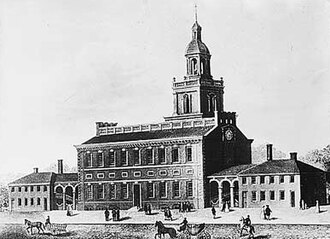
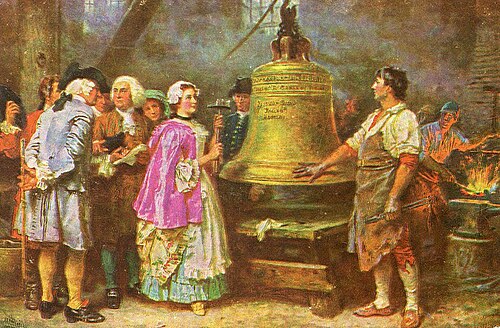
Local founders John Pass and John Stow took on the job of fixing it. According to one account, they used the failed bell as a pattern, then broke it apart with a sledgehammer so the metal could be reused in a fresh casting, completed in 175310,3. That recast object, heavier and less refined than the London original, is the bell that hung in the State House steeple, rang through the Revolutionary era and after, and eventually became a national symbol as abolitionists and others adopted it in the 1830s9,1.
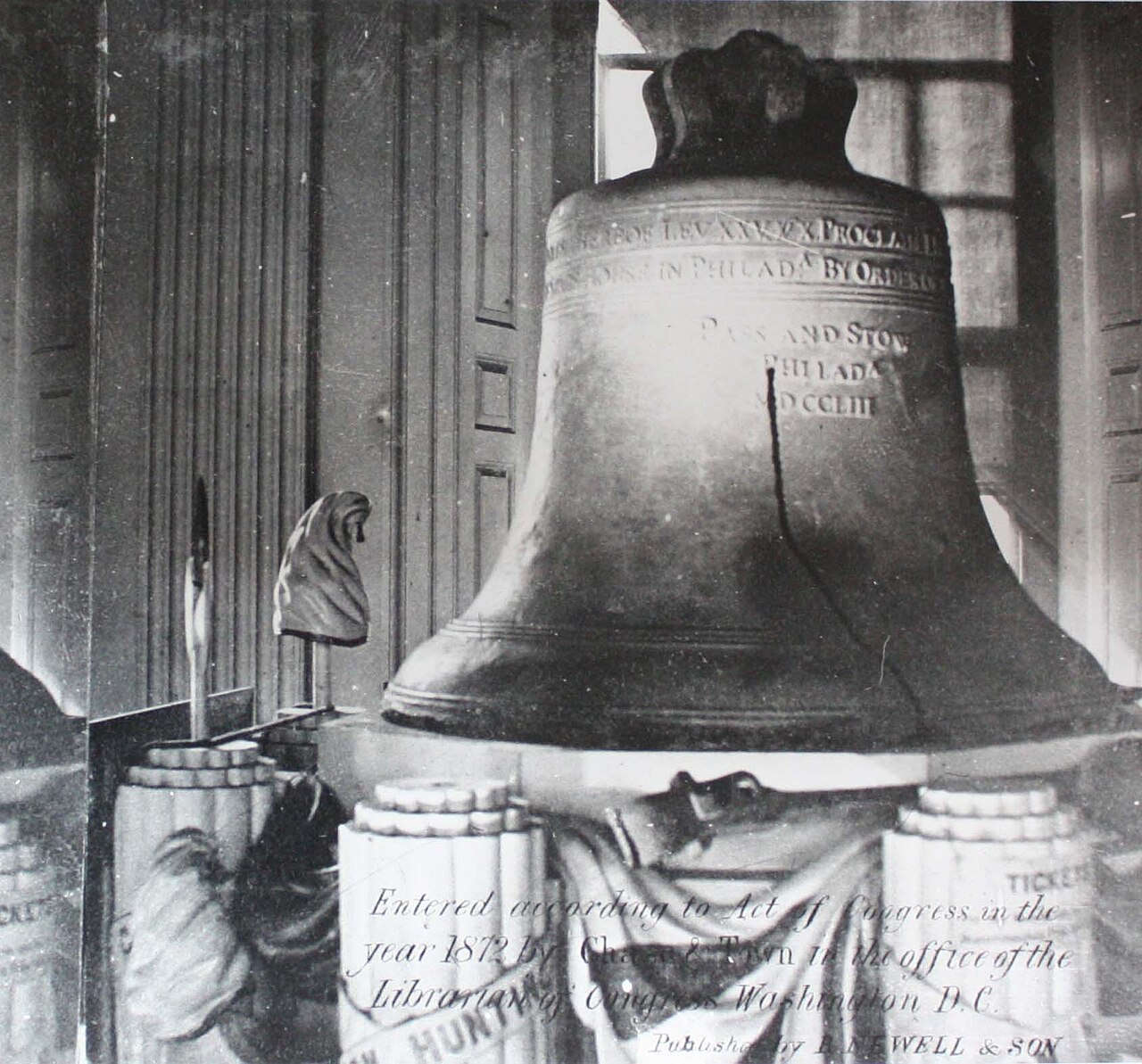
It did not ring forever. By the 1840s a crack had developed, and in 1846 city workers tried to repair it using a technique called stop drilling, widening the fissure to stop it from spreading1. The repair failed. A second crack ran up through the word "Liberty," and the bell has not rung freely since1. No one alive today has heard it the way Franklin or the Continental Congress might have1,2.
That absence is the reason Koopmann's cassette matters, and the reason it is slightly misleading to call what played through those speakers a recording at all. There is no audio of the Liberty Bell's original, undamaged voice1. What Koopmann's team built was a mathematical stand-in: they established the bell's dimensions, its weight of 2,080 pounds, and its traditional English-bell shape, then divided its surface into a grid of 450 squares, each one governed by an equation describing how it would vibrate3. A computer solved those equations together, and an acoustic model layered on top predicted how sound would radiate from the shape at each frequency3.

Tuning the model meant matching it against what was actually known: published records of English bell chords, made up of a strike note, a minor third, a major fifth, a nominal, and a hum tone, and historical evidence that the Liberty Bell's own strike note was close to E-flat3. When the frequencies didn't line up, the team adjusted the bell's modeled thickness and tried again3. Only then did they add the crack, which breaks the symmetry a bell normally has in its vibration patterns and scrambles the frequencies into something messier, in Koopmann's words, "less clarity" and "many more ways that it can vibrate"3,11.
That 1999 project has since been joined by newer efforts to improve the underlying geometry. In 2026, a Penn State-affiliated team used laser-line scanning, LiDAR, structured-light scanning, and photogrammetry to capture the bell's surface down to 10 to 25 microns, after first practicing on a replica in a Penn State lab5,6. Behrend graduate Remington Orange, who helped run the scanners, described crawling beneath the real bell before the park opened to the public, calling it a chance almost no one gets6. The plan is to feed that digital model into future acoustic simulations, and possibly into a full-scale 3D-printed replica that could be struck and actually heard5,12.
None of that changes what was really on Koopmann's cassette back in 1999. It was never the Liberty Bell ringing. It was 450 equations, tuned until they agreed with what history could tell us the bell's chord should sound like, played back through a good set of speakers3.
A Bell Built From a Broken One
The object now called the Liberty Bell was not the first bell delivered to Philadelphia. Isaac Norris, speaker of the Pennsylvania Assembly, ordered a bell of about two thousand pounds from London agent Robert Charles, who placed the order with Thomas Lester of what became the Whitechapel Bell Foundry9. It crossed the Atlantic and cracked on its first test in Philadelphia in 17529,3.
Pass and Stow's 1753 recasting was not universally admired. When the new bell was struck, the sound was judged only barely satisfactory, and Norris himself said he did not personally like it9. Later metallurgical analysis, conducted by the Winterthur Museum in 1975, concluded that errors across the original casting, the breakup, and the recasting left the bell brittle9.
The bell's association with July 4, 1776, is largely a later tradition. No contemporary account describes it ringing that day, and the first public reading of the Declaration actually happened on July 89,1. What is documented is that bells across Philadelphia, very possibly including this one, rang to mark that public reading9,1.
The Bell in Figures
- 2,080 pounds: the bell's weight, used as a starting input for Koopmann's acoustic model3
- 450: the number of grid squares into which the bell's surface was divided for the vibration calculations3
- E-flat: the bell's historically documented strike note, used to calibrate the model3,2
- 10 to 25 microns: the level of surface detail captured in 2026 laser and LiDAR scans of the bell5
- 1846: the year a failed repair and second crack silenced the bell for good1
What Nobody Can Settle
Accounts disagree on exactly why the first Whitechapel bell cracked in 1752. Some later versions blame a flawed casting or metal mixture; others point to the stress of mounting and testing it13,3. No surviving record gives a technical account of the failure.
It is also not established that the Liberty Bell rang on July 4, 1776, despite the popular image of it. The National Park Service and other historians note that there is no contemporary evidence for that specific claim, only that city bells rang for the Declaration's first public reading days later9,1.
Finally, none of the acoustic reconstructions, not Koopmann's 1999 model nor the newer digital-twin scans, recreate an actual historical recording. They are calibrated estimates built from geometry, metallurgy, and known pitch relationships, and the sources are explicit that this is a modeled approximation rather than a recovered sound1,3,5.
Timeline
- 1752The bell, cast by the London firm later known as the Whitechapel Bell Foundry, arrives in Philadelphia and cracks on its first test ring3,4.
- 1753John Pass and John Stow recast the bell in Philadelphia; the result becomes the artifact known today3,10.
- 1830sAbolitionists begin referring to the bell as the Liberty Bell, giving it symbolic weight beyond its civic function1.
- 1846A repair attempt fails and a second crack silences the bell permanently1.
- 1999Penn State engineer Gary Koopmann's team builds a 450-square computational model to simulate the bell's intact and cracked sound3.
- 2026A Penn State-affiliated team laser-scans a replica and then the actual Liberty Bell to build a detailed digital twin for future acoustic work5,6.
Pictures


Sources
- The Liberty Bell - Independence National Historical Park (U.S. National Park Service)nps.gov
- The Sound of the Liberty Bell - Independence National Historical Park (U.S. National Park Service)nps.gov
- Let Freedom Ring | Penn State Universitypsu.edu · 1999
- www.battlefields.org · learn · articlesThe Liberty Bell - American Battlefield Trustbattlefields.org
- How Technology Is Preserving the Liberty Bell for America's 250th ...news.lenovo.com
- Behrend alumnus helps team create digital twin of the Liberty Bell | Penn State Universitypsu.edu · 2026
- 'Proclaim Liberty Throughout All the Land' – Commentary Magazinecommentary.org
- The Bells and Clocks of Independence Hall (U.S. National Park Service)nps.gov
- Liberty BellWikipedia
- Proclaim Liberty Throughout All the Land - Pennsylvania Heritage Magazinepaheritage.wpengine.com
- Modéliser l’acoustique de la Liberty Bell dans COMSOL Multiphysics®comsol.fr
- Guest Post: The Philadelphia Liberty Bell by VAR Lab @ Penn ...nebulousflynn.substack.com
- Liberty Bell Timelineushistory.org
Researched and written by Lorelet from the sources above. It cites as it goes, but it can still get things wrong, so check the sources for anything that matters.
Report a problem
More featured lorelets
See all
Today · History
The Diary That Came Out of a Stourbridge Tip
A boy scavenging for toys among the bottles and cans found a small green book with a hole through it. It took thirty years, and a museum curator's ob…

Today · Film & TV
The Disney Channel's Strange First Act
Before tween sitcoms and pop stars, a brand-new cable channel filled sixteen hours a day with Mickey Mouse cartoons, made-for-cable movies, and a wil…

Oct 15 · Crime
The Wall That Swallowed Two Renoirs
Four men, a stolen vehicle, and a drug investigation that had nothing to do with art all collided over two paintings missing from a house in southern…