
Featured · Nov 15Technology
How Steve Wozniak Wrote Apple's First BASIC by Hand
Before there was any way to test code on the machine it was meant for, Steve Wozniak worked out an entire programming language with a pencil, a page, and a hex reference chart.

Listen
Read by Wren · 7 min
Addresses on the Left, Hex on the Right
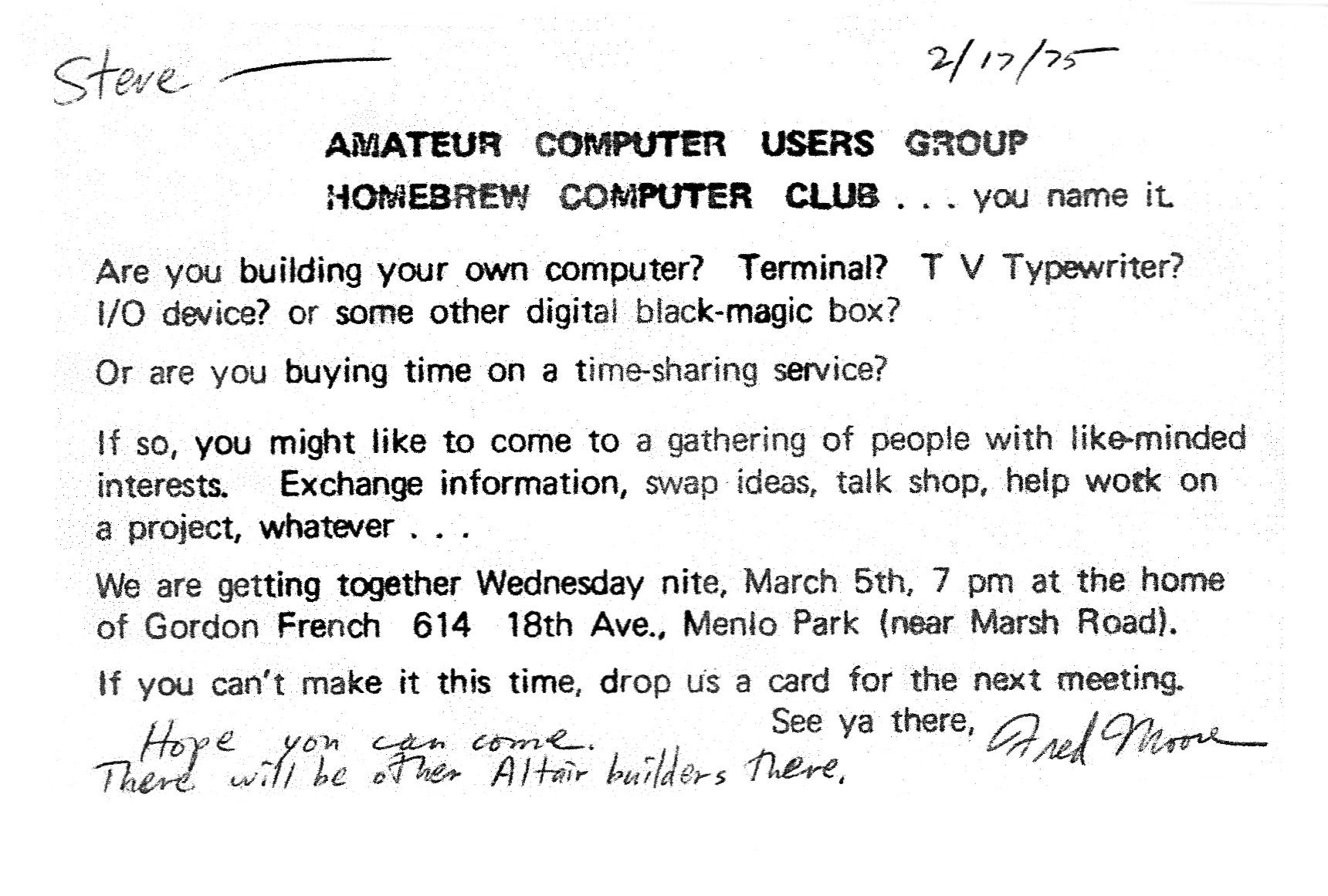
Steve Wozniak described the method years later in plain, almost clerical terms: write the assembly instructions on the right side of a page, the memory addresses on the left, then look up the hexadecimal value for each instruction and write that down too1. There was no assembler to do this work automatically, no second computer on which to draft and test the code before it touched real hardware. The translation from human-readable instruction to the raw bytes a 6502 chip would execute happened entirely in Wozniak's head and on paper, one line at a time.
He also said something more startling about the result. The BASIC that Apple shipped inside its first Apple II computers, he claimed, was never run through a conventional assembler at all: "There was one handwritten copy, all handwritten, all hand-assembled"1,2. Software that thousands of early computer owners typed commands into existed, in its origin, as a single paper document and whatever Wozniak carried in his memory of the 6502's instruction set.
To get to that point, Wozniak had spent the early 1970s as an engineer at Hewlett-Packard, running chip simulations by day and attending meetings of the Homebrew Computer Club, a Bay Area group of hobbyists trading circuit designs and ideas about personal computing3,4. The club's members were reacting to the Altair 8800 and its software, including an early BASIC from a small company called Microsoft, which Wozniak concluded he would need to match on whatever processor he chose3.
That processor turned out to be the MOS Technology 6502, a chip whose price had fallen to roughly $25, a fraction of what competing processors cost at the time4,5. The low price meant a hobbyist could build an entire computer around a single chip rather than scrounging support hardware to match an expensive one. Wozniak set 4 KB of RAM as his design minimum because that was what a BASIC interpreter would require, and he worked from a copy of 101 BASIC Computer Games and an HP BASIC manual as his references3.
An interpreter has to do several jobs simultaneously: read keystrokes, recognize keywords, store program lines, parse expressions, do arithmetic, handle loops and subroutines, and push output to a screen, all while fitting inside whatever memory is available3,6. Wozniak cut a corner that mattered: he abandoned floating-point math in favor of integers only, sacrificing a few weeks of programming time and some mathematical range in exchange for a smaller, faster interpreter he hoped might be the first BASIC written for the 65023. He referred to the project during development simply as GAME BASIC3.
While he wrote the interpreter, he was also designing the Apple-1's video circuitry and writing its monitor program, the low-level code that let a user inspect and modify memory directly, which went into ROM while BASIC had to be loaded separately into RAM6,7. Both programs went through the same manual process: instructions on paper, addresses tracked by hand, bytes computed one at a time.

The clearest public test of all this work came at a Homebrew Computer Club meeting in Palo Alto in March 1976, when Wozniak and Steve Jobs demonstrated the machine to other members, connecting it to a keyboard and a television set rather than presenting it as a paper design4,2. It was not yet a product. It was a working board that a room of hobbyists could see respond to a keyboard in real time.
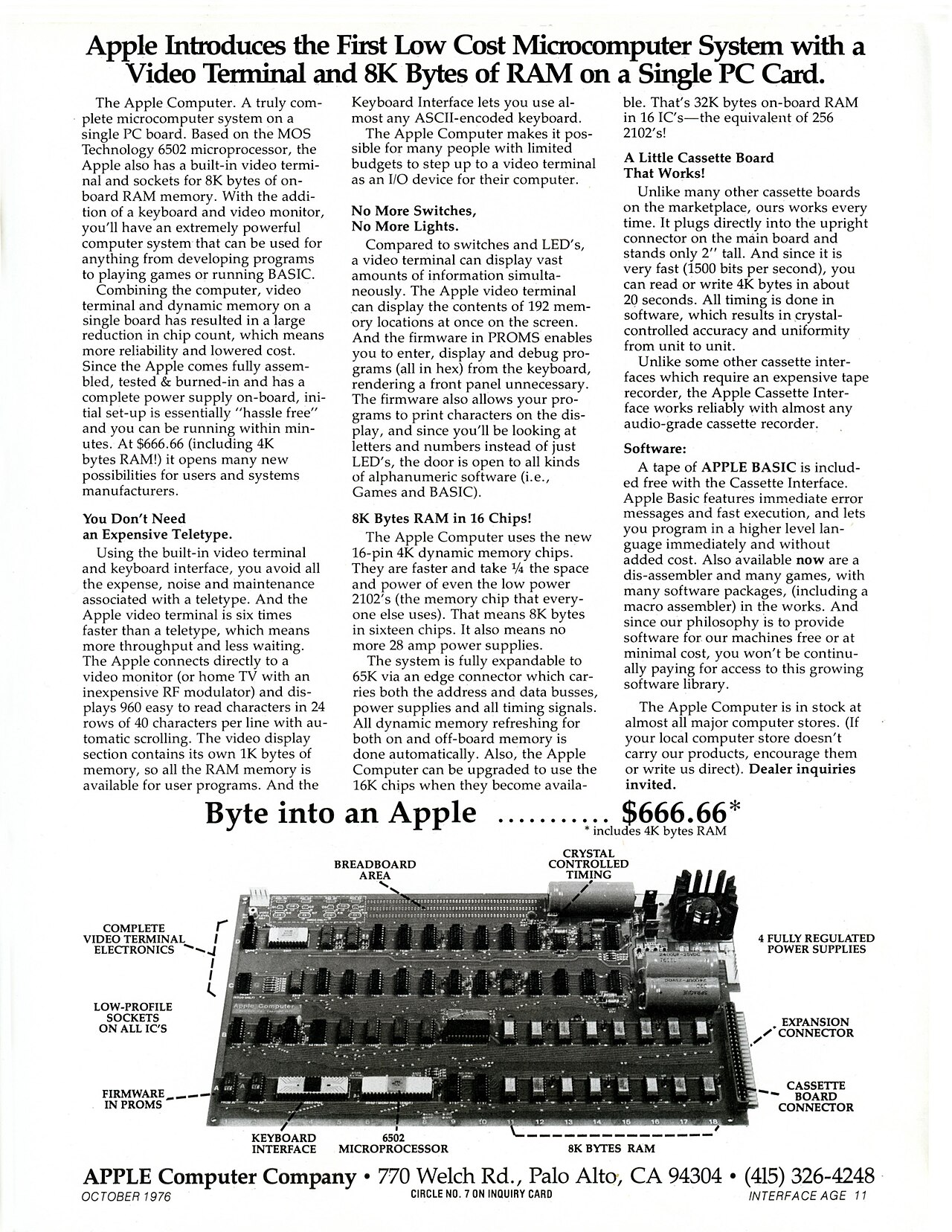
Jobs moved quickly to turn that demonstration into a business. He approached Paul Terrell, who owned the Byte Shop in Mountain View, and Terrell agreed to buy finished boards, which Apple then sold assembled for $666.66 each, with buyers expected to supply their own keyboard, display, and power supply2,8. Roughly 200 Apple-1 boards were built and about 175 sold2,8.
Only once Wozniak had working hardware in front of him could he move past paper. The bytes he had calculated by hand were entered into the Apple-1 through its monitor, or loaded via the cassette interface once that existed, and only then tested and debugged on the actual machine6,7. Writing and assembling the language happened with no computer in the loop at all; running it required one.
Integrated BASIC stayed in ROM on the Apple II until 1979, when Applesoft BASIC, licensed from Microsoft and offering the floating-point math Wozniak had skipped, replaced it starting with the Apple II Plus3. By then the method that had produced it, a page of addresses and hex codes with no assembler in sight, had already done its job: it got a language running on a chip that had no development tools built for it yet.
Timeline
- 1975MOS Technology releases the 6502 processor; Wozniak, attending Homebrew Computer Club meetings, begins designing a computer around it3,4.
- 1975-1976Wozniak designs the Apple-1's video circuitry and writes its monitor program and BASIC interpreter by hand6,7,4.
- March 1976Wozniak and Steve Jobs demonstrate the working Apple-1 at a Homebrew Computer Club meeting in Palo Alto4,2.
- 1976Paul Terrell of the Byte Shop agrees to buy Apple-1 boards; about 175 of roughly 200 built are sold at $666.66 each2,8.
- 1977The Apple II ships with Integer BASIC in ROM3,2.
- 1979Applesoft BASIC replaces Integer BASIC in ROM starting with the Apple II Plus3.
Pictures


Sources
- Integer BASIC - Apple Wiki | Fandomapple.fandom.com
- Integer BASICen-academic.com
- Integer BASICWikipedia
- 3 – The Apple IIapple2history.org · 2008
- www.callapple.org › docs › ap2Apple II Integer Basic Disassemblycallapple.org
- Steve Wozniak talks to Open Apple at KansasFest 2013YouTube
- PlatPhorm Newsplatphormnews.com · 2026
- How did Woz write the Apple 1 BASIC before building the computer?linkedin.com
Researched and written by Lorelet from the sources above. It cites as it goes, but it can still get things wrong, so check the sources for anything that matters.
Report a problem
More featured lorelets
See all
Today · Food
The Turkey Surplus That Became the TV Dinner
A company drowning in frozen birds found an answer on an airline food cart, or so the story goes for fifty years.

Today · Space
Why Is Jupiter's Great Red Spot Actually Red?
Jupiter is built almost entirely of colorless gas, yet its most famous storm glows orange-red. Scientists have spent decades in the lab trying to fig…

Today · Art & Design
The Aztec Labret Whose Golden Tongue Still Moves
A small gold serpent made for a pierced lip somehow ended up with a tongue that flicks side to side. No one alive has ever seen it worn.