
Featured · Nov 19History
The Ship That Couldn't Answer a Simple Signal
An Australian cruiser closed in on a battered Dutch freighter to ask a routine question. The answer took thirty minutes and cost 645 lives.
Listen
Read by Finch · 8 min
Where Bound?
At 1815 on 19 November 1941, HMAS Sydney had drawn almost abeam of a merchant ship off the coast of Western Australia, less than a mile away, both vessels steering west-south-west at about 14 knots1. The Australian cruiser signalled with flags and flashing light, asking the stranger to identify herself. The other ship answered that she was the Dutch freighter Straat Malakka, bound for Batavia1.
Sydney wasn't satisfied. She hoisted a two-letter signal, IK, the middle letters of Straat Malakka's secret four-letter identification code, and waited for the rest1. The other ship did not answer properly. For a vessel that had already spent half an hour fumbling basic signal exchanges, it was one more thing that didn't add up1.
HMAS Sydney was no stranger to a fight. The 6,830-ton light cruiser had sunk the Italian cruiser Bartolomeo Colleoni at the Battle of Cape Spada in 1940 and came home to a hero's welcome, the most celebrated ship in the Royal Australian Navy2,3. By November 1941 she was under Captain Joseph Burnett, 43, with 645 officers, sailors, airmen and canteen staff aboard, finishing an escort run to Singapore and turning back for Fremantle2,4.

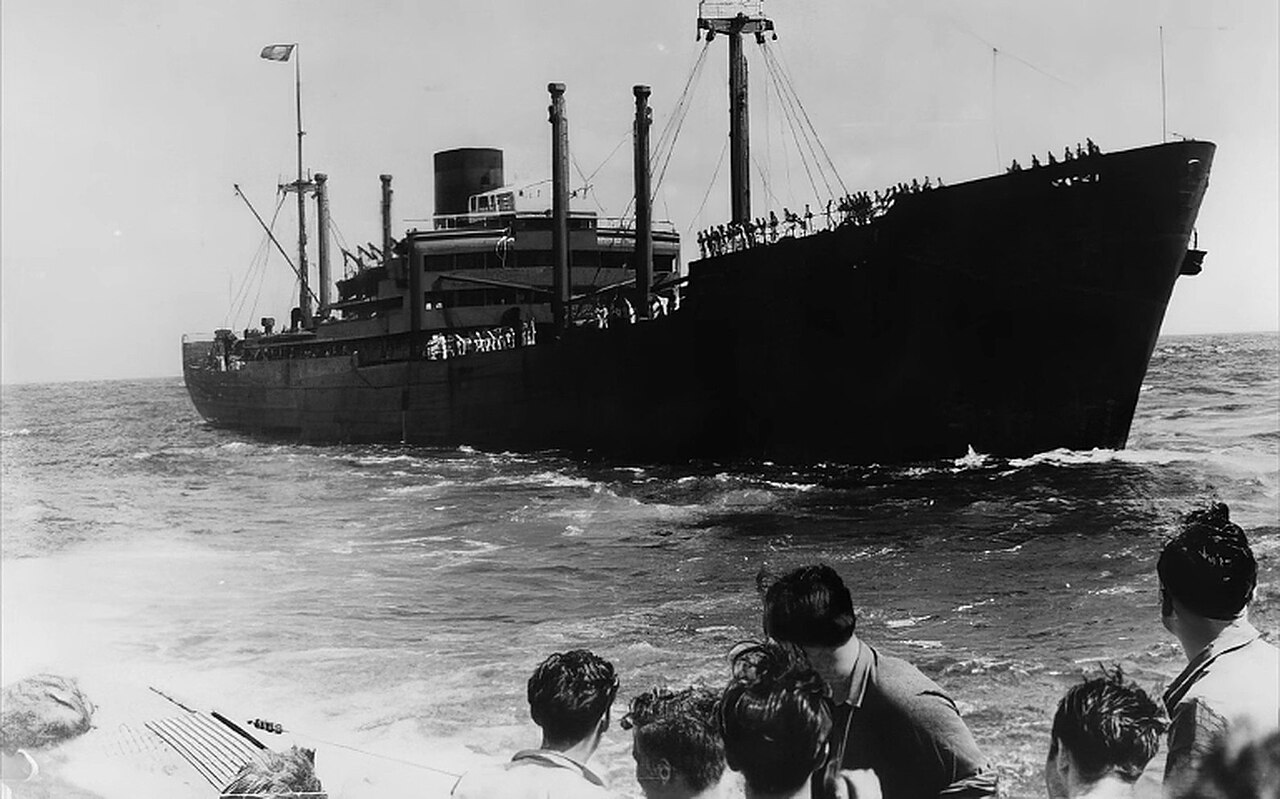
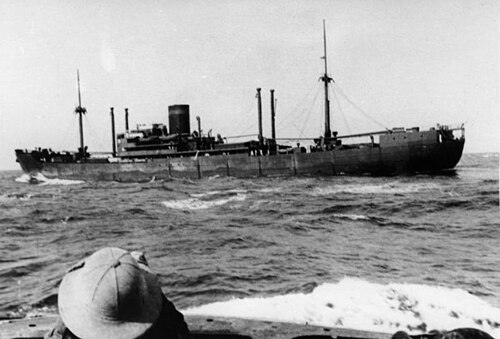
The ship asking for the rest of that code was not what she claimed to be. She had begun life as the German freighter Steiermark before the Kriegsmarine converted her into the auxiliary cruiser Kormoran, commissioned in October 1940 under Fregattenkapitan Theodor Detmers1. Hidden behind collapsible plating she carried six 150-millimetre guns, torpedo tubes, mines and machine guns, and Detmers' orders were to avoid exactly this kind of fight with a warship1. His job was raiding merchant shipping alone, far from attention, not trading broadsides with an Australian cruiser.
Kormoran had sighted the unidentified warship around 1600 that afternoon, roughly 120 nautical miles west of Shark Bay, and the crew at first feared it might be exactly what it was1. Detmers kept his ship disguised as Straat Malakka, raised a Dutch flag, and let Sydney close the distance, answering slowly and vaguely while the cruiser's own guns and torpedo tubes trained on him1. By 1815 Sydney had shut down the Walrus seaplane she had readied on her catapult and sat less than a mile off Kormoran's beam, close enough that her armor and gun range no longer gave her any advantage1.
When Sydney's plain-language signal demanded the secret identification letters, Detmers had nothing left to stall with. He ordered the Dutch flag struck, the German naval ensign run up, and the concealed guns and torpedoes to open fire, at about 18301. German accounts say Kormoran's first salvos wrecked Sydney's bridge, killing Burnett and knocking out the ship's central gun control before her main turrets could get off a second round1,5.
Sydney kept fighting. Her aft turrets scored hits on Kormoran's funnel and engine room, and at one point she turned hard as if to ram before a shell blew the top off one of her own turrets1. Kormoran fired torpedoes, one striking Sydney near her forward engine room; fires spread through both ships as they traded fire at point-blank range for roughly twenty minutes before Sydney, burning, pulled away into the dark1,6. Kormoran's engines failed completely around 1845, and by around 2000 Detmers gave the order to abandon his dying ship, its mines and ammunition making it too dangerous to stay aboard1.
The last German boat left Kormoran near midnight; one overloaded raft later capsized and drowned about 40 men, and the ship finally sank in the early hours of 20 November with roughly 317 to 318 of her original complement of about 380 to 397 men surviving1,7. Sydney was last seen by the Germans about ten miles off, glowing and flickering until midnight, when every trace of her disappeared1. She went down with all 645 aboard, and no one on the Australian side ever answered the question Kormoran had been asked that evening: where bound, and who, really, are you2.
Two Ships, Opposite Lives
Sydney and Kormoran had almost nothing in common except the ocean they died in. Sydney was built in England as HMS Phaeton, bought by the Australian government, and commissioned into the Royal Australian Navy in September 1935, a 171-metre light cruiser designed for scouting and trade protection4. Kormoran began as the civilian freighter Steiermark before the German navy requisitioned her for commerce raiding, the largest and newest of nine such disguised auxiliary cruisers the Kriegsmarine fielded during the war1,2.
Sydney's whole purpose was visibility: patrol, escort, and when necessary, outgun an enemy ship directly. Kormoran's purpose was the opposite: slip past Allied shipping lanes disguised as an ordinary freighter, stop and sink merchant vessels one at a time, and never be caught looking like what she was2,1. By late 1941 she had already sunk seven merchant ships and captured an eighth in the Atlantic before moving to the Indian Ocean5.
That difference in mission is why the two ships ended up fighting as equals despite Sydney's heavier armor and longer gun range on paper. Detmers' standing orders were to run from a warship, not fight one1. It was only because Sydney closed to a range where her advantages stopped mattering that Kormoran's concealed weapons could do the damage they did3.
Who Was Aboard
- Captain Joseph Burnett: commanded HMAS Sydney, 43 years old, killed when Kormoran's opening salvo hit the bridge1,2.
- Fregattenkapitan Theodor Detmers: commanded Kormoran, under orders to avoid combat with warships, later a prisoner of war and the primary source for how the battle unfolded1,8.
- HMAS Sydney: a 6,830-ton modified Leander-class light cruiser of the Royal Australian Navy, famous for sinking the Italian cruiser Bartolomeo Colleoni in 19402,3.
- HSK Kormoran: a German auxiliary cruiser converted from the freighter Steiermark, armed with six concealed 150-millimetre guns, torpedoes, and mines1.
- Royal Australian Navy: suffered its worst single loss of the war in Sydney's sinking, more than a third of its total wartime casualties9.
By the Count
- 645: officers, sailors, RAAF personnel and canteen staff aboard Sydney, all killed2,10.
- 317 to 318: Kormoran survivors rescued and held as prisoners of war, out of roughly 380 to 397 aboard7,1.
- 40: German crew who drowned when an overloaded life raft sank during the chaotic abandonment1.
- 1,500 to 1,800 metres, closing to under a mile: the range at which Sydney approached Kormoran before the Germans opened fire11,1.
- 2008: the year both wrecks were finally found, roughly 100 to 112 nautical miles off Steep Point, Western Australia, at depths around 2,470 to 2,560 metres2,8.
What Still Doesn't Add Up
Because no one from Sydney survived, every account of the battle's details comes from German prisoners, and Australian wartime secrecy around the loss (the government stayed silent for twelve days before Prime Minister John Curtin's first announcement) fed decades of suspicion that something was being hidden7,12.
Postwar writers alleged a cover-up, claimed the Germans broke the laws of war, alleged Australian survivors were massacred after the battle, or suggested a Japanese submarine was secretly involved before Japan's formal declaration of war that December5,2. The Australian War Memorial and the 2009 Commission of Inquiry both state plainly that no evidence supports any of these theories5,3.
The Commission, led by Commissioner T.R.H. Cole, concluded instead that Sydney's loss came down to an error of judgment, the decision that let her close to a range where her size and firepower advantage no longer protected her3. German accounts were assessed by wartime interrogators, and by most researchers since, as broadly truthful, though exact details of which ship fired first, and the precise sequence of salvoes, remain impossible to verify independently5,2,13.
Timeline
- 1935HMAS Sydney is commissioned into the Royal Australian Navy4.
- July 1940Sydney sinks the Italian cruiser Bartolomeo Colleoni at the Battle of Cape Spada2.
- October 1940Kormoran is commissioned as a German auxiliary cruiser under Theodor Detmers1.
- 11 November 1941Sydney departs Fremantle escorting the troopship Zealandia1.
- 19 November 1941, afternoonSydney encounters the disguised Kormoran off Western Australia and demands identification1.
- 19 November 1941, around 1830Kormoran drops its disguise and opens fire at close range; both ships are mortally damaged1.
- 20 November 1941, early hoursKormoran sinks after its crew abandons ship; Sydney disappears with all hands1.
- 24 November 1941The tanker Trocas rescues German survivors, giving the first evidence of the battle1.
- 1 December 1941Prime Minister John Curtin publicly confirms Sydney's loss7.
- March 2008The wrecks of both Kormoran and Sydney are located off Steep Point, Western Australia8.
- 12 August 2009The Commission of Inquiry releases its report on the loss of Sydney7,3.
Pictures



Sources
- Battle with the HSK Kormoran | Western Australian Museummuseum.wa.gov.au
- HMAS Sydney II and the Kormoran | Australian War Memorialawm.gov.au
- HMAS Sydney (II) Introduction | Western Australian Museummuseum.wa.gov.au
- HMAS Sydney (D48)Wikipedia
- Sinking of HMAS SydneyWikipedia
- Chapter 6aph.gov.au
- The sinking of HMAS Sydney | naa.gov.aunaa.gov.au
- Finding HMAS Sydney (II) | Western Australian Museummuseum.wa.gov.au
- Unknown HMAS Sydney II sailor named after 80 yearsDefence Ministers · 2021
- HMAS Sydney II: 85 years on | Australian War Memorialawm.gov.au
- Parliamentary Inquiry reports on the loss of HMAS Sydneyawm.gov.au
- The sinking of HMAS Sydney, November 1941 - naa.gov.aunaa.gov.au
- The Cole Inquirymuseum.wa.gov.au
Researched and written by Lorelet from the sources above. It cites as it goes, but it can still get things wrong, so check the sources for anything that matters.
Report a problem
More featured lorelets
See all
Today · Food
The Turkey Surplus That Became the TV Dinner
A company drowning in frozen birds found an answer on an airline food cart, or so the story goes for fifty years.

Today · Space
Why Is Jupiter's Great Red Spot Actually Red?
Jupiter is built almost entirely of colorless gas, yet its most famous storm glows orange-red. Scientists have spent decades in the lab trying to fig…

Today · Art & Design
The Aztec Labret Whose Golden Tongue Still Moves
A small gold serpent made for a pierced lip somehow ended up with a tongue that flicks side to side. No one alive has ever seen it worn.