Featured · TodayTechnology
The Company That Tried to Own ‘Cyberspace’
A software firm wanted the word from William Gibson's novels for its own virtual reality project. His response became one of the stranger footnotes in the history of a word everyone now uses for free.
Listen
Read by Wren · 6 min
A Word Shows Up on Someone Else's Letterhead
In the late 1980s, Autodesk chairman John Walker, working out of Sausalito, California, set a team to work on a toolkit for building shared virtual realities3. The project needed a name, and the one the company reached for was Cyberspace, with programmer Eric Gullichsen installed as its first lead3. Autodesk moved to claim the word commercially, seeking trademark protection tied to the product1,2,3.
Word of this reached William Gibson, the man who had put the term into print years earlier, and he did not let it pass1,2. The usual version of what happened next involves Gibson threatening to trademark Gullichsen's own name in retaliation, a story that has been repeated often enough to sound like settled fact7,8,3. It is not that simple.
Gibson had invented the word almost by accident. He has said more than once that he wrote it in red marker on a yellow legal pad, weighing it against rejects like "infospace" and "dataspace" before settling on cyberspace because it simply sounded better10,6. He used it first in the short story "Burning Chrome" in 1982, then built it into the fictional world of Neuromancer two years later4,5,6.

That novel appeared eleven years before the World Wide Web existed in any public form, according to a scholarly overview of Gibson's work5. For most of the 1980s, cyberspace was a literary device, a navigable, imagined space generated by linked computers, not yet a term anyone used to describe checking email or arguing online. Gibson later described it as "an almost perfectly empty neologism" when he first wrote it, one he filled in with meaning only over several books6.
When he learned Autodesk wanted the word for itself, Gibson contacted the company and objected, then spent money on lawyers to see what could be done1,2. What he found was not encouraging. "Basically, there was nothing I could do," he said later. "You can't trademark things like that"2.
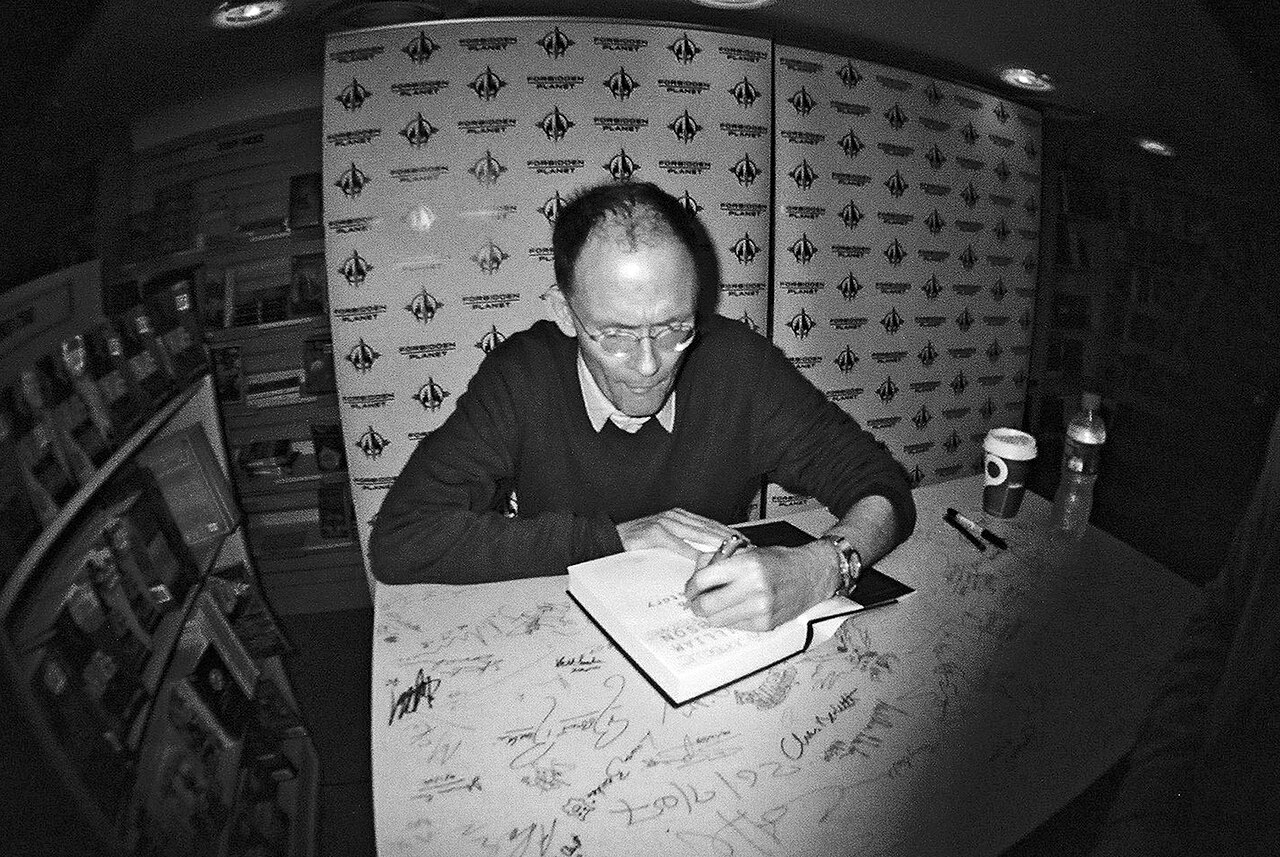
That is the part of the story usually left out when people repeat the Gullichsen anecdote as an act of petty revenge. Gibson's own account of his motive was almost the opposite of possessive. "My problem wasn't that they were taking away my intellectual property," he said, explaining that what he actually wanted was for the word to stay "completely in the public domain"2. He discussed the fight that way at the Art Futura festival in 1990, framing it as the self-organizing culture of "the street" against one company's attempt to fence off a shared word7.
As for the counter-trademark on Gullichsen's name, the record does not show that Gibson ever filed anything of the kind. Some accounts call it a joke that got passed along by Timothy Leary, John Perry Barlow, and Rudy Rucker until it hardened into legend7,3. A transcript elsewhere refers to Gibson's supposed "counterstrike trademarking of 'Eric Gullichsen'" as though it happened8, but no filing has surfaced to confirm it, and other sources explicitly call it a joke7. Gullichsen himself appears in this story only as the name attached to the corporate project, a programmer whose name became a punchline in a fight he does not appear to have started3.
What is confirmed is more modest and, in its way, more satisfying. Autodesk ended up calling its product "Autodesk Cyberspace," tying the word to its own brand rather than claiming it outright2. The project itself did not succeed and was eventually dropped2,3. The bare word stayed available, and by 2011 Gibson could tell The Paris Review that he had watched it travel "from the yellow legal pad to the Oxford English Dictionary"9. He got, more or less, what he said he wanted all along.
Trademark, Copyright, and a Word in the Wild
The dispute turns on a distinction that is easy to blur outside a courtroom. Copyright protects how an idea is expressed in a particular work. Trademark protects a word or symbol as an identifier of a specific company's goods or services. Neither is designed to let one person or company own a word simply because they coined or popularized it11.
A scholarly overview of trademark law notes that protection grants an owner the exclusive right to use a mark for specified goods or services, mainly to prevent marketplace confusion11. That is a narrower claim than owning a word outright, and it is the gap Gibson's dispute with Autodesk fell into: the company could potentially trademark "Cyberspace" for its own software line, but it could not stop the wider culture from using the word for anything else.
That gap is also why Gibson's quote, "you can't trademark things like that," should be read as his summary of a particular dispute rather than a complete statement of law2. Distinctive words can and do function as trademarks for specific products. The trouble for Autodesk was trying to claim a term that had already escaped into broader use as a descriptive, almost public, piece of vocabulary.
Timeline
- 1982Gibson uses 'cyberspace' in the short story 'Burning Chrome'6.
- 1984Neuromancer popularizes the term, eleven years before the World Wide Web5.
- 1988Autodesk chairman John Walker conceives a shared virtual reality toolkit3.
- late 1980sAutodesk seeks trademark protection tied to 'Cyberspace'1,2,3.
- c. 1989-1990Gibson learns of the claim and objects through lawyers1,2.
- 1990Gibson discusses the dispute at the Art Futura festival7.
- after disputeAutodesk brands its product 'Autodesk Cyberspace'; the standalone word stays free2.
- 2011Gibson tells The Paris Review the word reached the Oxford English Dictionary9.
- 2020Gibson recounts the yellow legal pad origin again to Time10.
Pictures


Sources
- Being in Nothingnesseff.org
- William Gibson Interviewbolhafner.com
- Autodesk trademarked Cyberspace - JTB World Blogblog.jtbworld.com
- William GibsonWikipedia
- Conversations with William Gibsonjstor.org
- William Gibson - High Profileshighprofiles.info
- Autodesk가 '사이버스페이스' 상표를 출원하자 William Gibson이 반발한 사건 | Zelizeli.app
- William Gibson Interview Transcriptcraphound.com
- William Gibson, The Art of Fiction No. 211theparisreview.org
- Sci-Fi Novelist William Gibson on the Invention of the Term 'Cyberspace' and How AI Could be Truly Intelligenttime.com · 2020
- INTELLECTUAL PROPERTY SERIES 1: TRADEMARK Scholarly work (preprint) · 2025
Researched and written by Lorelet from the sources above. It cites as it goes, but it can still get things wrong, so check the sources for anything that matters.
Report a problem
More featured lorelets
See all
Today · Science
Do Dogs Hear Shapes? The Bouba/Kiki Effect in Animals
A century-old party trick about nonsense words and blobby shapes turns out to tell you something about who's listening, and it isn't who you'd guess.

Today · Space
The Thing That Came From Nowhere and Argued With Harvard
In the fall of 2017, a telescope on a Hawaiian volcano caught sight of something moving too fast to belong to our Solar System, and a fight over what…
Oct 18 · Gaming
The Bigfoot That Was Never Coded Into GTA: San Andreas
For two decades, players have crept through a fictional forest looking for a creature Rockstar insists was never there. The hunt outlived every denia…