Featured · TodaySpace
The Thing That Came From Nowhere and Argued With Harvard
In the fall of 2017, a telescope on a Hawaiian volcano caught sight of something moving too fast to belong to our Solar System, and a fight over what it actually was has never fully settled.

Listen
Read by Finch · 6 min
A Faint Dot Moving the Wrong Way
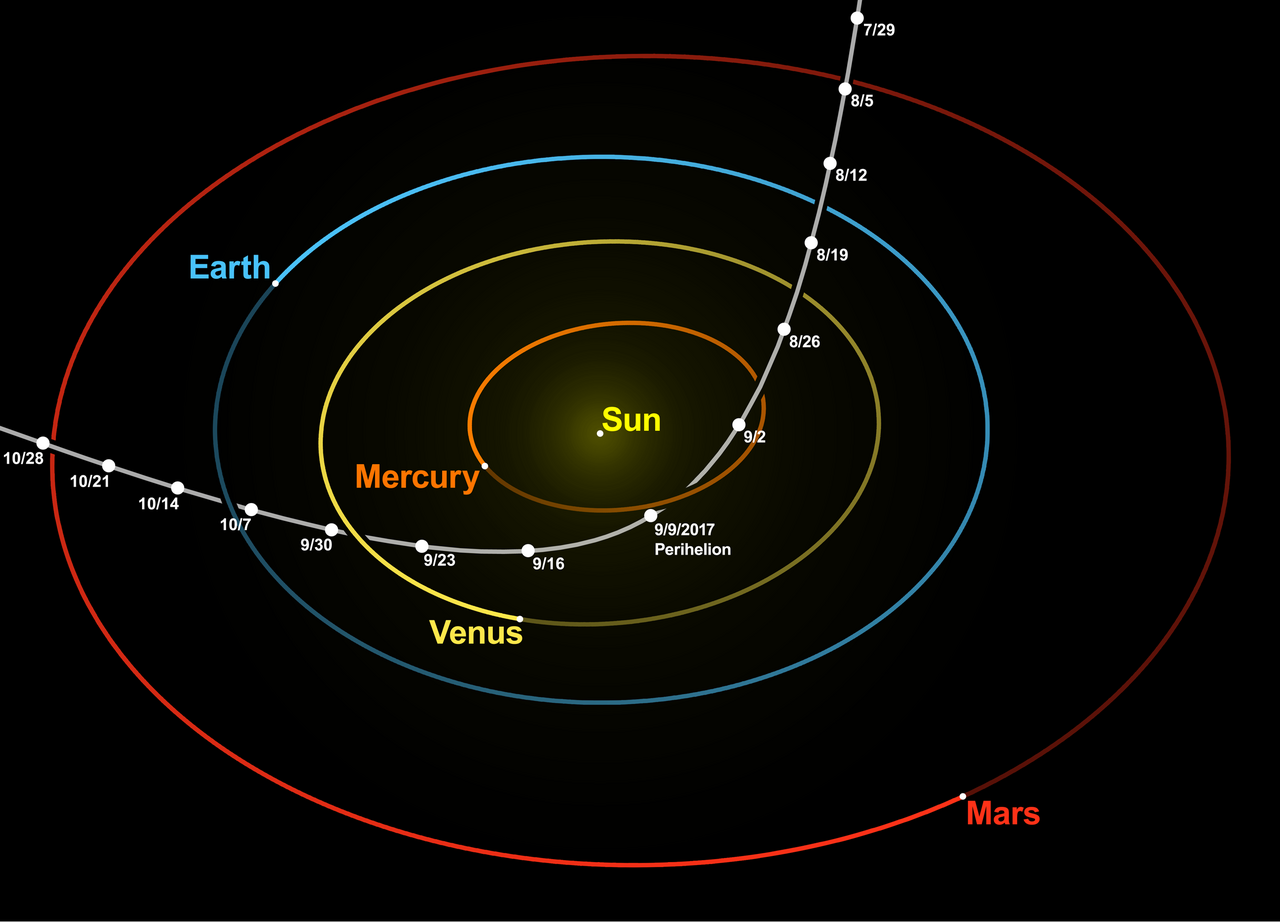
On October 19, 2017, Robert Weryk, a postdoctoral researcher at the University of Hawai'i, was going through images from the Pan-STARRS1 survey telescope on Haleakalā when he noticed a faint, fast-moving point of light that did not fit1,2. The object had already passed its closest approach to the Sun, about 0.25 astronomical units out, roughly 40 days earlier, on September 93,8. It was about 33 million kilometers from Earth when spotted, already heading outward, and nobody had caught it coming in3,8.
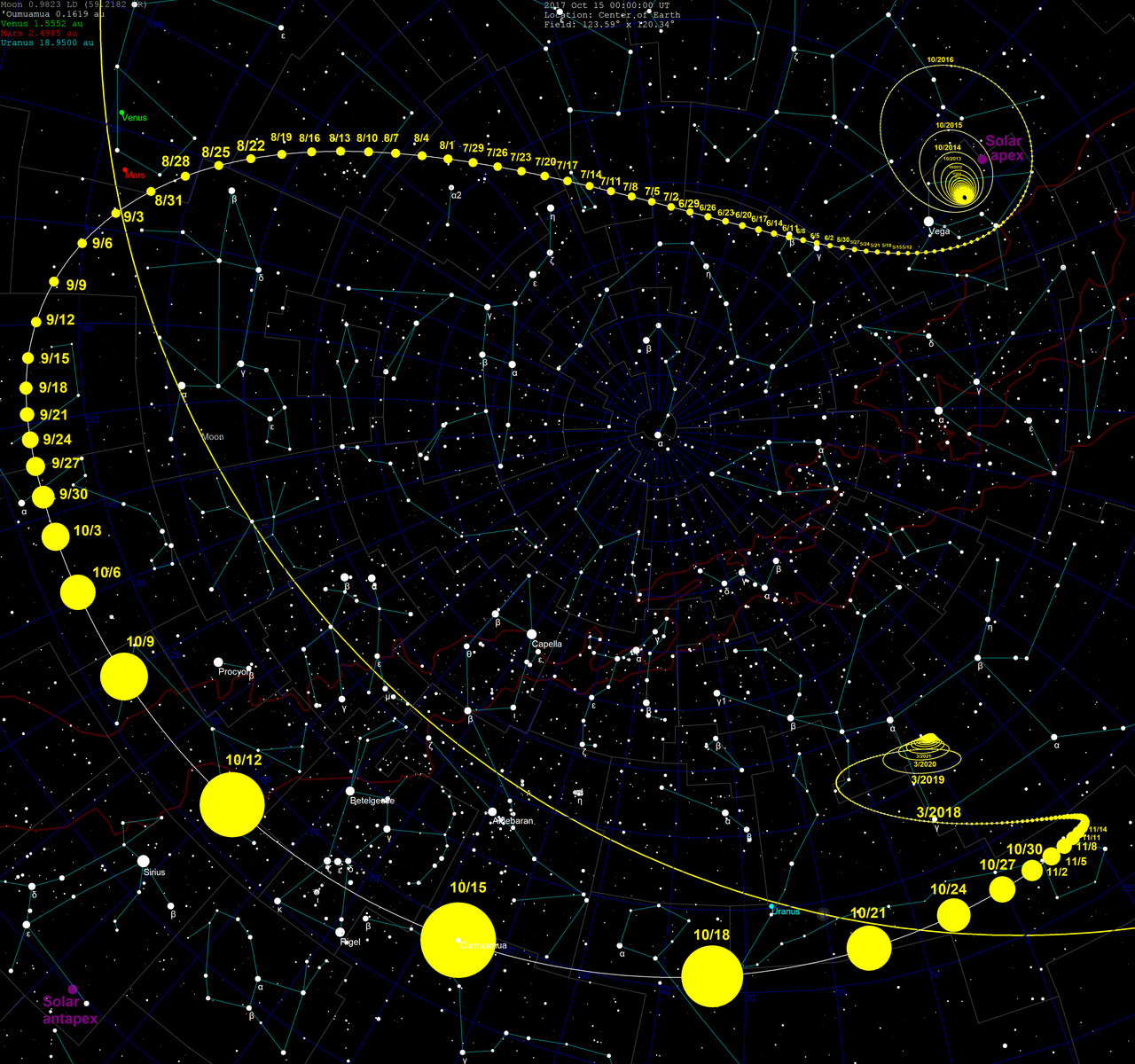
Follow-up observations over the next few days made one thing clear: this was not orbiting the Sun on any closed path astronomers recognized2,8. It was moving fast enough, on a track curved enough, that it would leave the Solar System and never return8,3.

Pan-STARRS1 exists to catch near-Earth asteroids before they catch us, a NASA-funded survey running out of Haleakalā Observatory2,1. Within days, the object had already changed names twice. First it was logged as a comet, C/2017 U1, on the strength of its sharply hyperbolic orbit3,2. Deep images from the Very Large Telescope that same week showed no coma, no tail, nothing a comet should have, so it was renamed an asteroid, A/2017 U1, the first object ever to be bumped from one designation to the other3. Once astronomers confirmed it had arrived from outside the Solar System entirely, the International Astronomical Union invented a new category just for it: 1I, for interstellar. The University of Hawai'i team, working with Hawaiian-language scholars Ka'iu Kimura and Larry Kimura, named it 'Oumuamua, roughly "a messenger from afar arriving first"3,2.
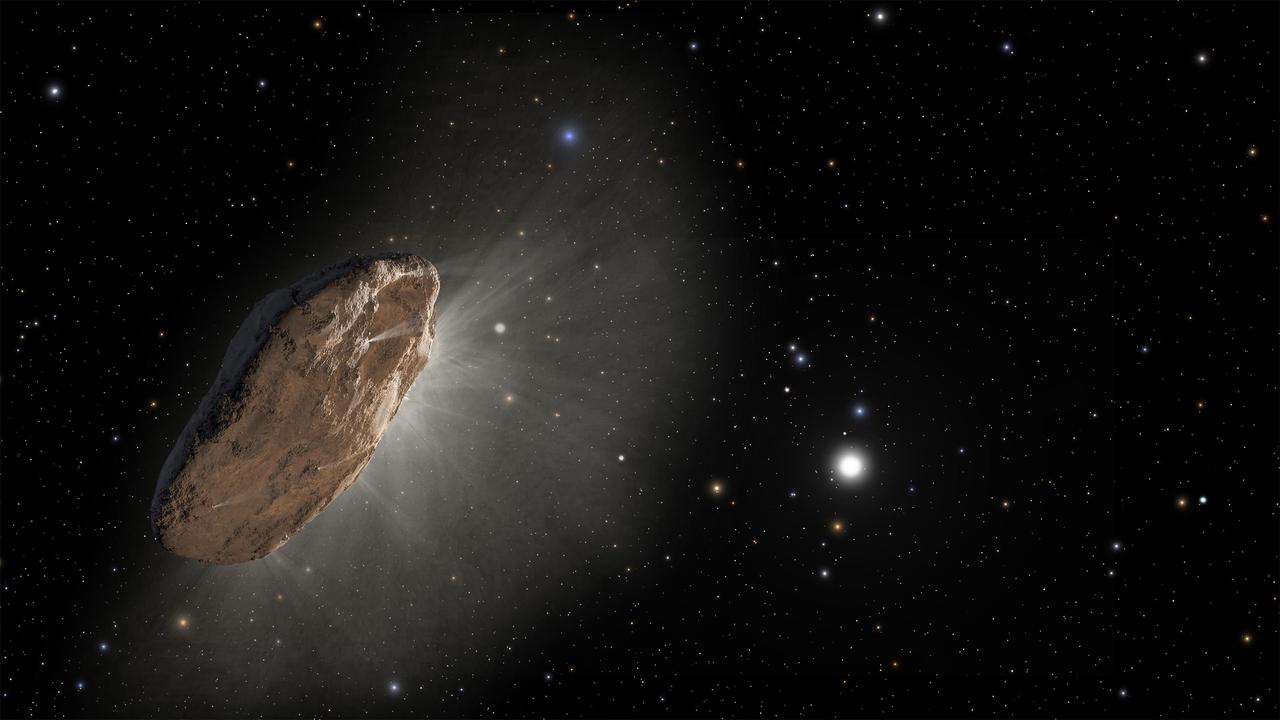
The object did not sit still long enough to be fully resolved. It was already receding from the Sun and dimming fast, and by mid-December 2017 it was too faint even for the largest ground telescopes3. In the brief window before it vanished, astronomers aimed Hubble, the Very Large Telescope, Gemini South, and others at it and found it tumbling, not spinning smoothly, with brightness swings suggesting a shape far more elongated or flattened than almost any object ever observed in the Solar System4,3.
Then Karen Meech's team, publishing in Nature in November 2017, reported something harder to explain: 'Oumuamua's outward path showed a small but statistically significant acceleration beyond what the Sun's gravity alone could produce, the kind of push usually caused by a comet venting gas as it warms4,5. The trouble was that no coma, no dust, no gas had ever been detected coming off it4,3. A natural object nudging itself along by invisible outgassing was odd. It was odd enough that in November 2018, Avi Loeb, then chair of Harvard's astronomy department, and his postdoc Shmuel Bialy proposed something else: that 'Oumuamua might be artificial, a thin light sail pushed by sunlight rather than gas2,6.

The light-sail idea drew enormous public attention and almost no support from other astronomers working the data2. Searches with the Green Bank Telescope under the Breakthrough Listen project turned up no radio signals of any kind3. Meanwhile, researchers kept testing natural explanations: a fragment of a tidally shredded planet, debris from a dying white dwarf system, an icy body loosened by cosmic rays over millions of years3,9,10. In March 2023, a team proposed that trapped molecular hydrogen, formed deep in an ice-rich body exposed to cosmic radiation, could escape and produce exactly the acceleration Meech's team had measured, without any need for a tail or a sail7,11. By mid-2019, most astronomers already considered 'Oumuamua natural, even if no single model explained every detail cleanly3.
It will not be checked against. 'Oumuamua passed beyond Jupiter's orbit in 2018, Saturn's in 2019, Neptune's in 2022, and is now gone for good, carrying its unresolved shape and composition with it3. Weryk's faint, wrong-moving dot turned out to be the first confirmed visitor from another star system, and the argument it set off, mostly settled toward rock and ice, never quite closed3,2.
Timeline
- September 9, 2017'Oumuamua makes its closest approach to the Sun, about 0.25 AU out, unobserved at the time3,8.
- October 19, 2017Robert Weryk spots the object in Pan-STARRS1 images from Haleakalā Observatory1,2.
- October 25-27, 2017Follow-up astrometry confirms a hyperbolic, unbound orbit; the object is recognized as interstellar8,2.
- November 2017Karen Meech's team publishes initial characterization in Nature, including the first hint of anomalous acceleration4,5.
- June 2018Micheli et al. confirm non-gravitational acceleration in 'Oumuamua's trajectory at 30-sigma significance in Nature5,12.
- November 2018Avi Loeb and Shmuel Bialy propose the artificial light-sail hypothesis2,6.
- Mid-December 2017'Oumuamua becomes too faint for ground-based telescopes to study further3.
- March 2023A peer-reviewed study proposes radiolytically produced molecular hydrogen as the source of the acceleration, favoring a natural cometary origin7,11.
Pictures



Sources
- [PDF] Rendezvous with `Oumuamua - ESO.orgeso.org
- 'Oumuamua: the first interstellar object found in our Solar System - NEOneo.ssa.esa.int
- 1I/ʻOumuamuaWikipedia
- [PDF] Non-Gravitational Acceleration in the Trajectory of 1I/2017 ... - Eso.orgeso.org
- Non-gravitational acceleration in the trajectory of 1I/2017 U1 (‘Oumuamua) - NatureNature · 2018
- Harvard researchers see alien potential in mysterious objectnews.harvard.edu
- Acceleration of 1I/'Oumuamua from radiolytically produced H2 in H2O ice - PubMedPubMed
- Radware Bot Manager Captchaiopscience.iop.org
- 1I/2017 ’Oumuamua-like Interstellar Asteroids as Possible Messengers from Dead Starsiopscience.iop.org · 2018
- Interstellar Object ’Oumuamua as an Extinct Fragment of an Ejected Cometary PlanetesimalThe Astrophysical Journal Letters · 2018
- Acceleration of 1I/'Oumuamua from radiolytically produced H<sub>2</sub> in H<sub>2</sub>O ice.Scholarly work · 2023
- Non-gravitational acceleration in the trajectory of 1I/2017 U1 ('Oumuamua).Scholarly work · 2018
- Avi LoebWikipedia
- Evidence that 1I/2017 U1 (‘Oumuamua) was composed of molecular hydrogen ice.arXiv
Researched and written by Lorelet from the sources above. It cites as it goes, but it can still get things wrong, so check the sources for anything that matters.
Report a problem
More featured lorelets
See all
Today · Technology
The Company That Tried to Own ‘Cyberspace’
A software firm wanted the word from William Gibson's novels for its own virtual reality project. His response became one of the stranger footnotes i…

Today · Science
Do Dogs Hear Shapes? The Bouba/Kiki Effect in Animals
A century-old party trick about nonsense words and blobby shapes turns out to tell you something about who's listening, and it isn't who you'd guess.

Oct 18 · Gaming
The Bigfoot That Was Never Coded Into GTA: San Andreas
For two decades, players have crept through a fictional forest looking for a creature Rockstar insists was never there. The hunt outlived every denia…