
Featured · Nov 20History
The Night the Indians Took Alcatraz
For nineteen months, a group of Native students and urban Indians ran a former federal prison as their own territory, and dared Washington to drag them off it.
Listen
Read by Wren · 9 min
Mayday on the Rock
The island's lone guard had been warned something was coming. When the boats appeared out of the dark, he got on his radio. "Mayday! Mayday!" he called. "The Indians have landed!"1
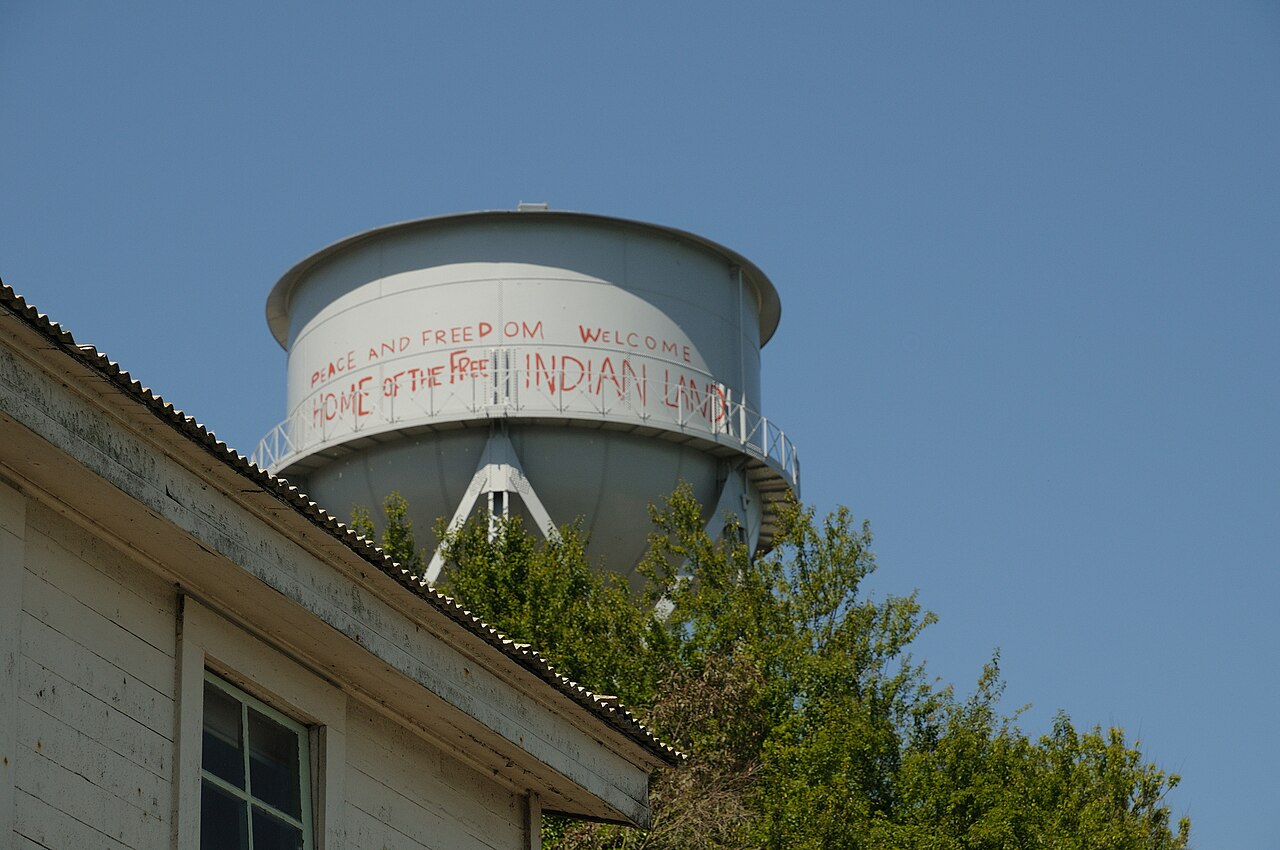
It was the night of November 20, 1969. The people crossing San Francisco Bay were not raiders. They were college students, urban Bay Area Indians, and a scattering of families, arriving to claim a decommissioned federal penitentiary as Indian land1,2. Most retellings put one man at the center of what happened next. The planning behind it tells a more complicated story.
Alcatraz Federal Penitentiary had closed on March 21, 1963, and the island had since sat as surplus federal property managed by the General Services Administration2,8. Native activists in the Bay Area had already tested the idea that such land could be reclaimed under treaty principles, most notably on March 9, 1964, when five Sicangu Lakota activists led by Belva Cottier and Richard McKenzie landed and held the island for about four hours, citing the Treaty of Fort Laramie of 18681,2. The US Attorney rejected the claim as unfounded, and that July the GSA formally took custody of Alcatraz1.
The pressure that produced the 1969 occupation had been building for two decades. Starting in the 1940s, federal termination policy ended the government's recognition of many tribes, cutting off services and legal protections, while a 1956 relocation program pushed thousands of Native people into cities including San Francisco for work6. By the late 1960s, a generation of Native students at San Francisco State College, UC Berkeley, and the American Indian Center had built networks that could organize quickly when the moment came6,9. That moment arrived on October 10, 1969, when fire destroyed the San Francisco Indian Center, a hub for jobs, health care, and legal aid that the community badly needed back1,7.

On November 9, Richard Oakes, a Mohawk ironworker and student, led a symbolic landing attempt aboard a chartered boat called the Monte Cristo. A larger flotilla failed to show, so only a small group made it out, and fourteen people stayed overnight before the attempt dissolved1,2,10. It was not yet the occupation. It was a dry run, and it exposed how fragile the logistics were.
The decision that turned a failed stunt into a nineteen-month occupation was made days later, at Fisherman's Wharf. LaNada Means, a Shoshone-Bannock student and head of the Native American Student Organization at Berkeley, picked November 20 specifically because Oakes had said the group would not try again soon, and because it would catch tribal elders away at a conference, giving the activists the element of surprise1. On the night chosen, roughly 89 Native people, including more than 30 women and six children, set out from Palo Alto. A partial Coast Guard blockade stopped most of the boats, but fourteen activists got ashore to begin the occupation that would hold for a year and a half1,2. The group called itself Indians of All Tribes4,5.
Within hours of the landing, Oakes delivered a statement that became known as the Alcatraz Proclamation, addressed to the "Great White Father and all his people." It argued, half in earnest and half in mockery, that Alcatraz suited a reservation because it had, in its words, "no running water, inadequate sanitation facilities, no oil or mineral rights, no industry and so on"4,5,7. The document offered to buy the island for "twenty-four dollars" in beads and cloth, the sum supposedly paid for Manhattan, a line meant as rhetoric rather than a real transaction4,5.
History settled quickly on Oakes as the leader, the Mohawk "chief" and spokesman most often quoted in the press, and later on John Trudell as the occupation's voice over the airwaves1,2. But the record credits Means with choosing the date, helping formulate the group's demands, and staying on the island from among the first arrivals to nearly the last1. Fellow activist Dean Chavers later called her "the real leader of the occupation"1. A 2003 study of women's activism in the Red Power movement found that men held most public roles at Alcatraz even though women did much of the organizing underneath them, a pattern Means spent later decades pushing back against3.
Life on the island settled into something like a small, improvised nation. Occupiers set up a school, a clinic, a security rotation, and a communications office, and issued their own identification to residents1,2,6. In December, John Trudell, a Santee Dakota activist, began nightly broadcasts known as Radio Free Alcatraz, carrying speeches, music, and news to listeners well beyond the bay1,6. Supporters sent donations, celebrities visited, and the Longshoremen's union, through organizer Joe Morris, threatened to shut down Bay Area ports if federal marshals tried to force the occupiers off1.
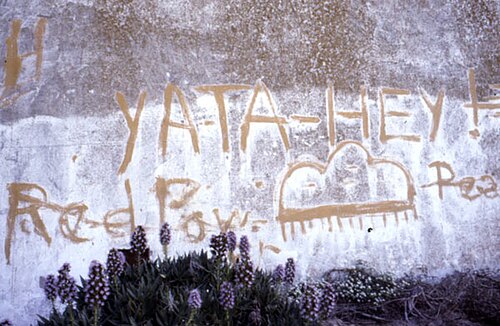
The occupation's cohesion did not last. In January 1970, Oakes's twelve-year-old stepdaughter Yvonne fell to her death on a stairwell on the island; grieving, Oakes and his family left soon after1,11,5. Students drifted back to school that same month and were replaced by a mix of reservation Indians, urban residents unconnected to the original plan, and, increasingly, non-Native hangers-on from San Francisco's countercultural scene1,2. Fires in June 1970 destroyed four structures and public sympathy began to erode along with the buildings6. On June 11, 1971, federal marshals arrived and removed the fifteen people still living there, ending the occupation after nineteen months1,2,6.

The island itself was never handed over. But during the occupation, President Nixon returned Blue Lake and 48,000 acres to the Taos Indians, and the administration moved away from termination toward a policy of tribal self-determination, a shift the National Park Service and other federal accounts tie directly to the pressure Alcatraz generated2,7. When marshals cleared the last holdouts, Oakes, who had by then returned to activism elsewhere, told reporters something that outlasted the occupation itself: "Alcatraz is not an island. It is an idea"6,1. The guard who radioed his mayday that first night had no way of knowing he was announcing the start of something that would outlive the prison walls around him by half a century and more.
Timeline
- March 9, 1964Five Sicangu Lakota activists occupy Alcatraz for about four hours, citing the Treaty of Fort Laramie2.
- November 9, 1969Richard Oakes leads a symbolic landing attempt aboard the Monte Cristo2,10.
- November 20, 1969Roughly 89 Native activists set out for Alcatraz, and fourteen land to begin a 19-month occupation as Indians of All Tribes1,2.
- November 20, 1969Richard Oakes delivers the Alcatraz Proclamation4,5.
- January 5, 1970Richard Oakes's stepdaughter Yvonne dies in a fall on the island; his family leaves soon after11,5.
- June 1970Fires destroy several structures on the island and public support begins to fade6.
- June 11, 1971Federal marshals remove the final fifteen occupants, ending the occupation1,2,6.
Pictures

Sources
- Occupation of AlcatrazWikipedia
- We Hold the Rock - Alcatraz Island (U.S. National Park Service)nps.gov
- American Indian Women's Activism in the 1960s and 1970s | Hypatia | Cambridge CoreCambridge Core · 2003
- Alcatraz Occupation | - UO Blogsblogs.uoregon.edu
- Alcatraz Proclamationteachingamericanhistory.org
- Red Power On Alcatraz, Perspectives 50 Years Later (U.S. National Park Service)nps.gov
- We Hold the Rock!text-message.blogs.archives.gov · 2020
- Alcatraz Island (U.S. National Park Service)nps.gov
- Alcatraz Occupation (1969) - Primary Sources: Civil Rights in Americacnu.libguides.com
- We Hold the Rock (U.S. National Park Service)nps.gov
- Richard Oakes (activist)Wikipedia
Researched and written by Lorelet from the sources above. It cites as it goes, but it can still get things wrong, so check the sources for anything that matters.
Report a problem
More featured lorelets
See all
Today · Food
The Turkey Surplus That Became the TV Dinner
A company drowning in frozen birds found an answer on an airline food cart, or so the story goes for fifty years.

Today · Space
Why Is Jupiter's Great Red Spot Actually Red?
Jupiter is built almost entirely of colorless gas, yet its most famous storm glows orange-red. Scientists have spent decades in the lab trying to fig…

Today · Art & Design
The Aztec Labret Whose Golden Tongue Still Moves
A small gold serpent made for a pierced lip somehow ended up with a tongue that flicks side to side. No one alive has ever seen it worn.