Featured · TodayArt & Design
Frank Lloyd Wright's War with New York City
A museum built to house art that didn't look like anything else took sixteen years, institutional turmoil, and a small war with city hall before anyone saw it.

Listen
Read by Wren · 7 min
A Temple of Spirit, Ordered by Mail
In June 1943, Hilla von Rebay sat down and wrote to an architect she believed, mistakenly, might already be dead5. She told him what she wanted was not a gallery but something closer to a sanctuary: "I need a fighter, a lover of space, an originator, a tester and a wise man," she wrote, adding that Solomon Guggenheim's collection of abstract paintings deserved "a temple of spirit, a monument"5,2. Frank Lloyd Wright, 76 years old and without a single major commission in New York City, wrote back promising to make building and painting into "an uninterrupted, beautiful symphony such as never existed in the World of Art before"6,2.
It would take sixteen years to find out what that symphony actually sounded like6,2.
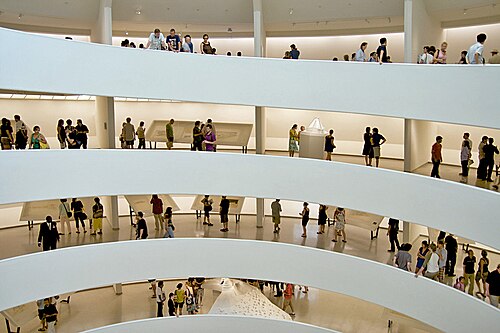
Solomon R. Guggenheim had made his fortune in mining and spent decades collecting old masters before Rebay, an artist he met in 1926, redirected his attention entirely toward what she called non-objective art: abstraction with no interest in representing the visible world5,7. Under her direction the collection had already outgrown a set of rented rooms at 24 East 54th Street, where it opened to the public in 1939 as the Museum of Non-Objective Painting5,8,4. Rebay wanted something more than more square footage. She wanted an environment that argued for the art, not just a container for it1,2.

Wright was an odd match for the assignment in almost every practical sense. He had spent his career arguing against the rectangular commercial city block, and he had never been licensed to practice architecture in New York, which meant he needed a local associate, Arthur Cort Holden, just to deal with the city's Board of Standards and Appeals5. The site Rebay and Guggenheim settled on in March 1944, at Fifth Avenue and 89th Street facing Central Park, put Wright's anti-urban instincts directly across the street from the most conventional stretch of Manhattan real estate imaginable5,9. Guggenheim approved Wright's spiral sketches that July and told him to proceed9.
What followed was not a straight line from sketch to steel. Wright produced more than 700 drawings and six full sets of working plans over the next decade, revising the design repeatedly, partly over how paintings should be mounted on curved walls and partly over lighting problems that nagged him through the late 1940s5,2,10. Rebay and Wright argued, but they argued toward the same goal, a building that fused art and architecture into one experience5.
Then Guggenheim died in 1949, before a shovel had touched the site5,3,11. His family's representatives on the foundation's board had never shared Rebay's tolerance for her increasingly mystical running of the museum, which one critic later described as "an esoteric, occult place in which a mystic language was spoken"5. The board moved to broaden the collection toward more conventional, representational art, a policy Rebay could not accept. She resigned as director in March 1952, seven years before anyone would walk through the building she had spent nearly a decade fighting for5,3.
Construction did not begin for another four years. The city's Department of Buildings rejected Wright's permit application outright in 1953, ruling that his design failed to meet building code, and sent him back to revise drawings in 1954 and again in 19565. Museum staff, meanwhile, complained the galleries left no room for storage or lab space5. A permit finally came through on May 23, 1956, and ground was broken that August5.
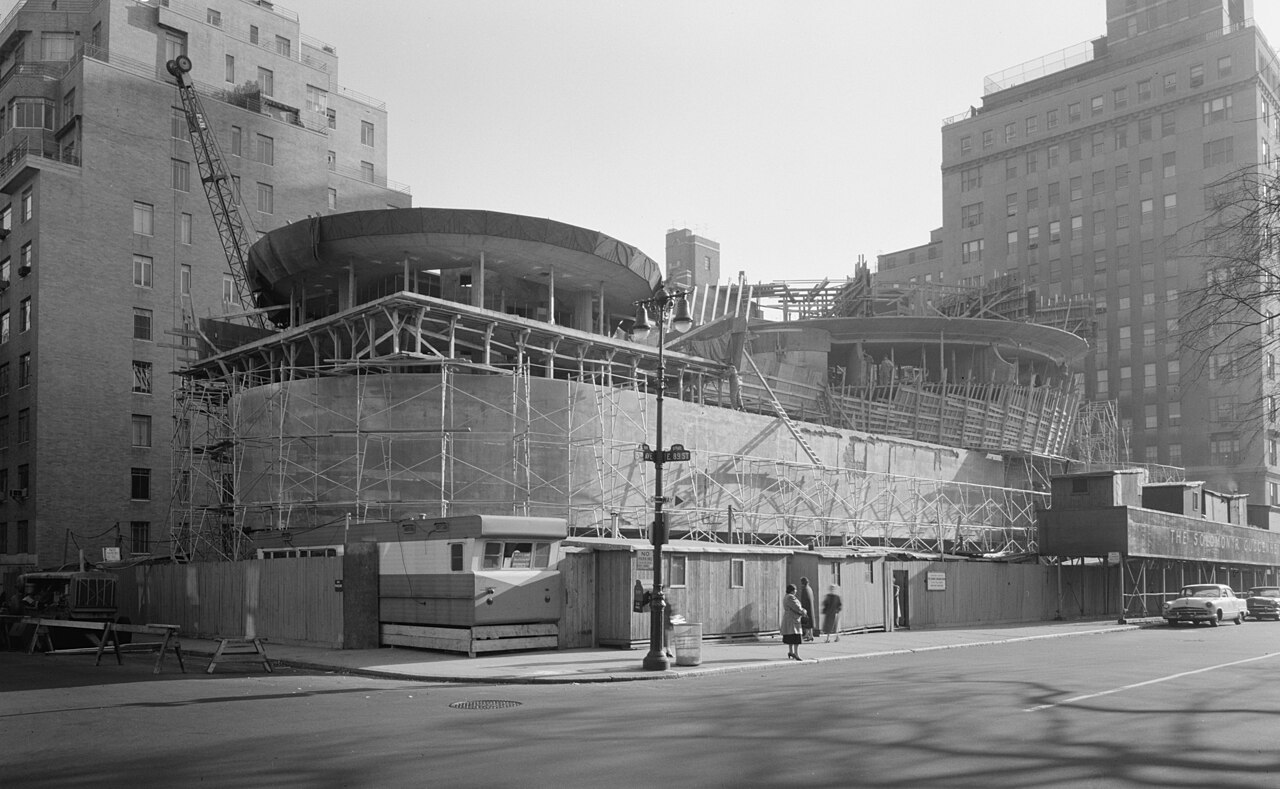
Wright, by then nearly ninety, opened a New York office to supervise the work and put his son-in-law William Wesley Peters in charge day to day, but in practice neither man was often on site. The job of actually running the construction fell to Holden's associate William Short5,6. What rose on Fifth Avenue through 1957 and 1958 was unlike anything nearby: a broad, white, curving concrete form next to the park, in a street otherwise defined by vertical masonry boxes6,2. Passersby and critics were not kind. The building was mocked as a "washing machine," an "imitation beehive," and a "giant toilet bowl," and some artists worried openly that Wright's architecture would overpower whatever was hung inside it1,2.
Wright died on April 9, 1959, six months before the museum he had spent sixteen years designing finally opened its doors12,2. The Solomon R. Guggenheim Museum, named for a man ten years dead, opened to the public on October 21, 19596,11,10. One critic called it the most beautiful building in America. Another said it was less a museum than a monument to Frank Lloyd Wright6. Rebay, who had asked for a temple of spirit and been gone from the project for seven years by the time it opened, got her building. She just wasn't there to see it unveiled.
Who Built the Spiral
- Frank Lloyd Wright: American architect who accepted the commission in 1943 at age 76, produced over 700 sketches, and died in April 1959, months before the museum opened5,12,2
- Hilla von Rebay: Guggenheim's art adviser and the Museum of Non-Objective Painting's first director; wrote Wright in 1943 asking for a "temple of spirit," then resigned in 1952 after losing a fight with the foundation's board5,3,2
- Solomon R. Guggenheim: mining industrialist and collector who approved Wright's spiral sketches in 1944 and died in 1949, before construction began5,9
- William H. Short: clerk of the works who ended up managing day-to-day construction after Wright and his son-in-law largely stayed away from the site5,6
- James Johnson Sweeney: appointed museum director in October 1952, oversaw the push to meet city building codes and finally start construction5
- New York City Department of Buildings: rejected Wright's 1953 permit application for code violations, forcing years of redesign before approving construction in 19565
The Count
- 16 years from Rebay's first letter to Wright (1943) to the museum's opening (1959)6,2
- Over 700 sketches and six full sets of working drawings produced during the design process5,2,10
- 1939: year the collection first opened publicly, as the Museum of Non-Objective Painting at 24 East 54th Street5,8
- 1949: year Solomon Guggenheim died, a decade before the museum named for him opened5,11
- 1952: year Hilla von Rebay resigned as director, seven years before the building was finished5,3
- October 21, 1959: opening day, six months after Wright's death6,2,11
Timeline
- 1939Museum of Non-Objective Painting opens at 24 East 54th Street under Hilla von Rebay's direction
- June 1943Rebay writes to Frank Lloyd Wright asking him to design a permanent museum building
- March 1944Site on Fifth Avenue at 89th Street, opposite Central Park, is acquired
- July 27, 1944Guggenheim approves Wright's spiral sketches
- 1949Solomon R. Guggenheim dies before construction begins
- March 1952Rebay resigns as director after conflict with the foundation's board
- 1952Museum renamed the Solomon R. Guggenheim Museum; James Johnson Sweeney appointed director
- 1953New York City Department of Buildings rejects Wright's construction permit application
- May 23, 1956Construction permit finally issued
- August 1956Construction begins on Fifth Avenue
- April 9, 1959Frank Lloyd Wright dies
- October 21, 1959Solomon R. Guggenheim Museum opens to the public
Pictures



Sources
- The Architecture of the Solomon R. ...guggenheim.org
- Solomon R. Guggenheim Museum - Frank Lloyd Wright Foundationfranklloydwright.org · 2017
- Hilla Rebay | The Guggenheim Museums and Foundationguggenheim.org
- Guggenheim Museum - Exhibitions - Art of Tomorrow: Hilla ...pastexhibitions.guggenheim.org
- Solomon R. Guggenheim MuseumWikipedia
- The Frank Lloyd Wright Building Timelineguggenheim.org
- Hilla von RebayWikipedia
- Guggenheim Museum - The Manhattan Project - Timelinepastexhibitions.guggenheim.org
- Frank Lloyd Wrightmoodle2.units.it
- Guggenheimpabook.libraries.psu.edu
- Solomon R. Guggenheimguggenheim.org
- Frank Lloyd WrightWikipedia
- Frank Lloyd Wright’s Guggenheim MuseumEducational Media Reviews Online · 2011
Researched and written by Lorelet from the sources above. It cites as it goes, but it can still get things wrong, so check the sources for anything that matters.
Report a problem
More featured lorelets
See all
Today · Space
The Fake Moon and Mars Rising Beside NASA Houston
A Texas hangar is filling with ten tons of volcanic rock to look like another world. It isn't NASA building it.

Today · Music
The Afternoon Tom Petty Waited Under a Pine Tree
A Florida boy with nothing to do got in his aunt's car to go watch a movie being filmed.

Oct 20 · Film & TV
The Princess Diana Pay-Per-View Seance
In March 2003, two British psychics claimed to put viewers in touch with a dead princess. What they were allowed to broadcast depended entirely on wh…