Featured · TodayScience
IceCube: Turning Antarctic Ice into a Telescope
To catch particles that pass through planets like they're not there, physicists buried thousands of light sensors a mile and a half beneath the South Pole, inside a cubic kilometer of the clearest ice on Earth.

Listen
Read by Wren · 9 min
A Telescope You Build by Melting a Mile of Ice
Francis Halzen had a strange idea in 1988: build a telescope not out of glass and mirrors, but out of a cubic kilometer of frozen water at the bottom of the world4,6. The target wasn't light. It was neutrinos, particles so famously indifferent to the rest of the universe that trillions pass through your body every second without you noticing7,5. Catching even a handful of the high-energy ones meant needing an absurd amount of something clear, dark, and stable. Antarctic ice, compressed over tens of thousands of years into something nearly bubble-free, fit the bill1,8.
The idea took its first real test in 1993, when researchers began sinking optical sensors into the ice as part of AMANDA, the Antarctic Muon and Neutrino Detector Array4,5. AMANDA was small and imperfect, but it answered the question that mattered: could you drop light sensors deep enough into South Pole ice to escape surface noise and still see something useful? The answer was yes, and it also proved that a crew could actually drill and deploy that deep, which set up everything that followed9.
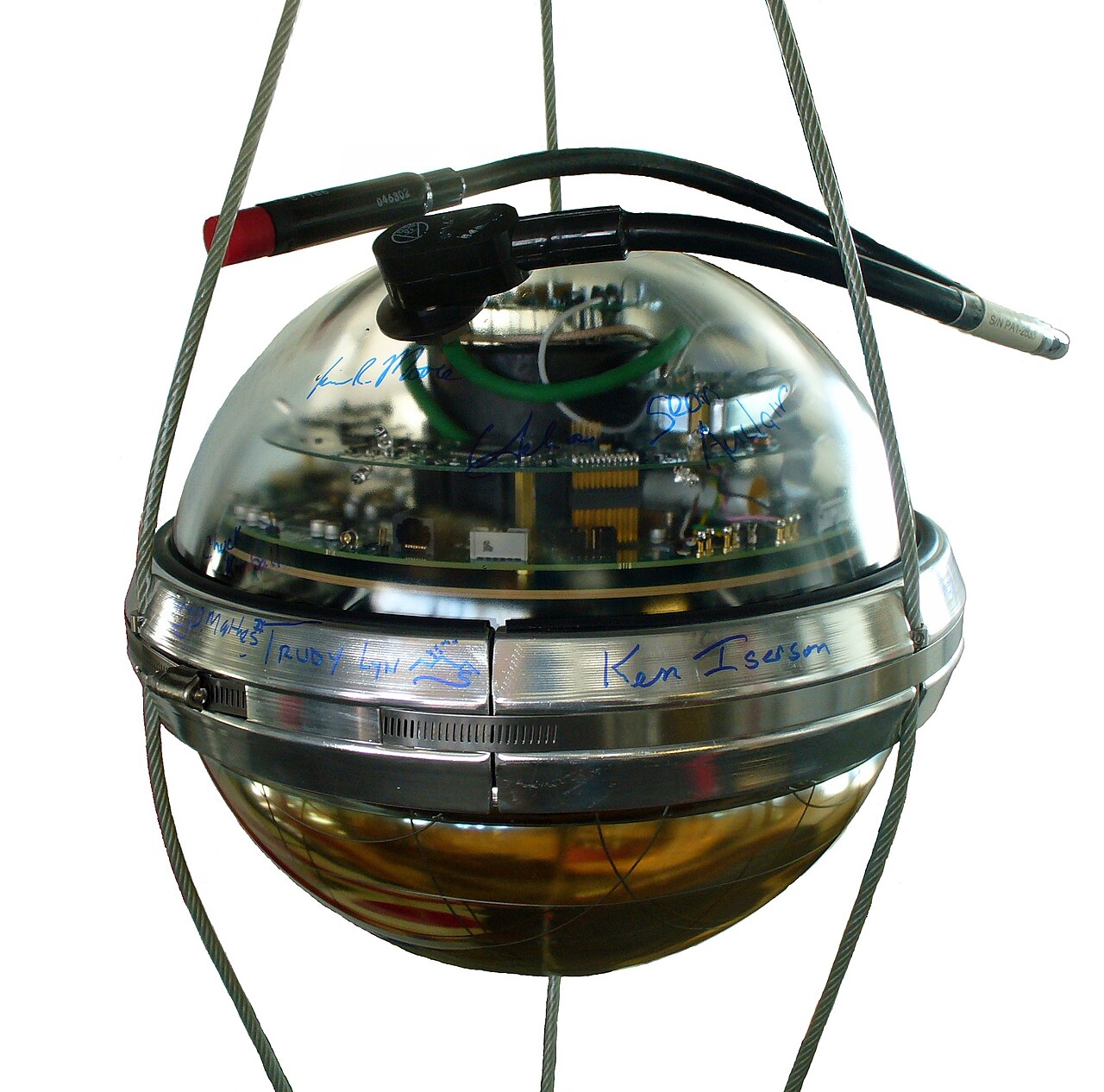
In November 1999, the IceCube Collaboration filed a 67-page proposal with the National Science Foundation and partners in Belgium, Germany, and Sweden, asking to build something a thousand times bigger than AMANDA: a full cubic kilometer, instrumented with over 5,000 sensors2. The University of Wisconsin-Madison took the lead, Halzen as principal investigator, Bob Paulos as project manager2. What followed was less a construction project than a seasonal military campaign, limited to the brief Antarctic summer when planes could land and the sun never set.
The tool that made it possible was a hot-water drill, built at Wisconsin's Physical Sciences Laboratory, that blasted water heated to roughly 80 degrees Celsius down a hose to melt boreholes about 60 centimeters wide2,1,10. Running at 4.8 megawatts, it could punch through more than two kilometers of ice in under two days, advancing at about 2 meters a minute under good conditions2,1,11. A crew of around 30 handled each hole10. As soon as a borehole was open, deployment teams lowered a string of 60 digital optical modules into the still-liquid water, which refroze around the sensors and locked them in place forever1,3.
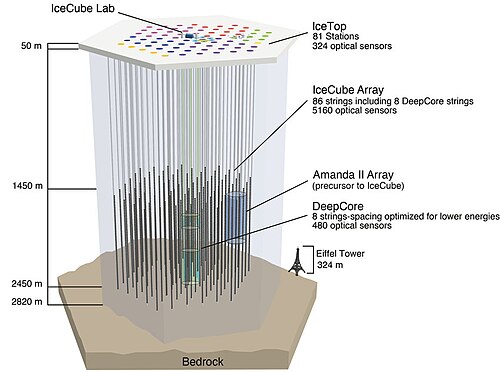
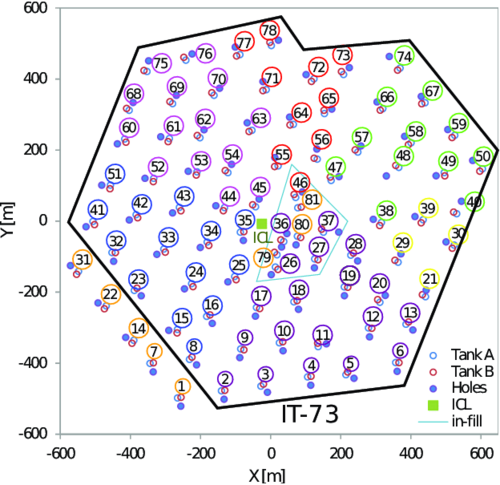
The first string went in during the 2004-05 season1,3. Six more seasons followed, each one adding strings to a hexagonal grid spaced 125 meters apart, sensors spread from 1,450 to 2,450 meters down1. On December 18, 2010, the last string dropped into its hole, finishing a job that had consumed roughly 28,000 person-days of labor, the equivalent of one person working for 78 years straight2,1,12. By then more than 450 people from dozens of countries had touched the project in some way13.
IceCube didn't wait for completion to start paying off. Partial configurations were already collecting data, and in 2013 the collaboration reported two startlingly energetic events, nicknamed Ernie and Bert, whose energies sat far above anything the atmosphere should produce4. It was the first real hint that some of these neutrinos were arriving from deep space rather than from cosmic rays hitting the sky overhead. By 2015, more data pushed that hint into a discovery: a genuine flux of high-energy neutrinos from beyond the Solar System, confirmed with the kind of statistical certainty physicists demand4. A new way of looking at the universe, built from a telescope buried under ice, had opened. In 2017, one of those neutrinos was traced back to a flaring blazar called TXS 0506+056, giving astronomers their first solid link between a neutrino and a specific object out in the sky, and tying IceCube's work into the broader push toward multimessenger astronomy, where light, gravitational waves, and particles are read together.
Why Ice, and Why Neutrinos at All
Neutrinos are nearly massless, carry no electric charge, and interact with matter so rarely that they can cross entire galaxies, or the Earth itself, without being stopped7,5. That makes them useless to detect with ordinary instruments but extraordinarily useful once you can see them: unlike light, they aren't blocked by dust, and unlike cosmic rays, they aren't bent off course by magnetic fields, so they point straight back to wherever they were born5.
They're thought to come from the universe's roughest neighborhoods: supernovae, the cores of active galaxies, and other places where cosmic rays get flung to extreme energies7,14. Scientists had been chasing the sources of cosmic rays for a century without success, because the rays themselves arrive scrambled by magnetic fields; neutrinos offered a workaround, a messenger that doesn't get lost on the way5.
When a neutrino does happen to strike an atom in the ice, it can produce a fast-moving charged particle, usually a muon, that briefly travels faster than light moves through that medium. That triggers a faint cone of blue Cherenkov light, the particle-physics equivalent of a sonic boom15,1. IceCube's sensors read the timing and brightness of that light, and from thousands of such flashes a sky map of neutrino arrivals, directions, and energies that no optical telescope could ever produce1.
Who Made It Happen
- Francis Halzen: University of Wisconsin-Madison physicist who proposed the Antarctic neutrino telescope in 1988 and served as IceCube's principal investigator4,5.
- Bob Paulos: Project manager named in the 1999 IceCube proposal2.
- University of Wisconsin-Madison: Lead institution for the project, home to the Physical Sciences Laboratory that designed the drill2,1.
- National Science Foundation: Lead U.S. funder, operating under a Major Research Equipment and Facilities Construction grant, with international partners in Belgium, Germany, and Sweden2,1.
- Amundsen-Scott South Pole Station: The U.S. Antarctic Program outpost that gave IceCube's crews the logistics to reach the site each summer1,5.
The Build, by the Numbers
- 86 vertical strings of sensors, each carrying 60 digital optical modules, about 5,160 modules total1.
- Depths from roughly 1,450 to 2,450 meters15,1.
- A borehole width of about 60 centimeters, drilled by a 4.8-megawatt hot-water system1,3.
- Drilling speed of about 2 meters per minute, capable of finishing a hole in under 48 hours3,2.
- Construction spanned the 2004-05 through 2010-11 austral summer seasons, roughly 28,000 person-days of labor3,12.
- More than 450 collaborators from 58 institutions in 14 countries, as of the collaboration's current count13.
Pictures


Sources
- IceCubeicecube.wisc.edu
- Timelineicecube.wisc.edu
- IceCube Enhanced Hot Water Drill functional description | Annals of Glaciology | Cambridge Corecambridge.org · 2014
- Nobel Prize in Physics 2026nobelprize.org
- I’m a physicist who worked on the Nobel-winning neutrino search – here’s how a cubic kilometer of Antarctic ice became a telescope for ghost particles from spacetheconversation.com
- Press release: Nobel Prize in Physics 2026nobelprize.org
- Neutrino astronomyWikipedia
- South Pole glacial climate reconstruction from multi-borehole laser particulate stratigraphy | Journal of Glaciology | Cambridge Corecambridge.org · 2013
- IceCube Neutrino Observatory Gen1 – Physical Sciences Lab ...uwpsl.wisc.edu
- Drilling IceCube: a story of innovation, expertise and strong willicecube.wisc.edu
- At South Pole, World's Most Extreme Scientific Construction ...science.psu.edu
- Five years since IceCube Neutrino Observatory completionicecube.wisc.edu
- Meet the Collaborationicecube.wisc.edu
- Diffuse neutrino background from past core collapse supernovae.Scholarly work · 2023
- IceCube Neutrino ObservatoryWikipedia
- IceCube – South Pole Neutrino ObservatoryHacker News · 2023
Researched and written by Lorelet from the sources above. It cites as it goes, but it can still get things wrong, so check the sources for anything that matters.
Report a problem
More featured lorelets
See all
Today · History
Operation Breakthrough: When the Cold War Thawed for Three Whales
In October 1988, a hunter's chance discovery near Point Barrow turned into a 20-day international scramble that put Soviet icebreakers, Greenpeace vo…

Today · Sports
222-0: John Heisman's Grudge Match
A disputed 22-0 baseball loss sent Georgia Tech's coach looking for payback, and he found it by burying a makeshift Cumberland team under the most lo…

Oct 6 · Technology
ChatGPT Started Forging New Yorker Cartoonists' Signatures
When an AI model began signing fake New Yorker cartoons with real cartoonists' names, it turned a style-imitation problem into something that felt, t…