
Featured · Nov 5History
Who Bombed the Vatican? The 1943 Neutrality Mystery
On a November night in wartime Rome, an unmarked plane dropped bombs on the one patch of ground that was supposed to be off limits to everyone. For decades, nobody would say who sent it.

Listen
Read by Finch · 9 min
The Plane Nobody Claimed
Luigi Turchetto was on duty at the Vatican railway station a little after eight in the evening on 5 November 1943, when he heard an aircraft flying low out of the darkness1. He could not see it. From the sound of the engine, he judged it was coming from the northeast, and he listened as it passed over the station, flew on a short distance, then turned back1.
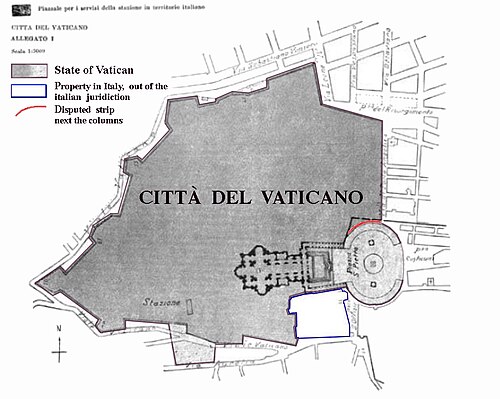
What followed, in his own written account, was a hiss and then a burst of noise that felt like several bombs going off almost at once1. Four impacts, he later recorded: the embankment near the boundary wall by St. Peter's Station, the terrace of the Mosaic Studio, an area behind the Governorate Palace, and a spot in the Vatican Gardens he could not immediately place1. Nobody was killed. Nobody was even hurt1,2. And nobody, not that night or for decades afterward, stood up and said they had done it.
Vatican City in the autumn of 1943 was, on paper, neutral ground in the middle of a war. Rome had been occupied by German forces since the Italian armistice of 8 September 1943, and the city would not fall to the advancing Allies until June 19443. The Vatican's own radio station broadcast war news and messages about prisoners and the missing, and Fascist officials reportedly suspected it of passing military information to the Allies4,5.
Rome had already been bombed once that year, in a daylight American raid on 19 July 1943 aimed at railway and industrial targets6. The November attack was something else: a small, unmarked plane, at night, hitting inside the one patch of the city that both sides had agreed, at least formally, to leave alone1,7.
On 6 November, Vatican Radio broadcast confirmation that an unidentified aircraft had dropped four bombs the night before, stressing the damage and the lack of casualties2. Behind the scenes, the Vatican's Secretariat of State wrote to Germany, the United States, and Great Britain, asking each to account for the attack4. All three denied involvement4.
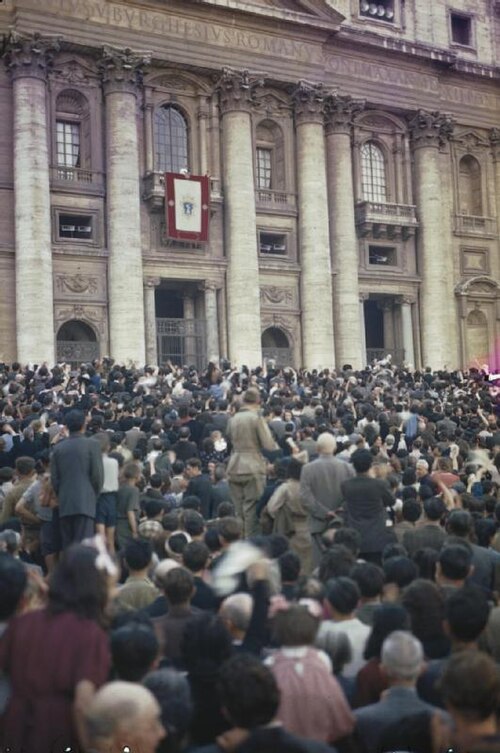
The following Sunday, 7 November, Pope Pius XII spoke to the crowd gathered in St. Peter's Square, telling them the Vatican had been bombed and that an investigation was under way4. Privately, he was reported to have said that "there was more respect in Cairo, as the religious center of Islam, than in Rome," comparing the treatment of a Muslim holy city with what had just happened to his own1.
One early theory held that an Allied pilot had simply lost his bearings in the dark. American sources floated the idea that a U.S. flier had dropped his bombs by accident, and another Allied pilot said he'd seen an aircraft release its load over the Vatican8. But a later British inquiry reportedly traced the suspected aircraft's actual bomb run to Arce, about fifty miles southeast of Rome, and cleared any British plane flying that night7,9. The accidental-Allied theory, plausible in the confusion of the moment, did not survive the paperwork.
The account that has gained the most traction since comes from Italian journalist Augusto Ferrara, whose research, published in the book 1943: Bombe sul Vaticano, points to an Italian Social Republic aircraft, a Savoia-Marchetti SM.79, flown from Viterbo, about fifty miles north of Rome10,4. Ferrara's sources name the pilot as a sergeant called Parmeggiani, and identify the man who ordered the mission as Roberto Farinacci, a hardline Fascist politician and adviser to Mussolini who believed Vatican Radio was feeding the Allies military intelligence10,4. According to this account, the bombing was designed to look anonymous, letting the Fascists strike at the Vatican without anyone having to answer for it4.
When word of that likely explanation reached Pius XII, he reportedly asked that it not be reported in the press, wary of anything that might further compromise the Vatican's fragile claim to neutrality in the middle of a city under foreign occupation1,4. The silence that followed the bombing, it turns out, was not only the silence of whoever dropped the bombs. It was also, in part, the Vatican's own choice. A second attack on 1 March 1944, which killed one person and injured another, showed that whatever message the first bombing was meant to send, Vatican City's immunity remained no sure thing1.
A Neutral City Surrounded by War
Vatican City's neutrality dated to the Lateran Treaty of 1929, which recognized it as sovereign territory and bound the Pope to abstain from mediating the conflicts of other states unless asked by all sides3. By 1943 that neutrality was a legal fact surrounded by a very unneutral city: Rome under German occupation from September, then under Allied control by June 19443.
Pius XII had tried, before the war even began, to broker peace among the major powers, starting with contacts to Mussolini in 19393. Once fighting started, he kept to a studied public evenhandedness, a posture historians have scrutinized closely, especially around his wartime statements on the persecution of Jews3,11. Vatican Radio fit into this same balancing act: a tool for humanitarian messaging that Fascist officials came to regard as something closer to an intelligence leak4,5.
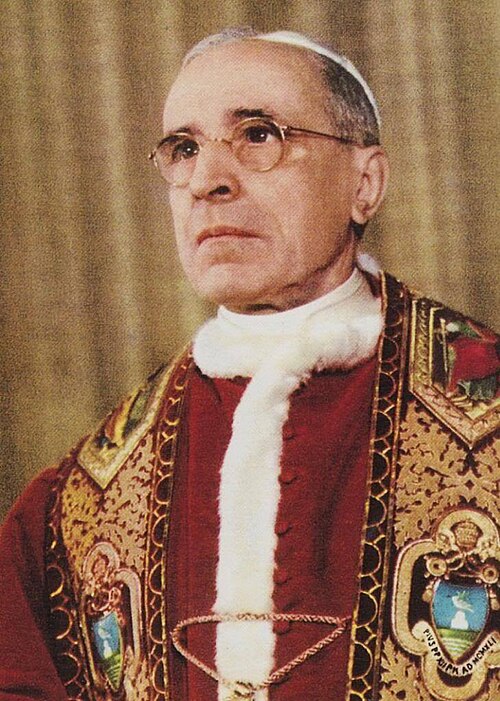
Franklin Roosevelt had assured Pius XII in June 1943 that Allied pilots were briefed on the Vatican's location and instructed to keep bombs out of its boundaries4. That promise held in the narrow sense that no Allied bombing of the Vatican was ever confirmed. It did nothing to explain the plane that came in low over St. Peter's Station on the night of 5 November.
Who's Who
- Pope Pius XII: Pope from 1939 to 1958, he publicly acknowledged the bombing days later and privately criticized the breach of Vatican neutrality, while asking that the likely Fascist motive be kept out of the newspapers1,4.
- Luigi Turchetto: A Vatican gendarme on duty that night, whose written account supplies the only ground-level record of the attack's sound and sequence1.
- Roberto Farinacci: A hardline Fascist politician and adviser to Mussolini, later accused by researcher Augusto Ferrara of ordering the attack to silence Vatican Radio10,4.
- Augusto Ferrara: Italian author whose 2010 book assembled documents, testimony, and aviation records pointing to a Fascist-ordered bombing10,4.
By the Numbers
- 8:10 p.m.: approximate time the aircraft was heard over Vatican City on 5 November 19431,7.
- 4 or 5: number of bombs dropped, with sources disagreeing1,4,2.
- 0: deaths or injuries from the November 1943 attack1,2.
- 50 miles: distance from Rome to Viterbo, the alleged launch point of the Fascist aircraft, and also roughly the distance to Arce, where a British inquiry says the Allied plane actually struck7,4,9.
- 1: person killed in the second Vatican bombing, on 1 March 19441.
What's Still Disputed
No wartime court or universally accepted official inquiry ever definitively proved who ordered the attack4. Vatican News still describes the bomber's identity as unknown even while noting Ferrara's research1,10.
Sources disagree even on basic details: some report four bombs, others five, with one unexploded1,4,2. The accidental-Allied theory was undercut by a reported British investigation pointing to Arce, but that investigation itself is known only through secondary accounts7,9.
A further theory holds that German authorities encouraged or directed the Fascist operation to make it look like an Allied strike, stirring anti-Allied feeling among Catholics. This remains speculative, with no surviving order or confession on record9.
Timeline
- 8 September 1943Italy signs armistice with the Allies; German forces occupy Rome3.
- 19 July 1943American bombers strike railway and industrial targets in Rome6.
- 5 November 1943, ~8:10 p.m.Unidentified aircraft drops bombs on Vatican City, damaging buildings but causing no casualties1,7,2.
- 6 November 1943Vatican Radio confirms the bombing; Secretariat of State seeks explanations from Germany, the US, and Britain4,2.
- 7 November 1943Pius XII addresses the crowd in St. Peter's Square about the attack4.
- 1 March 1944A second bombing hits Vatican City, killing one person and injuring another1.
- 2010Augusto Ferrara publishes '1943: Bombe sul Vaticano,' attributing the attack to Italian Fascists10,4.
Pictures




Sources
- 5 November 1943: the bombing of Vatican City State - Vatican Newsvaticannews.va · 2020
- Vatican Radio Confirms Bombing; Mosaic Shop, Governor's Home Hit; Vatican Radio Confirms Bombing of City; Mosaic Works and Governor's Palace HitThe New York Times
- Vatican City during World War IIWikipedia
- Remembering When Bombs Fell on the Vaticanncregister.com · 2019
- Did you know the Vatican was bombed in World War II?beachesofnormandy.com
- Americans bomb Rome in 2-hour daylight raid - UPI Archivesupi.com
- Bombing of Rome in World War II - Wikiwandwikiwand.com
- 690 American bombers hit Rome; 9,125 bombs fall on San ...patriotcompass.us
- The day the Vatican was bombed | Sky HISTORY TV Channelhistory.co.uk
- Vatican bombing in WWII was work of Italian fascists, author saysewtnnews.com · 2013
- Pope Pius XIIWikipedia
Researched and written by Lorelet from the sources above. It cites as it goes, but it can still get things wrong, so check the sources for anything that matters.
Report a problem
More featured lorelets
See all
Today · Food
The Turkey Surplus That Became the TV Dinner
A company drowning in frozen birds found an answer on an airline food cart, or so the story goes for fifty years.

Today · Space
Why Is Jupiter's Great Red Spot Actually Red?
Jupiter is built almost entirely of colorless gas, yet its most famous storm glows orange-red. Scientists have spent decades in the lab trying to fig…

Today · Art & Design
The Aztec Labret Whose Golden Tongue Still Moves
A small gold serpent made for a pierced lip somehow ended up with a tongue that flicks side to side. No one alive has ever seen it worn.