Featured · TodayHistory
The Jars at the Bottom of Kekova
Divers off Turkey's Mediterranean coast found a cargo with no ship attached to it, and a date that, if it holds, would push the story of sea trade back further than almost anyone expected.

Listen
Read by Finch · 7 min
Pottery Without a Ship
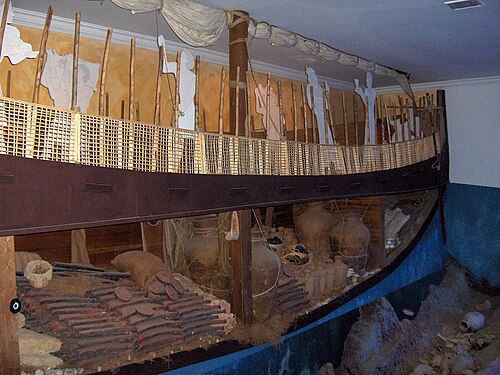
Thirty metres down, on a sloping seabed near Kekova Island on Turkey's southern coast, divers found about thirty ceramic storage jars and a scatter of stone anchors lying where a ship had apparently gone down1,3. There was no hull to see. The wood had long since rotted away, leaving only the cargo, spread across the slope the way a shipwreck's contents settle once the thing that carried them is gone1.
That absence turned out to be the whole case. With no timber to date and no organic material left for radiocarbon testing, everything about the age of this wreck would have to come from the jars themselves1,2.
The team behind the find was led by Hakan Öniz, an underwater archaeologist at Akdeniz University in Antalya2,3. According to New Scientist, Öniz and his colleagues first spotted the site during an underwater survey of Turkey's Mediterranean coast in 2024, then returned to complete the excavation earlier this month2. The amphoras, Öniz told the magazine, have a distinctive shape with side handles and flat bases, a form shared with Early Bronze Age pottery from the Levant and Egypt2. Minor differences between individual jars suggested they came from different workshops and probably different settlements, which Öniz read as evidence the ship had made stops along a coastline, picking up cargo village by village2.
On that basis, the team dated the jars, and by extension the wreck, to between 2700 and 2400 BCE, or roughly 4,400 to 4,700 years ago1,2. The ship itself is reconstructed as modest, about 10 metres long, likely departing from a harbor on the eastern Mediterranean coast and sailing toward Crete or Troy when it sank, according to Öniz1,2. Turkish Culture and Tourism Minister Mehmet Nuri Ersoy made the find public in a post on social media on 14 October 2026, and international outlets quickly ran with the headline that it was the world's oldest known shipwreck7,8.
That is where the story gets complicated. Jon Henderson, a maritime archaeologist at the University of Edinburgh, called the discovery fascinating and potentially very important, but said he wanted to see published evidence before, as he put it, crowning it the world's oldest shipwreck, because dating pottery by shape and decoration is not always precise: similar forms can turn up across long stretches of time1. He also pointed out that the previous record holder, an Early Bronze Age wreck at Dokos in southern Greece dated to 2700-2200 BCE, could easily be contemporary with Kekova rather than older or younger than it1. Öniz argues Kekova is older; Henderson isn't convinced the gap is real1.
There is a second layer of confusion that has nothing to do with dating and everything to do with naming. Off Kumluca, further along the same stretch of Antalya coastline, there is another, much younger Bronze Age wreck, roughly 3,600 years old, carrying more than a hundred copper ingots and, as of a 2024 report, a bronze dagger with silver rivets tied to the Minoan world4,5,9. That ship had already been called, in earlier coverage, the world's oldest known trading shipwreck5. The two sites are different wrecks found by different surveys years apart, but the overlapping language, the same minister, the same stretch of Turkish coast, has made it easy for the headlines to blur them together10,6.
What the Kekova jars can say for certain is narrower than the global headlines suggested: that around 4,400 to 4,700 years ago, someone built a ten-metre boat, loaded it with jars from several different places, and lost it somewhere off a small island near Antalya1,2. Henderson's point stands regardless of who holds the record. People were moving goods by sea in this period, he said, but finding physical remains of it is extraordinarily rare1. The jars on the slope at Kekova are, for now, one of the few places that rarity breaks the surface.
Who's Involved
- Hakan Öniz: Underwater archaeologist at Akdeniz University, Antalya, who led the team that surveyed and excavated the Kekova site2,3.
- Mehmet Nuri Ersoy: Turkey's Culture and Tourism Minister, who announced the Kekova find publicly on 14 October 20268.
- Jon Henderson: Maritime archaeologist at the University of Edinburgh, who called the find significant but questioned the precision of pottery-based dating1.
- Cemal Pulak: Archaeologist who led excavation of the separate, younger Kumluca wreck starting in 2019, with the Institute of Nautical Archaeology and Antalya Museum6.
By the Numbers
- 2700-2400 BCE: proposed date range for the Kekova wreck, based on pottery style1,2.
- ~4,400-4,700 years: how old that makes the wreck, if the dating holds1,7.
- 30 metres: depth of the slope where the cargo was found1.
- ~30: ceramic storage jars (amphoras) recovered2,3.
- ~10 metres: estimated length of the ship, reconstructed from the cargo spread1.
- 2700-2200 BCE: date range of the rival Dokos wreck in Greece, the previous record holder1.
- ~1600 BCE / 3,600 years: age of the separate Kumluca wreck off Antalya, often confused with this find5,9.
What's Still Disputed
The headline claim, that Kekova is the world's oldest known shipwreck, rests on dating by pottery shape and decoration rather than radiocarbon testing, because no organic material survived at the site1,2. Jon Henderson of the University of Edinburgh has said that method is not always accurate, since similar pottery forms can appear across long periods, and he wants to see published evidence before the title is settled1.
There is also a live competitor. The Dokos wreck off southern Greece, dated to roughly 2700-2200 BCE, overlaps with Kekova's proposed range, and Henderson has said the two could be contemporary rather than one being clearly older1.
Finally, the Kekova find should not be confused with the Kumluca wreck, a separate and much younger site off Antalya carrying copper ingots, which earlier reporting had already called the world's oldest trading shipwreck4,5. The two discoveries, years apart and archaeologically distinct, have been run together in some coverage because of overlapping geography and officials10,6.
Timeline
- 2018Akdeniz University identifies the separate Kumluca Bronze Age wreck off Antalya11.
- Summer 2019A team led by Cemal Pulak begins excavating the Kumluca wreck6.
- 2024Hakan Öniz's team first spots the Kekova wreck site during an underwater survey2.
- 2 September 2024Minister Ersoy visits the Kumluca wreck excavation10.
- Early October 2026Excavation of the Kekova amphoras is completed2.
- 14 October 2026Turkish officials and international media announce the Kekova find as a possible world's-oldest shipwreck1,7,8.
Pictures


Sources
- World's oldest shipwreck found off Kekova Island in TurkeyBBC
- Ancient shipwreck discovered off Turkey claimed to be world's oldest | New Scientistnewscientist.com · 2026
- World's oldest shipwreck discovered off coast of Turkey - AOL UKaol.co.uk
- Copper Ingots Found in Ancient Shipwreck off Turkish Coastbiblicalarchaeology.org
- Divers find dagger on world's oldest merchant shipwreckdivernet.com
- Kumluca Bronze Age Shipwreck Excavationnauticalarch.org
- World’s oldest shipwreck found off coast of Turkey | CNNcnn.com
- World's oldest shipwreck found off coast of Turkiyealjazeera.com
- Ancient world comes to life beneath Türkiye's blue watersdailysabah.com
- Beneath Türkiye's seas: Shipwrecks rewrite ancient Mediterranean history - Türkiye Todayturkiyetoday.com
- Maritime Archaeology of Ancient Shipwrecks - Recent articles and discoveries | Springer Nature Linklink.springer.com
Researched and written by Lorelet from the sources above. It cites as it goes, but it can still get things wrong, so check the sources for anything that matters.
Report a problem
More featured lorelets
See all
Today · Crime
The Wall That Swallowed Two Renoirs
Four men, a stolen vehicle, and a drug investigation that had nothing to do with art all collided over two paintings missing from a house in southern…

Today · Culture
The Real Christopher Robin's Bear Feud
A boy's teddy bear made him famous before he could spell his own name. He spent the rest of his life trying to decide what to do with that.

Oct 14 · Business
The Olympus Whistleblower Who Toppled His Own Board
A British executive became the first foreign CEO of a storied Japanese camera maker. Two weeks later, the board fired him unanimously, and gave a rea…