Featured · TodayCulture
The Real Christopher Robin's Bear Feud
A boy's teddy bear made him famous before he could spell his own name. He spent the rest of his life trying to decide what to do with that.

Listen
Read by Finch · 7 min
The Record He Broke
As a young boy, Christopher Robin Milne made a recording, a gramophone disc of him reciting lines connected to his father's Pooh poems2. His neighbours played the gramophone record he'd performed on over and over until, finally, they got bored with the joke and gave him the record2. Christopher smashed it to pieces2.
By then something had already curdled in the arrangement that made Christopher Robin a household name before he was ten2.
He had been born at 11 Mallord Street in Chelsea on 21 August 1920, the only child of A. A. Milne and Dorothy "Daphne" Milne1. The family's weekends at Cotchford Farm, near Ashdown Forest in East Sussex, supplied the raw material for the stories: the walks, the nursery games, and a teddy bear bought from Harrods that Christopher renamed Winnie after a Canadian black bear he had seen at London Zoo1,6,7. His father turned those afternoons into verse and then into fiction. "When We Were Very Young" appeared in 1924, when Christopher was four, and "The Wrong Sort of Bees," the story that introduced Winnie-the-Pooh by name, ran in the London Evening News at the end of 19256,8.

The books sold enormously, and the real boy behind them was expected to perform the part. He answered fan letters, appeared in a Pooh-themed pageant, and made the gramophone recording, all before he was eight9. For a while he liked it. He later told the broadcaster Gyles Brandreth that until he was eight or nine he "quite liked being famous" and that it felt "exciting" and made him "feel grand and important"9.
That changed in May 1930, a few months before his ninth birthday, when he started boarding at Boxgrove School near Guildford1,2,3. His classmates knew the books by heart, and his name made him an easy target. "It was now," he wrote later, "that began that love-hate relationship with my fictional namesake that has continued to this day"1,2. The bullying followed him to Stowe School as well1,5,3.
His father had already sensed trouble before Christopher ever left for school. A. A. Milne reportedly spoke of "amazement and disgust" at the publicity surrounding his son, and wrote that "the legal Christopher Robin has already had more publicity than I want for him"4,2. The disgust did not stop him from continuing to mine his son's childhood for material, and Christopher came to see the arrangement as a kind of theft. "It seemed to me almost," he wrote, "that my father had got to where he was by climbing upon my infant shoulders, that he had filched from me my good name and had left me with the empty fame of being his son"1,9.
He spent much of his adult life trying to climb back down off those shoulders. After Cambridge and wartime service, helped into a position as a sapper in the Royal Engineers partly through his father's influence10, he married his cousin Lesley de Sélincourt in 1948 and, in 1951, opened the Harbour Bookshop in Dartmouth, Devon, a life built around other people's books rather than his own fictional self1,5. He generally refused to profit from the Pooh royalties, though he later accepted money, reportedly selling half his future share for 150,000 pounds, to provide for his daughter Clare, who had cerebral palsy1,11,12.
He stayed in occasional contact with his father even as the resentment lingered, visiting him when he fell ill, though he never went back to Cotchford Farm after A. A. Milne died in 19561,5,3. The deeper rupture was with his mother: Christopher was estranged from Daphne Milne from 1956 until her death in 1971, and she reportedly refused to see him on her deathbed1,5.
It was writing, not silence, that eventually let him put the record back together in a different sense. His 1974 memoir, "The Enchanted Places," he said, "combined to lift me from under the shadow of my father and of Christopher Robin," leaving him able, finally, "to look them both in the eye"1,3. The boy who had once smashed the evidence of his own fame spent the rest of his life deciding, in print, what to do with what was left of it.
How a Nursery Became a Franchise
A. A. Milne was already an established writer, an assistant editor at Punch and a successful playwright, when fatherhood gave him a new subject4,6. The poem "Vespers," published in Vanity Fair in 1923 with the line "Christopher Robin is saying his prayers," was his first public use of his son's name6.
The Pooh books followed in quick succession: "When We Were Very Young" (1924), "Winnie-the-Pooh" (1926), "Now We Are Six" (1927), and "The House at Pooh Corner" (1928), all illustrated by E. H. Shepard6,8. The setting was Ashdown Forest itself: Gill's Lap became Galleon's Lap, a stand of pines became the Six Pine Trees, and a bridge at Posingford became Pooh Sticks Bridge1.

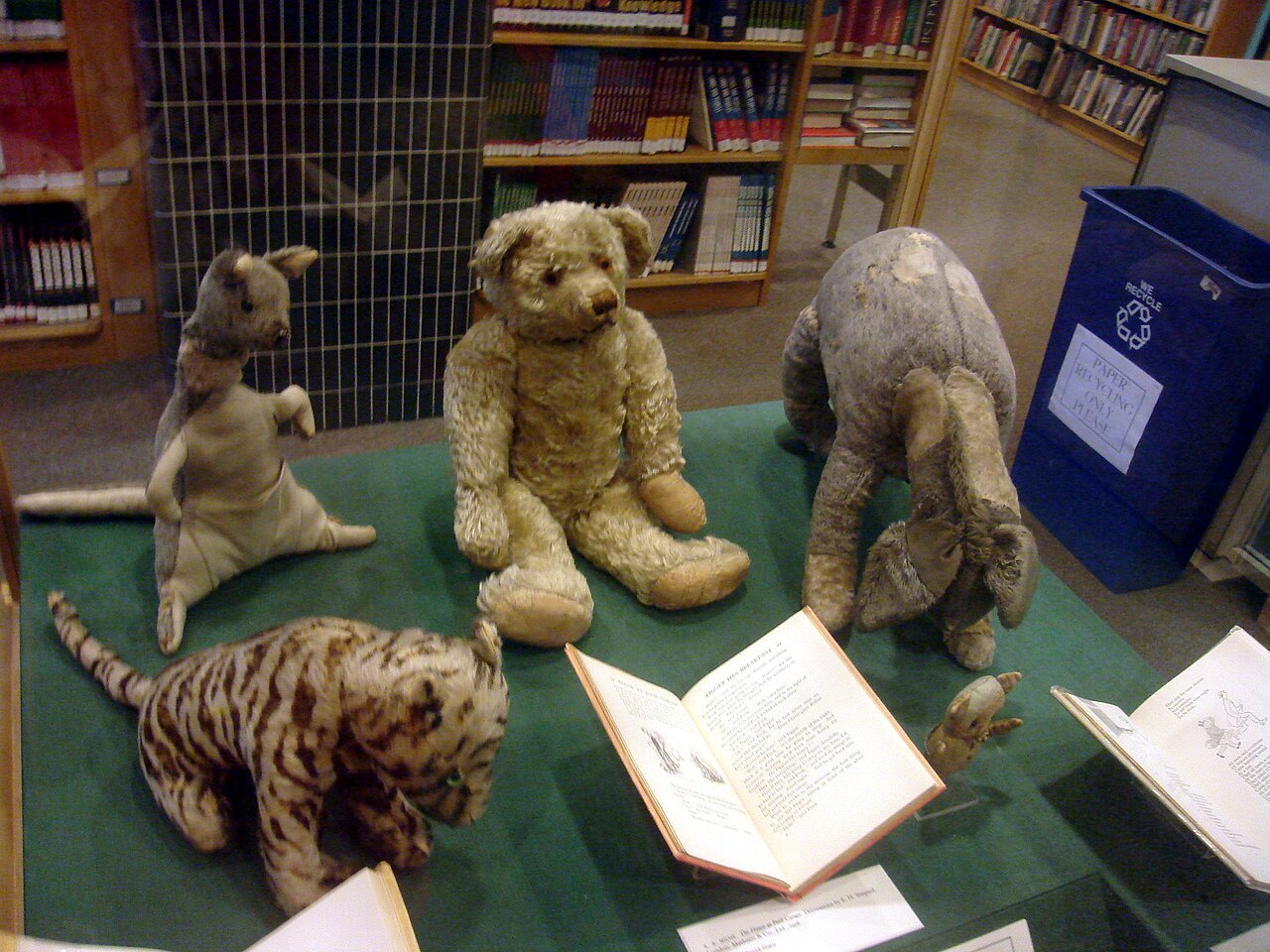
The original toys, including the real bear named Winnie that Christopher renamed and reimagined, later ended up on display in the children's section of the New York Public Library, a detail that still irritates some British fans who would rather see them come home6.
Who's Who
- Christopher Robin Milne: the real child behind the character, later a bookseller in Dartmouth and memoirist of his own complicated childhood1.
- A. A. Milne: his father, the author who turned the boy's nursery life into a global literary franchise, and who later resented the fame it brought1,4,2.
- Dorothy "Daphne" Milne: Christopher's mother, from whom he was estranged for the last fifteen years of her life1,5.
- E. H. Shepard: the illustrator whose drawings of Christopher Robin and the toys became as famous as Milne's text6.
- Olive Rand ("Nou"): Christopher's nanny and primary caregiver until he left for boarding school in 19301.
- Gyles Brandreth: broadcaster and friend of the adult Christopher Robin Milne, who recorded many of his later reflections9.
By the Figures
- 1920: year of Christopher Robin Milne's birth in Chelsea, London1.
- 1924-1928: span of the four original Pooh books, written when Christopher was four to eight years old6,8.
- 1930: year Christopher started boarding school and the bullying over his name began1,2,3.
- 1951: year he opened the Harbour Bookshop in Dartmouth, Devon5.
- 1956-1971: the fifteen years Christopher was estranged from his mother, Daphne Milne1,5.
- 150,000 pounds: reported sum Christopher received for selling half his future Pooh royalties, used to care for his daughter Clare12.
What the Record Doesn't Settle
Several popular retellings flatten Christopher Robin Milne's story into a simple refusal to touch Winnie-the-Pooh money at all. The available accounts complicate that: he generally avoided profiting from the books but later accepted a substantial payment tied to his daughter Clare's care, a detail reported with a specific figure (150,000 pounds) that should be read as a reported financial detail rather than an audited fact11,12.
Accounts also disagree, in tone if not in substance, about how bad the schoolyard bullying actually was. Christopher's own description of a "love-hate relationship" with his fictional self is well documented1,2,3, but the sources available here do not reconstruct a specific scene of an assault or quote exact taunts, so the texture of that bullying is asserted more than it is shown.
Finally, the popular image of total estrangement between father and son is not quite accurate. Christopher remained in intermittent contact with A. A. Milne, visiting him during his final illness, and the clean, long-term break was with his mother instead, lasting from 1956 until her death in 19711,5.
Timeline
- 1920-08-21Christopher Robin Milne is born in Chelsea, London1.
- 1924"When We Were Very Young" is published, inspired by four-year-old Christopher8.
- 1925"The Wrong Sort of Bees" introduces Winnie-the-Pooh by name in the London Evening News6,8.
- 1926"Winnie-the-Pooh" is published6.
- 1930-05Christopher starts boarding at Boxgrove School and is bullied over his famous name1,2,3.
- 1951-08-25Christopher opens the Harbour Bookshop in Dartmouth, Devon5.
- 1956A. A. Milne dies; Christopher's estrangement from his mother begins1,5.
- 1971Daphne Milne dies, ending the fifteen-year estrangement1,5.
- 1996-04-20Christopher Robin Milne dies in Totnes, Devon, aged 751,8.
Pictures
Sources
- Christopher Robin MilneWikipedia
- AA Milne and the curse of Pooh bearBBC · 2016
- When We Were Very Young – An Irishman’s Diary on Christopher Robin Milneirishtimes.com · 2020
- A. A. MilneWikipedia
- Christopher Robin Milne – A Joyful Practiceajoyfulpractice.com
- How Winnie-the-Pooh Became a Household NameSmithsonian Magazine · 2017
- The Inspiration Behind Winnie-the-Poohthepeoplesfriend.co.uk
- Christopher Robin Milne; Son of Pooh's Creatorlatimes.com · 1996
- The Real Christopher Robin Had a Complicated Relationship With Winnie-the-Poohmentalfloss.com · 2026
- Christopher Robin in real life: Who was Christopher Robin Milne?smoothradio.com
- The True Story Behind Winnie the Pooh and Christopher Robinpeople.com
- How real life Christopher Robin was more of an Eeyore than a Tiggermirror.co.uk
- Winnie-the-Pooh: The real bear behind the 100-year-old bookBBC · 2026
Researched and written by Lorelet from the sources above. It cites as it goes, but it can still get things wrong, so check the sources for anything that matters.
Report a problem
More featured lorelets
See all
Today · Crime
The Wall That Swallowed Two Renoirs
Four men, a stolen vehicle, and a drug investigation that had nothing to do with art all collided over two paintings missing from a house in southern…

Today · History
The Jars at the Bottom of Kekova
Divers off Turkey's Mediterranean coast found a cargo with no ship attached to it, and a date that, if it holds, would push the story of sea trade ba…

Oct 14 · Business
The Olympus Whistleblower Who Toppled His Own Board
A British executive became the first foreign CEO of a storied Japanese camera maker. Two weeks later, the board fired him unanimously, and gave a rea…