Featured · TodayHistory
The Little Cannon That Started a Revolution
A loaned Mexican cannon, a buried gun in a peach orchard, and a hand-painted flag daring soldiers to come and take it: how a small-town squabble in Gonzales lit the Texas Revolution.
Listen
Read by Wren · 10 min
A Cannon Nobody Wanted to Give Back
In January 1831, the empresario Green DeWitt wrote to Ramón Músquiz, the political chief in Béxar, asking for a weapon to defend his struggling colony at Gonzales against Comanche, Karankawa, and Tonkawa raids2,8. Mexican officials agreed, on one condition: the gun could be reclaimed whenever they wanted it back. On March 10, 1831, colonist James Tumlinson Jr. signed for a small Spanish-made bronze six-pounder in Béxar and hauled it home1,2.
For four years the cannon did nothing more dramatic than sit, probably mounted in a blockhouse as a deterrent2. Then Mexican politics turned. Santa Anna's government was centralizing power, alarming both federalist Mexicans and the mostly Anglo-American colonists who had settled Texas under earlier, looser immigration rules6,2. By September 1835, Colonel Domingo de Ugartechea, the senior Mexican military commander in Texas, decided it was unwise to leave an armed, restless colony sitting on artillery. He sent a corporal and five soldiers to fetch it back.
Gonzales said no. The town's alcalde, Andrew Ponton, had the Mexican soldiers escorted out empty-handed and sent riders to neighboring settlements asking for help1,3. Rather than wait to see what Ugartechea would do next, the colonists dug a hole in George W. Davis's peach orchard and buried the cannon1,3.
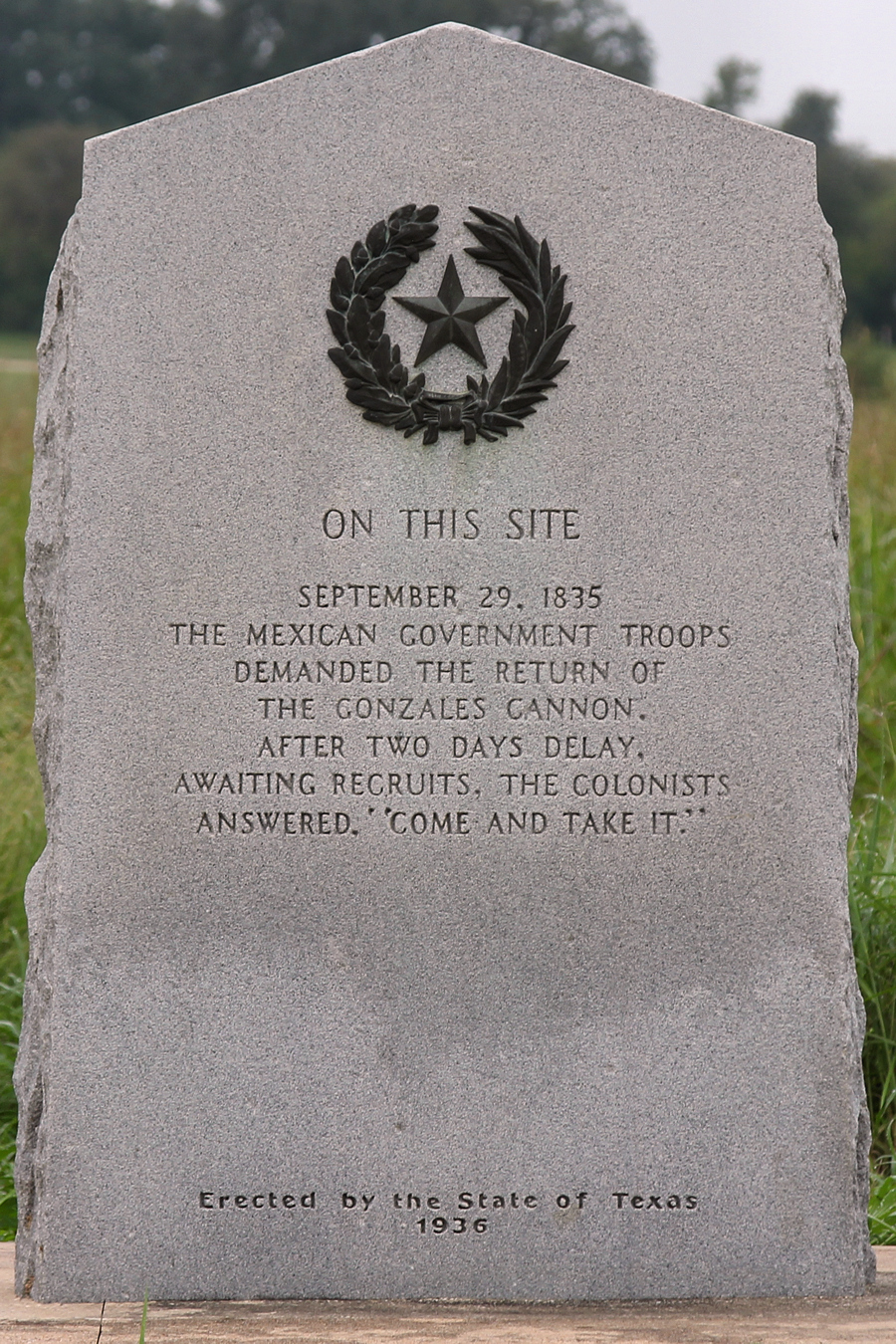
Ugartechea's answer was Lieutenant Francisco de Castañeda, sent with a larger detachment, somewhere between 100 and 150 dragoons depending on the source, to finish the job properly3,9. By the time Castañeda reached the Guadalupe River near Gonzales in late September, the town had scraped together a defense out of eighteen men, later nicknamed the "Old Eighteen," who stalled him with excuses while couriers rode out for reinforcements6,1.
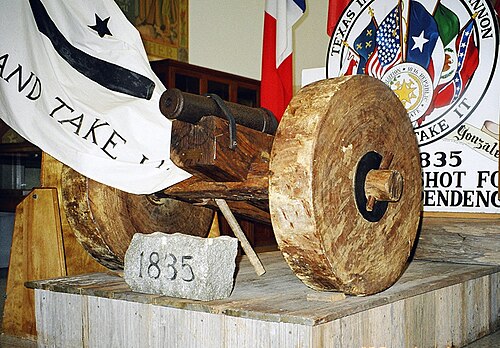
Reinforcements came. Volunteers under John Henry Moore and J. W. E. Wallace swelled the Texian ranks to somewhere between 140 and 160 men within a few days6,3. On September 28 or 29 they dug the cannon back out of its shallow grave, dragged it to John Sowell's blacksmith shop, and bolted it onto the fore-wheels of a cotton wagon belonging to Albert Martin, since there was no proper carriage and no proper ammunition either. They loaded it with chains and scrap iron1,3.
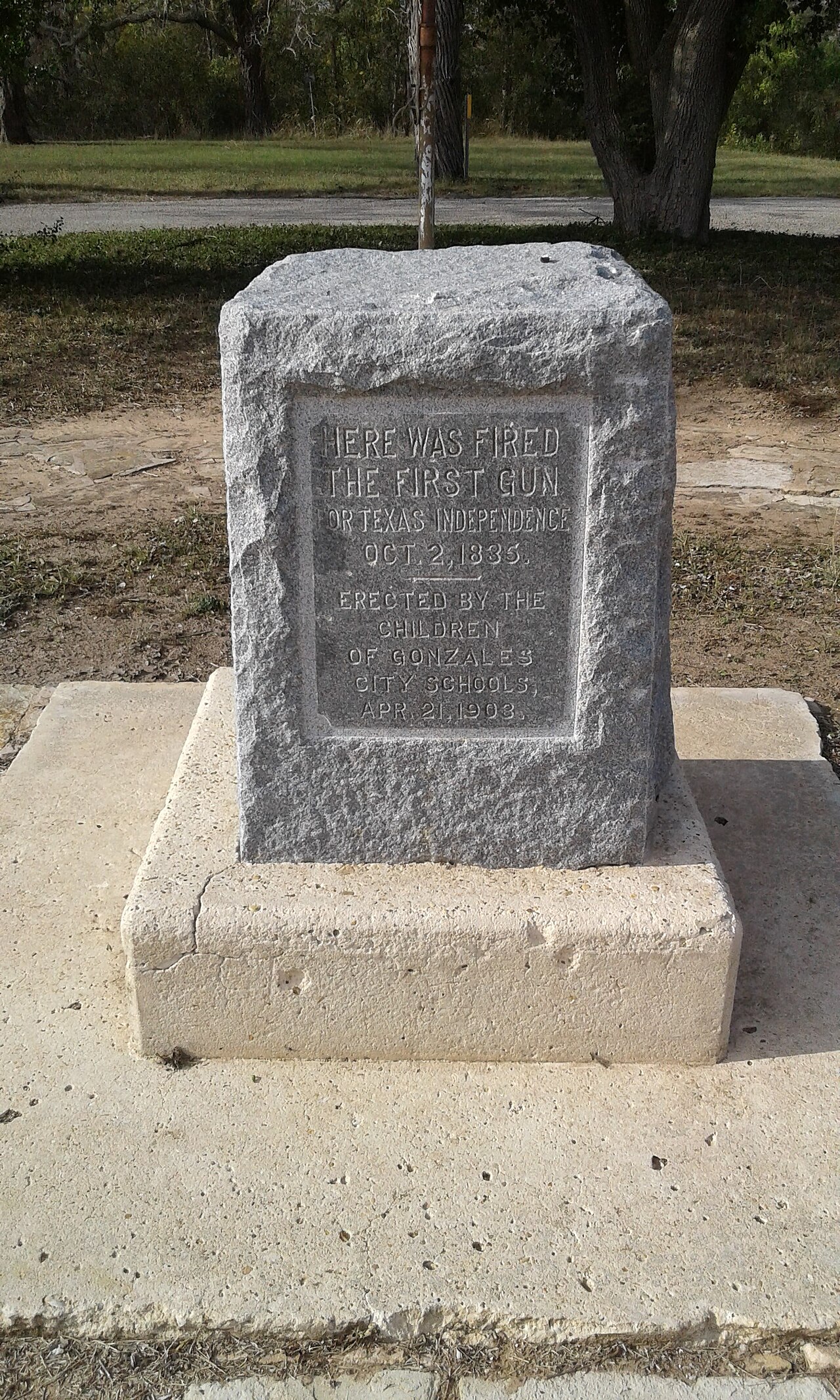
Before dawn on October 2, the Texians crossed the Guadalupe near present-day Cost, a few miles upriver from Gonzales, and found Castañeda's camp. Scouts traded shots and pulled back, drawing the Mexican cavalry into pursuit. Then the makeshift cannon fired, twice according to the Texas State Historical Association, and the Mexican force broke off and retreated toward Béxar1,4,3. Nobody on either side died in any numbers worth recording. It was, as the Texas Historical Commission's own marker puts it, a short, almost anticlimactic skirmish that nonetheless became known as the Lexington of Texas6,3.
A Flag Nobody Can Quite Agree On
The phrase and the image people now associate with that morning, a white flag bearing a black cannon, a lone star, and the words COME AND TAKE IT, almost certainly did not exist yet when the shooting happened. The Texas Historical Commission's affiliated handbook entry states that a committee of five officers designed and hastily prepared the flag in the days before the battle, with materials donated by the women of Gonzales2. The Texas Historical Commission's own blog, by contrast, says the flag was painted by the women of Gonzales after the battle, to commemorate it, and that Austin's volunteer army carried it toward Béxar afterward10.
Local and popular traditions complicate things further. A Gonzales visitors' account credits Sarah DeWitt and her daughter Evaline with making it; other sources name Caroline Zumwalt and Eveline DeWitt, or Sarah and Naomi DeWitt11,1,5. A persistent story holds that the white fabric came from a wedding dress, Naomi DeWitt's silk gown by one version, which is a charming detail that shows up again and again but has no firm contemporary documentation behind it1,12,5.
Whatever its exact origin, the flag did not last. It was carried with the cannon as Stephen F. Austin's volunteer army marched on San Antonio, and then, according to at least one member of that campaign, both the flag and the gun were simply abandoned along the way2,10. No verified original has surfaced since, though versions of the design have been sold and auctioned as purported fragments over the years13.
Which Cannon, Exactly?
The battle produced two cannons, not one, and that gets flattened in most retellings. Alongside the bronze six-pounder was a much smaller iron esmeril, a one-pound-or-less swivel gun of a type common in Spanish colonial Texas6,1. Historian Thomas Ricks Lindley's research, cited in secondary accounts, holds that both pieces were present at Gonzales6.
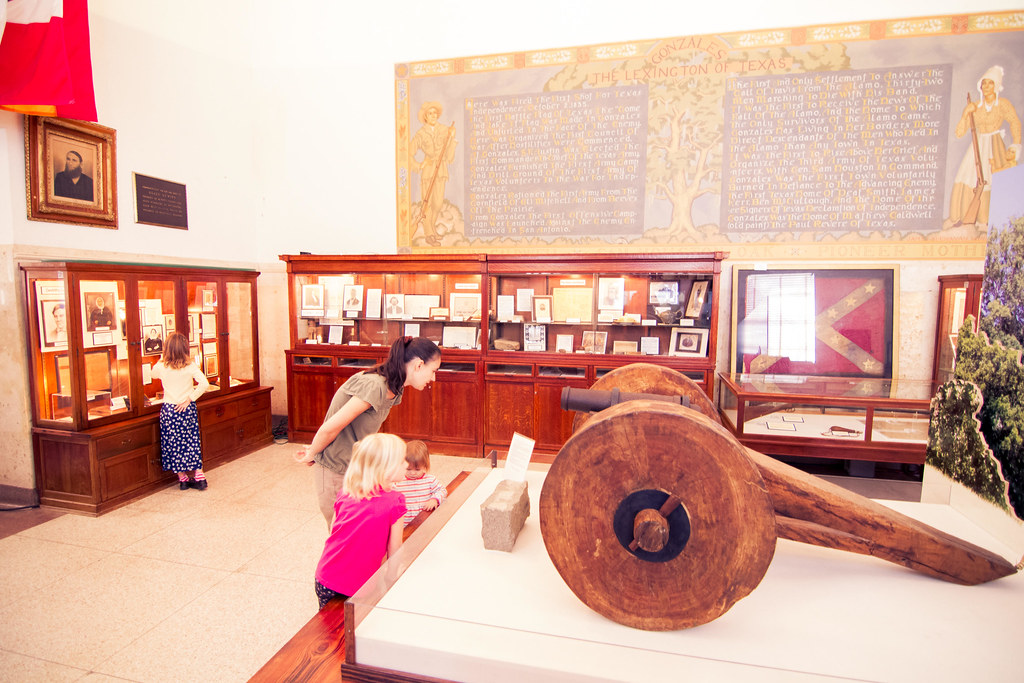
After the battle, the six-pounder went with the Texian army to the Siege of Béxar and was reportedly left at the Alamo, where it became one of twenty-one Mexican-captured artillery pieces when Santa Anna's army retook the fort in March 18362. One account traces a six-pounder from that haul being dug up in 1852, shipped to New York in 1874, and melted down into a church bell that still hangs in San Antonio6. A separate tradition says a different cannon, recovered from the Guadalupe River decades later, was identified as the original Gonzales gun and now sits in the Gonzales Memorial Museum7, a claim the city itself makes without qualification4,14.

The sources gathered here do not supply an unbroken chain of custody for either claim. The Texas Legislature has treated the matter as settled enough to matter politically: a 2015 resolution formally designated the Gonzales cannon as the official state gun of Texas15,16. Settled by statute is not the same as settled by evidence, and a storyteller retelling this is on solid ground saying plainly that nobody can prove which cannon, if any, now on display is the one that fired on October 2, 1835.
The Count
- 1831: year Mexican authorities loaned Gonzales the bronze six-pound cannon1,2
- 100 to 150: size of the Mexican dragoon force sent to retrieve it, depending on the source3,9
- 18: the "Old Eighteen" who initially stalled Castañeda's troops6
- 140 to 160: Texian volunteers gathered by the morning of the battle6,3
- October 2, 1835: date of the battle, the first land engagement of the Texas Revolution6,2,3
- 21: large Mexican-captured artillery pieces at the Alamo in March 1836, among them possibly the original Gonzales gun6,2
Why a Loaned Gun Became a Cause
The dispute landed at a combustible moment. Mexico's 1824 constitution had opened Texas to American settlers, and DeWitt's colony around Gonzales grew out of that opening, but by the early 1830s the government in Mexico City was tightening its grip: ending slavery with carve-outs for existing colonists, closing the border to new immigration, and swinging toward centralist rule under Santa Anna6,2. Earlier friction, including a soldier's assault on a Gonzales resident in September 1835, had already soured relations between the garrison and the town6.
Against that backdrop, a cannon that had sat quietly for four years stopped being a defense tool and became, as historian Stephen Hardin is quoted describing it, a point of honor and an unlikely rallying symbol6. The settlers' refusal to hand it over was not really about the gun's firepower, which Timothy Todish once dismissed as barely good for starting horse races6. It was about whether Mexico City or the colonists themselves would decide what happened next in Texas, a question the rest of the revolution, through the Alamo in early 1836 and the decisive Texian win at San Jacinto on April 21, 1836, would go on answering6.
Timeline
- 1831-01Green DeWitt requests a cannon from Mexican authorities for Gonzales's defense.
- 1831-03-10James Tumlinson Jr. receives the bronze six-pound cannon on behalf of Gonzales.
- 1835-09Colonel Domingo de Ugartechea demands the cannon's return; Gonzales refuses.
- 1835-09-29The cannon is buried in George W. Davis's peach orchard as Lieutenant Francisco de Castañeda's larger force approaches.
- 1835-10-02Texian volunteers under John Henry Moore fire the recovered cannon, and Castañeda's dragoons withdraw toward Béxar.
- 1835-12The cannon reportedly reaches San Antonio with the Texian army after the capture of Béxar.
- 1836-03-06Mexican forces retake the Alamo and seize its artillery, possibly including the Gonzales cannon.
Pictures


Sources
- The Complete Come and Take It Story for Visitorsdiscovergonzalestx.com
- The Gonzales Cannon: A Symbol of the Texas Revolutiontshaonline.org
- Details - Battle of Gonzales - Atlas Number 5177002221 - Atlas: Texas Historical Commissionatlas.thc.texas.gov
- Gonzales Memorial Museumgonzales.texas.gov
- The “Come and Take It” Flag Now Symbolizes Something It Never Stood ForTexas Monthly
- Battle of GonzalesWikipedia
- Gonzales' come and take it cannon. - Texas Escapestexasescapes.com
- Gonzales County: History, Geography, and EconomyTexas State Historical Association
- Salsa2DocProd 1..2legis.state.tx.us
- Flags of the Texas Revolution | Texas Historical Commissionthc.texas.gov
- Come and take itWikipedia
- Come and Take It, I Guess | Texas Standardtexasstandard.org
- For Sale: A Texan Symbol Of DefianceNPR
- EXPLOREgonzales.texas.gov
- https://capitol.texas.gov/tlodocs/89R/analysis/html/SC00022I.htmcapitol.texas.gov
- https://capitol.texas.gov/tlodocs/89R/analysis/html/SC00022F.htmcapitol.texas.gov
Researched and written by Lorelet from the sources above. It cites as it goes, but it can still get things wrong, so check the sources for anything that matters.
Report a problem
More featured lorelets
See all
Today · Culture
Live Forever: The Carnival Sword That Made a Writer
In 1932, a traveling sideshow magician tapped a 12-year-old boy with an electrified sword and shouted two words that Ray Bradbury spent the rest of h…
Today · History
The Real Jolly Roger: Rare Surviving Pirate Flags
Pop culture gives every pirate a crisp skull-and-crossbones banner. Reality left behind maybe two or three faded, bullet-scarred scraps of cloth, and…

Oct 1 · Film & TV
Why Nick Jr. Aired the Same Blue's Clues Episode All Week
A preschool show about a cartoon dog and her pawprints became a quiet experiment in how children actually learn from television, and the data said: r…