
Featured · Nov 5History
The Uranium Cubes in Heisenberg's Last Reactor
In a rock cellar under a Swabian castle church, American troops found Germany's last attempt at a nuclear reactor still hanging from its chains. How close it really came took eighty years to answer.
Listen
Read by Wren · 8 min
What They Found in the Cellar
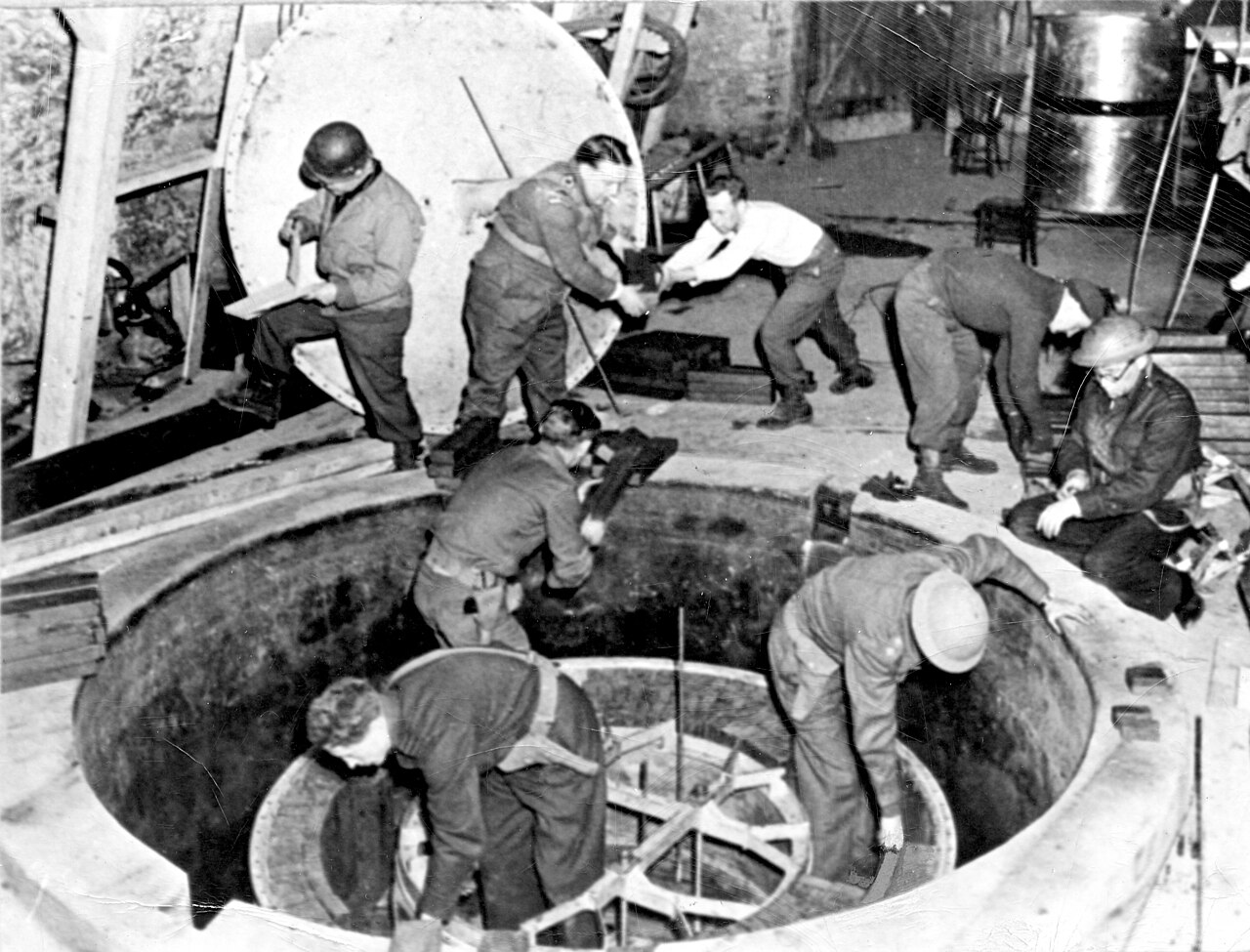
In April 1945, American troops and the scientist-soldiers of the Alsos Mission moved into the small Swabian town of Haigerloch, where German physicists had been working inside a rock cellar beneath a former castle church1,3. Inside was a cylindrical tank, its lid sealed, with chains disappearing down into roughly 1,400 liters of heavy water3,4. At the end of those chains hung 664 blocks of natural uranium, weighing some 2.5 kilograms, strung in alternating groups of eight and nine around five concentric rings3,9. The men who pulled it apart were looking at the last and largest reactor experiment Nazi Germany ever built1,3.
It looked, to many who studied it afterward, like it might have been close to working4. For decades that was more or less the official story, repeated by the man who built it.
The cubes were not bomb parts. They were reactor fuel, meant to sustain a controlled chain reaction inside a moderator, heavy water, that slows neutrons enough to keep fission going3. The idea traced back to December 1938, when chemists Otto Hahn and Fritz Strassmann detected fission in Berlin, and Lise Meitner and Otto Frisch, working from exile, worked out what it meant1,10. Germany organized its wartime nuclear effort within months, under the awkward collective name Uranverein, the Uranium Club, splintering almost immediately into competing institutes run by Werner Heisenberg, Kurt Diebner, Walther Gerlach, and others who rarely cooperated1.
The program's single worst vulnerability was heavy water. Unlike the Americans, who eventually found graphite pure enough to moderate a reactor, German physicists distrusted graphite and built their entire program around heavy water produced almost exclusively at Vemork in occupied Norway11. Repeated sabotage and bombing of that plant, along with chronic shortages of uranium, scientists, and industrial capacity, meant Germany never assembled enough of either material for a full-scale reactor, let alone a bomb2,11.

After the war, Heisenberg gave the world its working explanation for why Haigerloch had failed. Writing in Nature in 1947, he said the pile had been 'just insufficient,' short only a relatively small amount of uranium from achieving a self-sustaining reaction5. That line, repeated in interviews and books for decades, cast the German program as a near miss, stopped by bad luck and bad timing rather than by a wide material gap8.
A 2026 nuclear archaeology study, combining forensic analysis of surviving uranium and graphite with wartime records, came to a different number. Using a neutronics model validated against the Germans' own 1945 measurements, the researchers calculated the pile's effective multiplication factor at 0.94, well short of the 1.0 needed for self-sustaining fission5. To get there, they found, Germany would have needed roughly twice the uranium it had on hand and more than twice the heavy water, quantities that exceeded the country's entire wartime inventory, not just what happened to be sitting in the Haigerloch cellar4,5.
The aftermath played out far from Haigerloch. Ten members of the Uranverein, Heisenberg among them, were interned by the British that summer at Farm Hall, a bugged country house, where he reacted to the news of Hiroshima by insisting no one could have had enough uranium to build such a bomb, a judgment that only highlighted how far off his own wartime estimate of the material needed, often cited at around 13,000 kilograms of U-235, had been from the real figure10,12,7. What the Alsos men carried out of that rock cellar in April 1945 was not a bomb program on the verge of success. It was an experiment that, by the clearest measurement anyone has since been able to make, had a long way left to go4,5.
From Fission to a Fractured Program
The science came first and came fast. Hahn and Strassmann's late-1938 discovery of fission, interpreted within weeks by Meitner and Frisch, made clear that splitting a uranium nucleus released enormous energy, and that the energy could in principle power either a controlled reactor or an uncontrolled explosion1,10.
Germany's response was organized but never unified. A first Uranverein formed in April 1939, dissolved around the invasion of Poland, and was promptly replaced by a second effort run through the army's ordnance office starting that September1. From there the work split into three separate lanes, reactor design, uranium and heavy-water production, and isotope separation, spread across nine institutes whose directors largely set their own priorities1. Historian Mark Walker's verdict, that the program became 'frozen at the laboratory level' with the modest goal of sustaining any chain reaction at all, captures how far ambitions had shrunk by the war's final years1.
In January 1942, the army handed the project to the civilian Reich Research Council while continuing to fund it, a bureaucratic shuffle that reflected the military's conclusion that fission would not meaningfully affect the war's outcome1. Scientists kept drifting off to more urgent wartime work, and by the time the survivors regrouped in Haigerloch, the program was a shadow of what its early momentum had promised1,11.
Who Was Involved
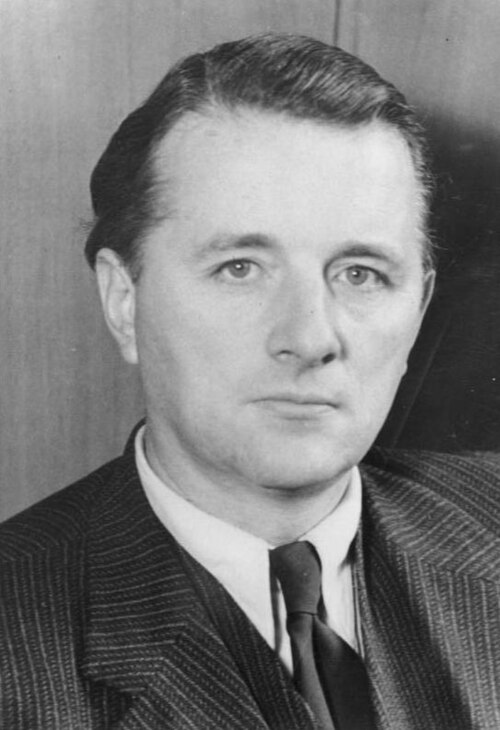
- Werner Heisenberg: Nobel laureate physicist and the program's most visible scientific figure, who led reactor work and later authored the influential, and disputed, account of why Germany failed13,5.
- Kurt Diebner: Army ordnance adviser who ran competing research stations and, according to some historians, held more real control over the project than Heisenberg did1.
- Carl Friedrich von Weizsäcker: Physicist who in 1940 reported to army ordnance on using transuranic elements, including what would become plutonium, for nuclear explosives7.
- Otto Hahn and Fritz Strassmann: Berlin chemists whose December 1938 experiments first revealed nuclear fission1.
- Lise Meitner and Otto Frisch: Physicists in exile who supplied the theoretical interpretation of fission and named it1,10.
- Paul Harteck: Physical chemist and army ordnance adviser who co-signed one of the earliest letters urging military interest in uranium1.
- The Alsos Mission: Allied intelligence operation tasked with locating German nuclear sites, materials, and personnel as the war ended1.
The Pile, by the Numbers
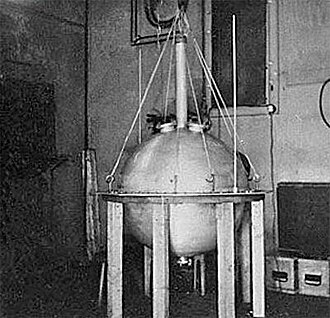
- 664 natural-uranium cubes made up the core of the B-VIII reactor at Haigerloch3,4.
- Each cube measured about 5 centimeters per side and weighed roughly 2.5 kilograms3,9.
- The cubes hung in alternating chains of eight and nine, arranged in five concentric rings3.
- The core sat in a tank about 61.7 centimeters in radius and 124 centimeters high, immersed in roughly 1,400 liters of heavy water3.
- The 2026 reassessment put the pile's effective multiplication factor at 0.94, versus the 1.0 needed for a self-sustaining reaction5.
- To reach criticality, the design would have needed about twice the uranium and more than 2.2 times the heavy water Germany actually had on hand4,5.
- Heisenberg's wartime estimate of the uranium-235 needed for a bomb ran to roughly 13,000 kilograms, far above the actual requirement of 15 to 60 kilograms10,12.
What's Still Argued Over
The biggest dispute is not about the physics but about Heisenberg's intentions. He and his defenders later suggested German physicists quietly steered the project away from a bomb on moral grounds, telling Albert Speer a weapon could not be finished in wartime8,14. Other historians, including Paul Lawrence Rose, argue this is far too forgiving: Heisenberg tried hard to interest the regime in weapons work before 1943 and only reframed his role after the fact7.
A related argument concerns competence versus conscience. Some scholars hold that Heisenberg's own miscalculation of the critical mass needed for a bomb, off by roughly two orders of magnitude, did more to doom the project than any scruple6,10,12. The transcripts from the bugged Farm Hall house, declassified only in 1992, are often cited as evidence that Heisenberg was genuinely startled by Hiroshima rather than quietly vindicated12.
Finally, how 'close' Haigerloch came remains contested in degree, if not in direction. Heisenberg's own 1947 account described the pile as 'just insufficient'5, and a 2009 neutronics study estimated a measured multiplication factor of 6.7 consistent with the Germans' own readings15,16. The 2026 nuclear archaeology paper does not dispute that neutron multiplication was observed, but it concludes the gap to actual criticality was roughly double what earlier accounts implied4,5.
Timeline
- December 1938Otto Hahn and Fritz Strassmann detect nuclear fission in Berlin1.
- April 1939A first Uranverein research group forms in Germany1.
- September 1939A second, army-run Uranverein begins the day Germany invades Poland1.
- 1940Carl Friedrich von Weizsäcker reports on using transuranic elements for nuclear explosives7.
- January 1942The army hands the nuclear program to the civilian Reich Research Council1.
- February to April 1945The B-VIII reactor is built and tested in the Haigerloch rock cellar3,15.
- April 1945American forces and the Alsos Mission seize the Haigerloch reactor and its scientists1,2.
- July 1945German physicists, including Heisenberg, are interned at the bugged Farm Hall estate in Britain10.
- 1947Heisenberg publishes his account in Nature describing the pile as 'just insufficient'5.
- 2026A nuclear archaeology reassessment finds the pile needed roughly twice the uranium and heavy water it had4,5.
Pictures



Sources
- German nuclear program during World War IIWikipedia
- Why the Germans Failed to Develop an Atomic Bomb Is Now Revealed in Two ReportsThe New York Times
- Nuclear archaeology reassesses Heisenberg’s last reactor experimentacademic.oup.com
- Uranium Cubes and Wartime Records Show Nazi Germany's Last ...natureworldnews.com
- Nuclear archaeology reassesses Heisenberg's last reactor experiment.Scholarly work · 2026
- Getting even with Heisenbergthphys.uni-heidelberg.de
- The Nazis and the Atom Bomb: An Exchange | Thomas Powers, Jeremy Bernstein, Paul Lawrence Rosenybooks.com · 1991
- NAZIS SPURNED IDEA OF AN ATOMIC BOMB; Dr. Heisenberg Says Germans' Research Was Far Advanced but Lacked Hitler SupportThe New York Times
- Heisenberg cubes, master key to nuclear forensic analysis -revistanuclear.es
- German Nuclear Program Before and During World War IIlarge.stanford.edu
- German Atomic Bomb Project - Nuclear Museumahf.nuclearmuseum.org
- Germany and the Atom Bombengines.egr.uh.edu
- Werner HeisenbergWikipedia
- The Private Heisenberg and the Absent Bomb | Thomas Powersnybooks.com · 2016
- A Neutronics Study of the 1945 Haigerloch B-VIII Nuclear Reactor - Physics in PerspectiveSpringerLink · 2009
- A Neutronics Study of the 1945 Haigerloch B-VIII Nuclear Reactor - Physics in PerspectiveSpringerLink · 2009
- New Neutronics Analysis of Heisenberg’s B-VIII Reactor with ...trtr.org
Researched and written by Lorelet from the sources above. It cites as it goes, but it can still get things wrong, so check the sources for anything that matters.
Report a problem
More featured lorelets
See all
Today · Food
The Turkey Surplus That Became the TV Dinner
A company drowning in frozen birds found an answer on an airline food cart, or so the story goes for fifty years.

Today · Space
Why Is Jupiter's Great Red Spot Actually Red?
Jupiter is built almost entirely of colorless gas, yet its most famous storm glows orange-red. Scientists have spent decades in the lab trying to fig…

Today · Art & Design
The Aztec Labret Whose Golden Tongue Still Moves
A small gold serpent made for a pierced lip somehow ended up with a tongue that flicks side to side. No one alive has ever seen it worn.