
Featured · Nov 11History
The Snack Kiosk at the Edge of West German Power
For nearly fifty years, a tiny oval pavilion sold sausages and newspapers steps from the Bundestag. Chancellors queued there too.

Listen
Read by Finch · 8 min
A Trailer at 2 A.M.
At around two in the morning on Sunday, 17 May 2020, a heavy transport crew began work at the Baumann company's building yard in Hersel, loading a small oval pavilion onto a flatbed trailer6. An advance team drove ahead of it, taking down road signs and lamps so the truck could clear the route at little more than walking pace along the roughly twelve kilometers back toward Bonn's former government district6. At four in the morning, the trailer passed the bronze bust of Konrad Adenauer, who had been a customer at the kiosk during his lifetime6. By six, a crane was lifting the structure onto a freshly prepared foundation at the corner of Heussallee and Platz der Vereinten Nationen8.
It is an unusual amount of care for a 20-square-metre snack stand3. But this particular snack stand had spent nearly five decades parked between the offices of a government deciding how West Germany would conduct itself through the Cold War, and that proximity had made it something more than a place to buy a bread roll2.
The business began modestly. Shortly after the Federal Republic was founded in 1949, Christel Rausch's mother started selling goods from a fruit cart in Bonn's newly developing government quarter, later moving to a wooden stall and then a mobile trailer1,3. In 1957 she was permitted to build something permanent: an oval, kidney-shaped pavilion in the rounded style of the decade, with a tiled base, a wide canopy, and glass on every side1. It stood diagonally opposite the Bundesrat entrance, close to the Bundestag's main door and the road leading to the Chancellery1,2.

For the next forty-two years, that location did the work. Politicians, parliamentary staff, diplomats, and journalists stopped there for newspapers, cigarettes, coffee, ice cream, and sausages on their way between buildings that otherwise demanded appointments and credentials2,3. Jürgen Rausch, who took over the kiosk from his family in 1984, later said everyone came to him, 'from the Stadtstreicher to the Bundeskanzler,' from the local vagrant to the chancellor3. Joschka Fischer reportedly bought sixteen newspapers there most mornings, from Bild to the Frankfurter Allgemeine, and later a fitness magazine once he started jogging, though what he came back for every time, Rausch recalled, was the newest Asterix comic3. Hans-Dietrich Genscher is said to have picked up gummy bears before business trips4.
What the record supports is narrower than the legend that grew around the place. The kiosk was not a backchannel for treaties or a site of recorded cabinet decisions. What the Weg der Demokratie project and others document is something more modest and, in its way, more telling: a reliable spot for casual encounters, short conversations, and unofficial contact among people who, inside their own buildings, mostly spoke to each other through staff and protocol2. Norbert Blüm put it in terms of what it did to the temperature of politics rather than its substance, saying it served to take the tension out of political combat, since members who had just argued in the plenary chamber would stand together moments later waiting for gummy bears3. That, more than any secret deal, was the kiosk's actual function: it kept Bonn's politics walkable, human-sized, and within earshot of a sausage grill.
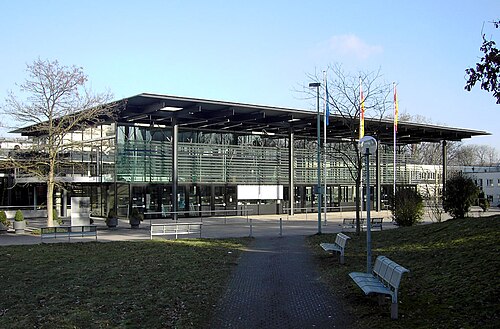
The arrangement ended with the Bundestag's move to Berlin in 1999, after which the kiosk lost its old clientele almost overnight2,3. Rausch considered following, and had even secured permission from a Berlin district mayor to relocate, but his family wanted to stay on the Rhine3. In 2006, construction of the World Conference Center Bonn put the pavilion in the way outright, and it was dismantled rather than demolished, then stored at a haulage yard in Hersel for the next fourteen years1,5,6.
The restored Bundesbüdchen reopened to the public on 21 August 2020, near enough to its old spot that regulars could still find it6,7. The early-morning convoy that brought it there three months earlier had carried, in effect, Bonn's old habit of running its politics past a snack counter, back into view of the buildings it had once served6.
By the Numbers
- 1949: Christel Rausch's mother begins selling from a fruit cart in Bonn's new government district1,3
- 1957: The permanent pavilion is built, about 20 square metres in size1,3
- 1957-1999: The kiosk operates beside the Bundestag, Bundesrat, and Chancellery during the Bonn Republic2
- 1999: Government and parliament relocate to Berlin2,9
- 2006: The kiosk is dismantled for the World Conference Center Bonn and moved to storage in Hersel5,6
- 14 years: Length of time the kiosk spent in storage6
- 17 May 2020: The kiosk is transported back to Bonn's former government quarter6,8
- 21 August 2020: The restored Bundesbüdchen reopens to the public6,7
Who's Who
- Christel Rausch: Began the family business with a fruit cart in 1949; later built the permanent pavilion in 19571,3.
- Jürgen Rausch: Took over the kiosk in 1984 and ran it through the move to Berlin, the 2006 demolition, and efforts to rebuild it1,3.
- Helmut Kohl: West German chancellor said to have eaten boiled sausages at the kiosk1.
- Norbert Blüm: Former labor minister who described the kiosk as emblematic of an unpretentious Bonn1,3.
- Joschka Fischer: Bundestag member and later foreign minister, a regular customer for newspapers and comics4,3.
- Hans-Dietrich Genscher: Vice chancellor said to have bought gummy bears before trips4.
- Konrad Adenauer: First West German chancellor, described as a guest at the kiosk during his lifetime6.
Legend Versus Record
The claim that the Bundesbüdchen functioned as a literal nerve center of West German statecraft, where decisions were made, is not supported by the available sources. What is documented is its role as an informal gathering spot near the seat of government, used for casual and unofficial contact2,10.
Anecdotes about specific politicians, such as Fischer's newspaper order or Genscher's gummy bears, come from the kiosk's own promotional materials and a tourism-focused reference site, not from contemporaneous reporting with dates or verification4,3. They should be treated as oral tradition attached to the place rather than confirmed fact.
No source in this research establishes a specific negotiation, treaty discussion, or parliamentary decision that took place at the kiosk itself.
Timeline
- 1949Christel Rausch's mother begins selling from a fruit cart in Bonn's developing government district.
- 1957The permanent Bundesbüdchen pavilion is built near the Bundestag, Bundesrat, and Chancellery.
- 1999The German government and parliament relocate from Bonn to Berlin.
- 2006The kiosk is dismantled for construction of the World Conference Center Bonn and placed in storage.
- 2020-05-17The kiosk is transported overnight back to Bonn's former government quarter.
- 2020-08-21The restored Bundesbüdchen reopens to the public.
Pictures


Sources
- Bundesbüdchen | Historybundesbuedchen.de
- Bundesbüdchen - Weg der Demokratiewegderdemokratie.de
- Retro: Bonner Bundesbüdchen ist wieder dadw.com · 2020
- Bundesbüdchen in BonnAtlas Obscura
- From Past to Presentworldccbonn.com
- Bundesbüdchen | Special Momentsbundesbuedchen.de
- Bundesbüdchen |bundesbuedchen.de
- Bundesbüdchen | Archiv englishbundesbuedchen.de
- The Bundesbüdchen: a cult kioskbonn-greeters.org
- enwegderdemokratie.de
Researched and written by Lorelet from the sources above. It cites as it goes, but it can still get things wrong, so check the sources for anything that matters.
Report a problem
More featured lorelets
See all
Today · Food
The Turkey Surplus That Became the TV Dinner
A company drowning in frozen birds found an answer on an airline food cart, or so the story goes for fifty years.

Today · Space
Why Is Jupiter's Great Red Spot Actually Red?
Jupiter is built almost entirely of colorless gas, yet its most famous storm glows orange-red. Scientists have spent decades in the lab trying to fig…

Today · Art & Design
The Aztec Labret Whose Golden Tongue Still Moves
A small gold serpent made for a pierced lip somehow ended up with a tongue that flicks side to side. No one alive has ever seen it worn.