Featured · TodaySports
222-0: John Heisman's Grudge Match
A disputed 22-0 baseball loss sent Georgia Tech's coach looking for payback, and he found it by burying a makeshift Cumberland team under the most lopsided score in college football history.
Listen
Read by Finch · 5 min
A Score Nobody Could Believe
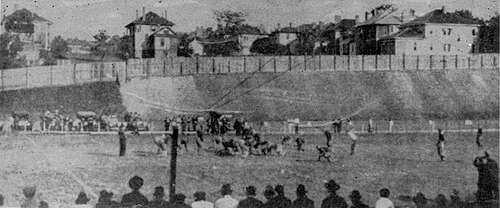
By the time the fourth quarter ended at Grant Field on October 7, 1916, the scoreboard read Georgia Tech 222, Cumberland 0. It remains the most lopsided result and the highest single-team score in major college football history1,2.
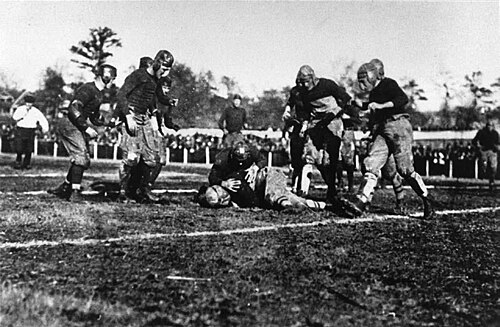
The game did not start as a rout so much as a demolition. Cumberland received the opening kickoff, failed to gain a yard, and punted. Georgia Tech scored on the very next play. Cumberland fumbled on its following possession, and Georgia Tech returned the fumble for another touchdown. Then Cumberland fumbled again1. By the end of the first quarter, Georgia Tech led 63-06.

The halftime score was 126-0, and coach John Heisman, who was also Georgia Tech's baseball coach, reportedly told his players to keep hitting hard because Cumberland "may spring a surprise"6,1. There was no surprise. Georgia Tech added 54 points in the third quarter and 42 in the fourth, finishing with 32 touchdowns and not a single forward pass attempted all game6. Cumberland's quarterback, Charles Edwards, was carried off the field with concussions three times1.
What made the score possible, beyond the mismatch itself, was the rules of the day. Georgia Tech kept recovering its own onside kicks after touchdowns, letting it retain possession again and again rather than kicking off conventionally6,1. Cumberland finished with negative yardage and no first downs, a detail repeated so often it has become the game's signature line1,6.
A Baseball Grudge Behind the Blowout
The usual explanation for why Heisman wanted this game so badly traces back to the spring before, when Cumberland's baseball team beat Georgia Tech's 22-0. Sources differ on whether that happened in 1915 or 1916, but the number, 22-0, is consistent2,8,9.
Heisman, who coached both sports at Georgia Tech, believed Cumberland had stacked its baseball lineup with semiprofessional players recruited out of Nashville and passed them off as students2,3. That accusation is widely repeated in later retellings, but the available sources describe it as Heisman's allegation rather than a formally proven case of ineligible players2,7,9. True or not, it stung enough that commentators ever since have treated the football rematch as calculated payback, down to speculation that Heisman aimed for exactly 222 points as a jab at Cumberland's 221.
Cumberland, meanwhile, had already discontinued its football program before the 1916 season, a fact it apparently neglected to pass along to Georgia Tech in time2,4,3. Because the game was still on the contracted schedule, Georgia Tech could demand Cumberland show up or pay a reported $3,000 forfeiture fee, a sum that one historian told The Tennessean could have closed the financially strapped school outright3. Heisman also sent Cumberland a letter offering $500 and a paid trip to Atlanta if the team honored the contract, legal threat tucked neatly inside a tempting offer10,3.
Who Showed Up
- John Heisman: Georgia Tech's head coach of football and baseball, who insisted Cumberland fulfill its contract and later became the namesake of the Heisman Trophy11,2.
- George E. Allen: Cumberland's student manager, tasked with scraping together a team after the school had already dropped football; he later became a political operative advising presidents from Franklin Roosevelt to Eisenhower4,12.
- Cumberland's roster: Roughly 13 students, mostly fraternity brothers and law students, some with little or no football experience; accounts vary on the exact number, with some citing up to 194,3,5.
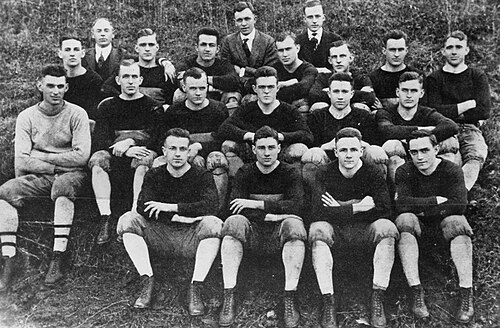
- Georgia Tech's team: A fully fielded, well-drilled varsity squad executing Heisman's offense without ever throwing a pass2,6.
The Damage, By the Numbers
- Final score: Georgia Tech 222, Cumberland 01,2.
- Quarter-by-quarter: 63-0, 63-0 (126-0 at half), 54-0, 42-06.
- 32 touchdowns scored, with no forward passes attempted6.
- Cumberland recorded zero first downs and finished with negative total yardage1,12.
- Third and fourth quarters were shortened from 15 minutes to 12 at Heisman's agreement1,13.
- Cumberland's roster numbered around 13 players, assembled days before the game4,5.
What's Fuzzy in the Legend
Several details repeated in nearly every retelling turn out to be softer than they sound. The date of the baseball loss shifts between 1915 and 1916 depending on the source2,8,7,9. The claim that Cumberland used paid "ringers" in that baseball game is widely stated as fact in popular writeups, but the underlying sourcing presents it as an accusation rather than a documented finding2,7,9.
The financial terms also get told differently: some accounts stress the $3,000 forfeiture threat, others the $500 payment, and some mention Georgia Tech covering travel costs too. These may describe different pieces of the same deal rather than contradicting each other2,10,6.
Finally, there's the popular claim that the 222-0 loss effectively saved Cumberland financially, thanks to the payment and publicity. That is a retrospective interpretation offered by some later accounts, not an established single-cause explanation for the school's survival7,5.
Timeline
- 1915 or spring 1916Cumberland's baseball team beats Georgia Tech's baseball team 22-0; Heisman later alleges Cumberland used professional ringers.
- Before fall 1916Cumberland discontinues its football program but remains contractually scheduled to play Georgia Tech.
- 1916Heisman threatens a $3,000 forfeiture fee and offers Cumberland $500 plus travel expenses to honor the game.
- October 7, 1916Georgia Tech defeats a hastily assembled Cumberland squad 222-0 at Grant Field in Atlanta, the most lopsided score in major college football history.
Pictures



Sources
- 1916 Cumberland vs. Georgia Tech football gameWikipedia
- Georgia Tech 222, Cumberland 0: College football's ...ncaa.com
- 222-0: The Worst Blowout in College Football Historymentalfloss.com · 2018
- In 1916, Georgia Tech Beat Cumberland College, 222 to 0Smithsonian Magazine · 2013
- Revisiting Georgia Tech 222, Cumberland 0 and how it may have saved the schoolcbssports.com
- ESPN Classic - Oct. 7, 1916: Heisman's Catch-222espn.com
- Why losing 222-0 kept Cumberland University open 100 years agotennessean.com
- Today in History—October 7: The Most Lopsided Score in College FootballBritannica
- Georgia Tech 222, Cumberland 0 happened 100 years agofoxsports.com
- Georgia Tech 222, Cumberland College 0 | History, weird factsncaa.com
- John HeismanWikipedia
- Warm up for the big game by reading about the biggest blowout in football historyavclub.com · 2021
- In 1916, a Blowout for the AgesThe New York Times
Researched and written by Lorelet from the sources above. It cites as it goes, but it can still get things wrong, so check the sources for anything that matters.
Report a problem
More featured lorelets
See all
Today · History
Operation Breakthrough: When the Cold War Thawed for Three Whales
In October 1988, a hunter's chance discovery near Point Barrow turned into a 20-day international scramble that put Soviet icebreakers, Greenpeace vo…

Today · Science
IceCube: Turning Antarctic Ice into a Telescope
To catch particles that pass through planets like they're not there, physicists buried thousands of light sensors a mile and a half beneath the South…

Oct 6 · Technology
ChatGPT Started Forging New Yorker Cartoonists' Signatures
When an AI model began signing fake New Yorker cartoons with real cartoonists' names, it turned a style-imitation problem into something that felt, t…