Featured · Sep 29Crime
The Man Who Flooded Missouri to Ditch His Wife
In 1993, a levee near Quincy gave way and drowned 15,000 acres of farmland. Prosecutors said James Scott broke it so his wife couldn't come home from work.

Listen
Read by Finch · 7 min
The Night the River Got In
By mid-July 1993, the Mississippi River had already spent months breaking records across the Midwest, and the people of West Quincy, Missouri had been sandbagging the levee that stood between their homes and the water for days7. On the night of July 15 into July 16, with the river reportedly a foot and a half below the top of the levee, the structure gave way anyway3,1. Within hours, roughly 14,000 to 15,000 acres of farmland and town were underwater, more than 100 buildings were destroyed or damaged, and a gas station caught fire after a loose barge slammed into it during the flooding1,2.
The only bridge across the Mississippi for 200 miles in either direction was knocked out of service for 71 days, forcing people to drive 80 miles to St. Louis or Burlington, Iowa, or catch a ferry, just to cross a river that used to take five minutes3,8.
Among the people gathered at the levee that night was James Scott, a 23-year-old from Fowler, Illinois, who worked at a Burger King and had a habit of drinking hard and getting into trouble. He told a Quincy TV reporter, live, that he'd spotted a weak spot bubbling with "boils" and tried to reinforce it with extra sandbags before going for a drink and coming back to find the levee gone3,9. It was a good story. It just wasn't quite true.
A police sergeant named Neal Baker, who'd arrested Scott twice before for arson, thought Scott looked too clean for a man who'd supposedly spent the day hauling sandbags, and noticed he couldn't keep his account straight3. Investigators soon learned the levee had failed at one of its strongest, most recently inspected points, which only deepened their suspicion3.
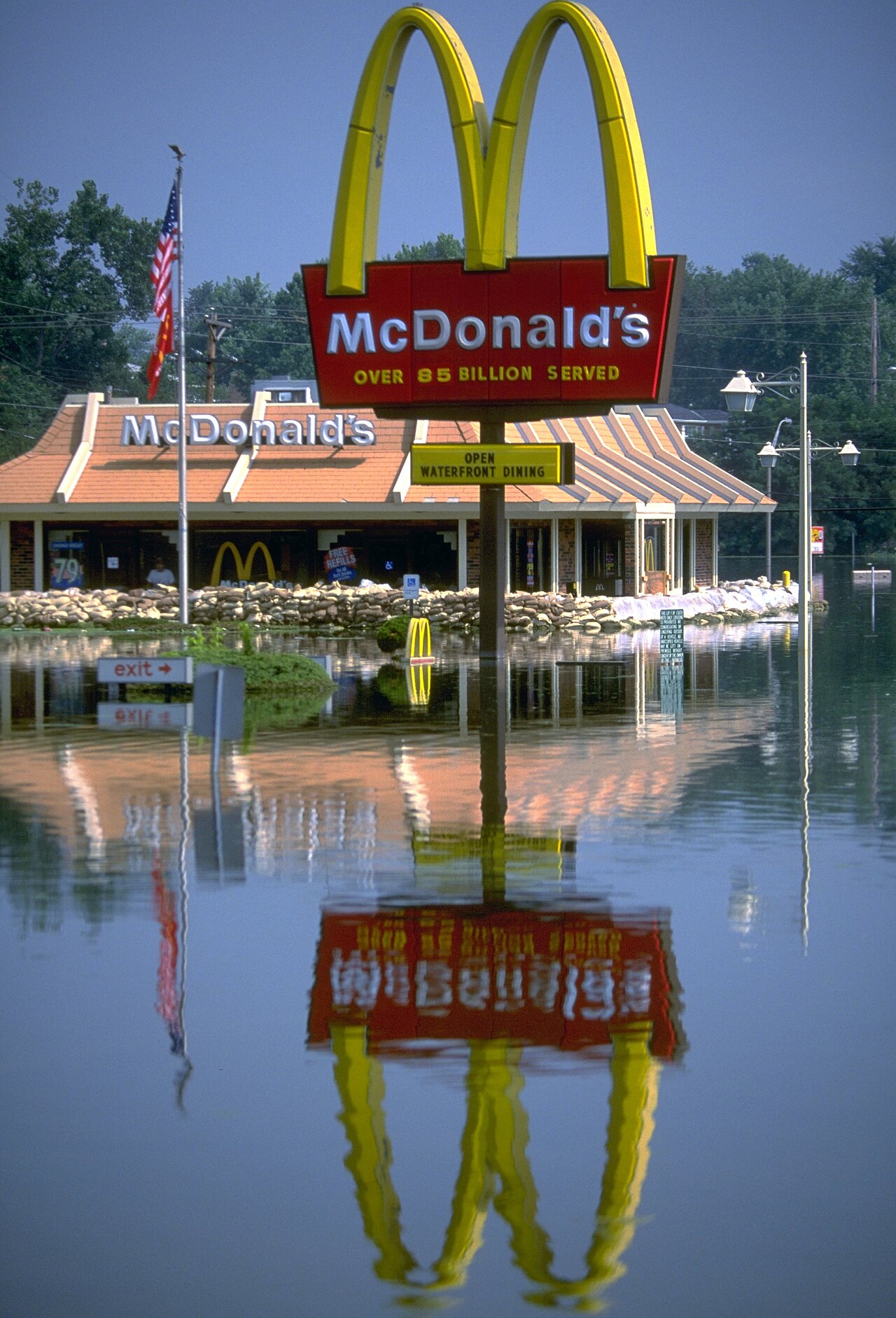
The break came on October 1, 1993, when Quincy police picked Scott up on an unrelated burglary charge. During questioning, he admitted he had pulled sandbags from one part of the levee and moved them to the spot he claimed was leaking, but denied trying to cause any harm: "I had no plans to hurt anything. They needed help, so I helped"3. He was arrested on a Missouri warrant, held on a million dollars bond, and charged with intentionally causing a catastrophe under a Missouri statute passed in 1979 that, as far as anyone could tell, had never actually been used to convict anyone10,5.
The case against him leaned heavily on Joe Flachs, an old friend, who told investigators Scott had confided that he'd broken the levee to strand his wife, Suzie, who worked as a waitress across the river in Taylor, Missouri, so he'd be free to party, fish, and see other women3,5. Other witnesses said Scott had bragged about it at a party after the flood3. Prosecutor John Jackson summed it up for the jury: "He said he was going to break the levee so he could strand his wife in Missouri … so he could have parties, so he could have affairs"4.
A jury in Kirksville convicted Scott of causing a catastrophe in November 1994 after just a few hours of deliberation, and he was sentenced to life in prison, to run consecutively with a 10-year Illinois sentence he'd already picked up for burglary3,2. It did not end there. In February 1997, the Missouri Court of Appeals threw out the conviction because prosecutors had withheld the existence of two witnesses from the defense3,1. Scott was retried in 1998, convicted again in about three hours, and the original life sentence was reinstated3.
Who's Who
- James R. Scott: born 1969, of Fowler, Illinois; convicted of intentionally breaking the West Quincy levee; maintained he was trying to help, not cause a flood3.
- Suzie Scott: James's wife, who worked at a truck stop across the river in Taylor, Missouri; prosecutors said she was the intended target of the plan3.
- Joe Flachs: friend of Scott's whose testimony that Scott described the plot became central to the prosecution's case3,5.
- John Jackson: prosecutor who argued the case and summarized the alleged motive for the jury4.
- Neal Baker: Quincy police sergeant who had arrested Scott for earlier arsons and grew suspicious of his account of the flood3.
- Norman Haerr: then-president of the Fabius River Drainage District and a major landowner affected by the flood; testified against Scott and later received an insurance payout tied to the flood being ruled deliberate, a financial interest he did not disclose at trial, according to a Vice News documentary3.
The Damage, By the Numbers
- 14,000–15,000 acres flooded when the levee gave way, depending on the source1,2,10.
- 100+ buildings destroyed or damaged, per the Missouri Court of Appeals1.
- 71 days the Quincy–West Quincy bridge, the only Mississippi crossing for 200 miles, stayed closed3,8.
- $1 million bond set when Scott was arrested in October 19939.
- Life sentence, consecutive to a 10-year Illinois burglary term3,1.
- 1979: the year Missouri's rarely-used "causing a catastrophe" statute was enacted, decades before Scott became its test case5.
What's Actually Proven
The case against Scott was built on testimony and his own shifting story, not on physical proof that he deliberately breached the levee. No one testified to seeing him remove sandbags with intent to flood the town; the prosecution's strongest evidence was what witnesses like Flachs said he'd told them afterward3,11.
The defense called two soil-science experts, David Hammer of the University of Missouri and Charles Morris of the University of Missouri-Rolla, who testified the levee likely failed from natural causes; Morris argued that a last-minute decision to bring in bulldozers actually weakened the structure3. A Corps of Engineers engineer, Dennis Gilmore, later said levees under that much hydraulic stress can fail without anyone's help12.
Journalist Adam Pitluk's 2007 book Damned to Eternity and a 2022 Vice News documentary both took a skeptical view of the conviction, and raised the undisclosed financial interest of witness Norman Haerr as a reason to doubt the verdict3. None of this overturned the conviction on appeal, and Scott was reconvicted in 1998. He has consistently denied intending to cause the flood3.
Timeline
- 1993-07-15/16The West Quincy levee fails overnight, flooding 14,000-15,000 acres and destroying scores of buildings.
- 1993-10-01James Scott is questioned about a burglary and implicates himself in the levee break; he is arrested on a Missouri warrant.
- 1994-11A jury in Kirksville convicts Scott of causing a catastrophe.
- 1994-12-05Scott is sentenced to life in prison, consecutive to a 10-year Illinois sentence.
- 1997-02-25The Missouri Court of Appeals overturns the conviction over withheld witness information.
- 1998-04-30Scott is retried and convicted again.
- 1998-07-06The life sentence is reinstated.
Pictures


Sources
- State v. Scottlaw.justia.com
- Saboteur of Levee Bent on Love Affairs Receives Life Termlatimes.com · 1994
- James Scott (criminal)Wikipedia
- MIDWEST MAN GUILTY OF SABOTAGING LEVEEdeseret.com
- Mississippi Levee Breaks: A Man's Life Changes Foreverweather.com
- Man convicted for breaking levee 25 years ago still serving prison timefox2now.com
- Great Flood of 1993Wikipedia
- Man gets life for sabotage that aided Midwest floodtampabay.com · 2005
- MAN CHARGED IN BREAK OF RIVER LEVEEThe Washington Post · 1993
- Man Charged With Flood's Levee Breaklatimes.com · 1993
- Missouri man convicted of ‘causing a catastrophe' seeks parole 33 years after floodky3.com
- Midwest Communities Remember Great Flood of 1993hmpgloballearningnetwork.com
- The Great USA Flood of 1993nwrfc.noaa.gov
- Man Convicted of Breaking Leveelatimes.com · 1998
Researched and written by Lorelet from the sources above. It cites as it goes, but it can still get things wrong, so check the sources for anything that matters.
Report a problem
More featured lorelets
See all
Today · Film & TV
Why Nick Jr. Aired the Same Blue's Clues Episode All Week
A preschool show about a cartoon dog and her pawprints became a quiet experiment in how children actually learn from television — and the data said:…
Today · Crime
Liquid Gold: The Black Market for Used Cooking Oil
Green energy policy turned restaurant fryer grease into a commodity worth stealing, and a quiet corner of American crime grew up around it.

Today · Business
The Terminal: How a Firing Built Wall Street's Addiction
Michael Bloomberg got pushed out of Salomon Brothers with a check for about $10 million. He turned it into a locked-box machine that trading floors s…