
Featured · Nov 9Technology
The Cap'n Crunch Whistle and the Hole in Ma Bell
A cereal box toy, a blind kid with perfect pitch, and two collaborators who thought a magazine article had to be a hoax, until they checked.
Listen
Read by Wren · 6 min
A Magazine Article Too Exact to Believe
Sometime after October 1971, Steve Wozniak and Steve Jobs went looking for proof at the Stanford Linear Accelerator Center library, pulling telephone engineering material off the shelves to check whether a magazine story about secret tones controlling the nation's phone network could possibly be real1,2. The article, Ron Rosenbaum's "Secrets of the Little Blue Box," described frequencies with a precision that struck them as too exact to be plausible without checking1,2.
The numbers held up. What the two of them found in the stacks matched what the article claimed: a tone at 2,600 cycles per second that the Bell System used internally to tell its switches a long-distance line was free1,3,2. But the full story behind that tone, and who actually found that a toy could produce it, was never quite as clean as the legend that followed them out of that library1,3.
The tone existed because of how AT&T's long-distance network was built. Signaling information, the clicks and pulses that told switches where to route a call, traveled over the same wires as the voices themselves, a design called in-band signaling4,5. A tone of 2,600 Hz told a trunk line that the previous call had ended and the circuit was free again. If a caller produced that same tone mid-call, the switching equipment could be fooled into thinking the line was idle while the caller's own connection stayed open, handing over kinds of long-distance control normally reserved for Bell's own equipment5,3.
Joe Engressia, a blind phone enthusiast who later took the name Joybubbles, is usually credited with finding this out first, as a child, sometime around 19576. One account holds that he discovered it almost by accident: imitating a sound during an ordinary long-distance call, he happened to produce the right pitch and heard the call drop from the network's side while his own line stayed open7. He had something close to perfect pitch, and he and a circle of mostly blind friends began gathering at clusters of payphones, playing tones into the receivers to explore a phone system most people never thought about beyond dialing it8,5.
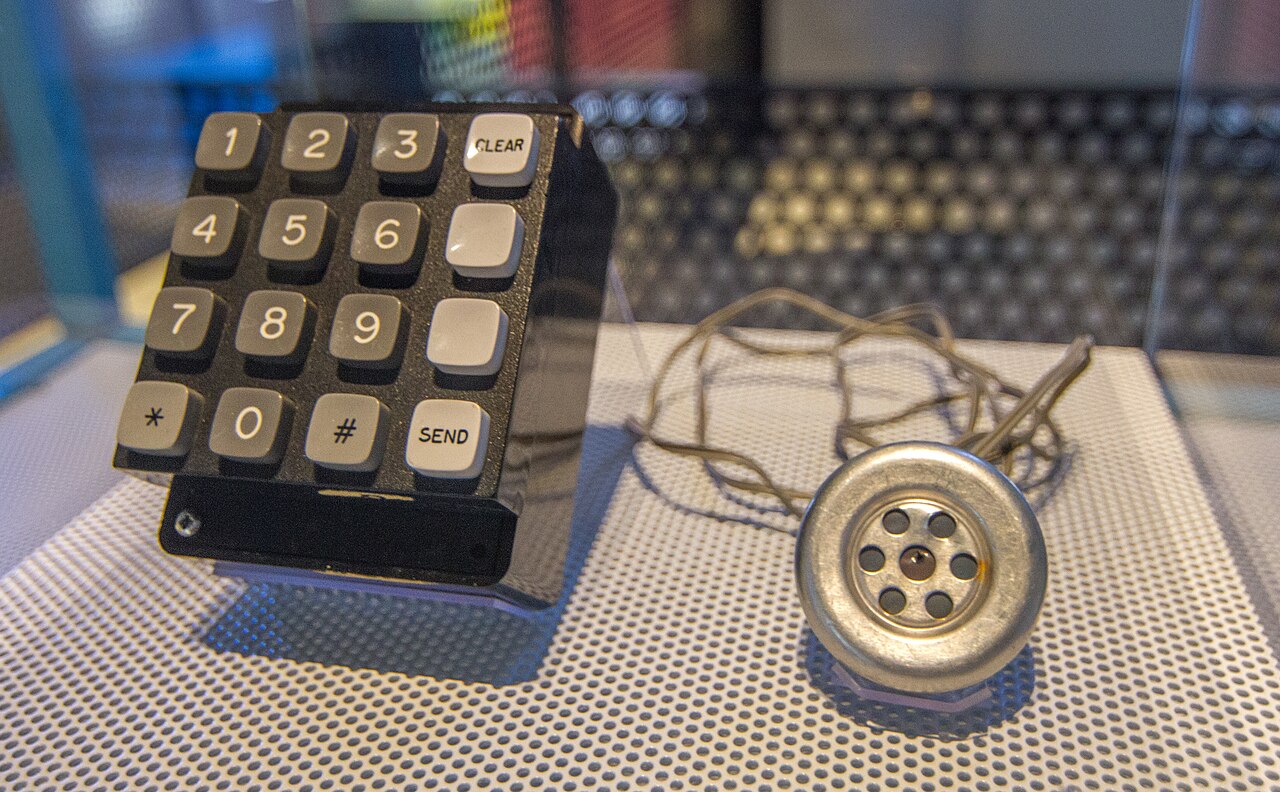
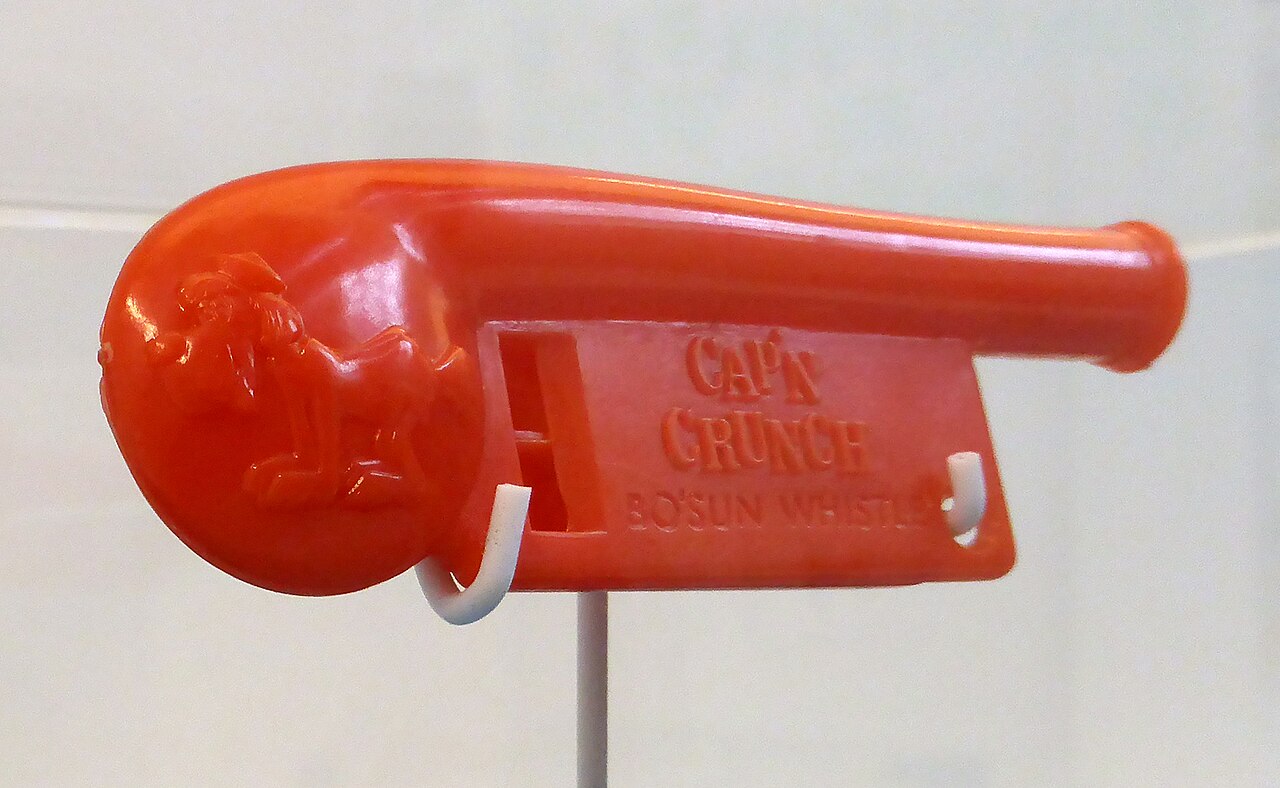
John Draper came into this world in 1969, introduced by a fellow pirate-radio broadcaster named Denny Teresi, himself a blind teenager connected to Engressia's circle8. Teresi told Draper about the whistle: a toy packaged in boxes of Cap'n Crunch cereal in 1963 that happened to emit a 2,600 Hz tone when blown8. Draper, an Air Force veteran with real electronics training, was the one asked to build something sturdier than a toy, a tone generator the group began calling a blue box8.
Here the standard version of the story quietly parts from the most detailed account of it. Popular retellings, including much of the coverage that followed Rosenbaum's article, credit Draper himself with discovering that the cereal-box whistle produced the tone, which is where his nickname, Captain Crunch, came from8,3,9. But one detailed account traces the actual discovery to a Los Angeles-based phreak who used the pseudonym Sid Bernay, with Draper learning of it through Teresi rather than finding it himself8. Draper became the face of the whistle. He did not appear to be the first to blow it.

The Esquire piece that sent Wozniak and Jobs to that library ran in October 1971 and featured both Engressia and Draper prominently, turning a scattered, informal subculture into a nationally known phenomenon almost overnight4,10,11. Wozniak designed his own blue boxes after verifying the article's claims, and Jobs helped sell them to other students, an operation Jobs later described as foundational to how the two of them would later work together at Apple10,1,12.
Accounts of the partnership also include a run-in with police over one of the devices, though the sources disagree on the specifics, the sequence, and even the setting, and some of the more colorful details repeated online, such as a call placed to the Vatican while impersonating a US official, are not consistently documented and should be treated as retellings rather than verified fact1,2.
By the 1980s, AT&T and other carriers had largely replaced in-band signaling with out-of-band systems such as Signaling System 7, which separated control tones from voice paths and made the whistle, the blue box, and the whole technique obsolete4,13. Phreaking did not vanish so much as migrate: many of its techniques and much of its culture carried over directly into the earliest computer hacking, as phone lines became the way computers found each other4. The library trip that started this telling never gets mentioned in most short versions of the Apple origin story, but it is the moment the legend had to pass before the blue box business could begin2.
Timeline
- 1957 (approximate)Joe Engressia discovers that whistling a particular tone affects long-distance telephone calls.
- 1963Cap'n Crunch cereal begins including a toy bo'sun whistle that happens to produce a 2,600 Hz tone.
- 1969John Draper is introduced to phone phreaking by Denny Teresi and learns of the cereal-box whistle's effect.
- October 1971Esquire publishes Ron Rosenbaum's 'Secrets of the Little Blue Box,' exposing phreaking nationally.
- 1971-1972Steve Wozniak and Steve Jobs verify the article's claims at the Stanford Linear Accelerator Center library, then build and sell blue boxes.
- 1980sAT&T and other carriers adopt out-of-band signaling (SS7), closing the vulnerability the whistle exploited.
Pictures



Sources
- The Definitive Story of Steve Wozniak, Steve Jobs, and ...The Atlantic
- Founder Mode on X: "In 1971, Steve Wozniak’s mother mailed ...x.com
- Phreaking | Telecom Security, History & TechniquesBritannica
- PhreakingWikipedia
- Joe Engressia, Expert 'Phone Phreak,' DiesNPR · 2007
- Blog Archives - Justin Patrick Mooresothismedias.com
- Joybubbles, 58, Peter Pan of Phone Hackers, DiesThe New York Times
- John DraperWikipedia
- Captain Crunch sets up security firmtheregister.com
- ESPN Recounts Esquire's Role in Apple Origin Storyesquire.com
- How My 1971 Article Inspired Steve Jobs To Found Appleslate.com
- Steve Jobs Was Inspired By Article Titled 'Secrets Of The ...huffpost.com
- Blue box - WikipediaWikipedia
Researched and written by Lorelet from the sources above. It cites as it goes, but it can still get things wrong, so check the sources for anything that matters.
Report a problem
More featured lorelets
See all
Today · Food
The Turkey Surplus That Became the TV Dinner
A company drowning in frozen birds found an answer on an airline food cart, or so the story goes for fifty years.

Today · Space
Why Is Jupiter's Great Red Spot Actually Red?
Jupiter is built almost entirely of colorless gas, yet its most famous storm glows orange-red. Scientists have spent decades in the lab trying to fig…

Today · Art & Design
The Aztec Labret Whose Golden Tongue Still Moves
A small gold serpent made for a pierced lip somehow ended up with a tongue that flicks side to side. No one alive has ever seen it worn.