Featured · Sep 30Art & Design
Lost in Plain Sight: The Rediscovery of Church's The Icebergs
A monumental Arctic painting by America's most famous landscape artist spent decades hanging unrecognized in an English boys' home before selling for a record $2.5 million.

Listen
Read by Finch · 7 min
A Painting Vanishes on a Stairway Landing
In the spring of 1978, Mair Baulch was trying to raise a little money for the boys in her care. She ran Rose Hill, a converted mansion outside Manchester that the city used as a home for delinquent boys, and she had her eye on a derelict country house her charges could fix up as a clubhouse3. To pay for it, she thought about a huge, filthy painting she walked past nearly every day on a stairway landing — icebergs, dirty and unframed, tucked away where nobody much looked at it3.
Baulch had the painting taken down and went over it with a magnifying glass. Under a century of grime and yellowed varnish she found a tiny signature on a spur of ice: "F. E. Church 1861"3,2. It didn't take much digging to learn that Frederic Edwin Church had once been one of America's most celebrated painters, hugely popular in England around the time of the American Civil War3.

What Baulch had stumbled on was The Icebergs, a 5.4-by-9.4-foot Arctic seascape Church painted in 1861 after a sketching trip to Newfoundland and Labrador, made partly from a rowboat while seasick2,1. He'd ridden the era's fever for Arctic exploration — the search for Sir John Franklin's lost expedition was front-page news on both sides of the Atlantic — and the painting drew paying crowds in New York, Boston, and London2,1. Church later sold it in England to Sir Edward William Watkin, a railway tycoon who hung it at his house, Rose Hill1,6. After Watkin's death in 1901, the painting simply dropped out of art-world memory, even as galleries in New York quietly went looking for it decades later1,2.
Baulch's inquiry — a letter to the Art Institute of Chicago, a museum she'd once visited — kicked off what one contemporary account called "an art-world circus of rumor, pursuit, and clandestine wheeling and dealing"3. A Manchester dealer named Arthur Watkins was brought in to look at the canvas, and a photograph eventually made its way to Sotheby's in London7,6. Grete Meilman, an American specialist with Sotheby's New York, flew over to inspect it in person and confirmed it was the real thing6. The painting was moved to the Manchester Art Gallery for safekeeping while the city's Social Services Committee worked out how to sell it3.
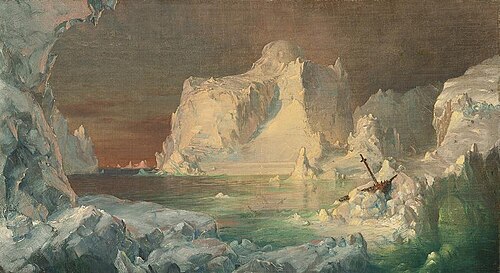
The sale happened in New York on October 24, 1979 — some later accounts say the 25th, likely a reporting quirk, but the contemporaneous date is the 24th2,1. Sotheby's catalogued it as lot 34, The Icebergs (The North), among 263 lots3. Eight to ten bidders chased it; the whole contest lasted under four minutes, with two phone bidders slugging it out near the $2 million mark before the hammer fell at $2.5 million1,3. That blew past the previous American-art record of $980,000, paid for George Caleb Bingham's The Jolly Flatboatmen, by more than two and a half times2,8.
The anonymous buyers turned out to be Lamar and Norma Hunt — he was a Texas businessman who owned the Kansas City Chiefs, and the couple were serious collectors2,1. They didn't keep it. They gave The Icebergs to the Dallas Museum of Art, where it still hangs2,5.
Church, the Arctic, and a Fading Reputation
Church was born in Hartford, Connecticut, in 1826 and trained under Thomas Cole, founder of the Hudson River School9. By the time he made The Icebergs, at 34, he was arguably the most famous landscape painter in America, known for spectacular single-painting exhibitions that drew paying crowds to see works like Niagara and Heart of the Andes2.
The Icebergs rode the period's Arctic obsession — the hunt for Franklin's lost expedition, Elisha Kent Kane's bestselling survival account, and Church's own friendship with the explorer Isaac Israel Hayes, who named an Arctic peak after him2,10. Church debuted the work in New York in April 1861 under the title The North, days after the Civil War began, a title chosen for its double meaning: an Arctic vista and a nod to the Union2. He later added a broken ship's mast to the composition, an elegiac reference to Franklin's doomed crew, and retitled it before selling it in England1,7.

By the mid-twentieth century, Church and the rest of the Hudson River School had fallen out of critical fashion, eclipsed by European modernism and later American movements2,11. The 1979 sale landed just as scholars and museums were reassessing nineteenth-century American landscape painting, which is part of why a nearly forgotten canvas from a boys' home could suddenly command a record price2,11.
Who's Who
- Frederic Edwin Church: American landscape painter (1826-1900), a leading figure of the Hudson River School and the artist behind The Icebergs9,1.
- Sir Edward William Watkin: British railway entrepreneur who bought the painting in England and displayed it at his house, Rose Hill, near Manchester1,6.
- Mair Baulch: Administrator of Rose Hill, the Manchester home for delinquent boys, who found the painting and set the rediscovery in motion3,2.
- Arthur Watkins: Manchester art dealer who helped identify and value the canvas7,3.
- Grete Meilman: Sotheby's New York specialist who traveled to England to authenticate the painting6.
- Lamar and Norma Hunt: Texas collectors and philanthropists who bought the painting at auction and donated it to the Dallas Museum of Art2,1.
By the Figures
- 1861: Year Church completed The Icebergs, after a 1859 sketching trip to Newfoundland and Labrador2,1.
- 64½ x 112½ inches (about 5.4 by 9.4 feet): the painting's size10,1.
- ~78 years: roughly how long the painting went missing from art-world awareness after Watkin's death in 19011.
- October 24, 1979: date of the Sotheby's New York sale2.
- $2.5 million: the winning bid, a record for an American painting at the time (some later sources cite $2.75 million, likely reflecting a buyer's premium)2,1,4,12.
- $980,000: the previous American-art auction record, set by George Caleb Bingham's The Jolly Flatboatmen2,8.
Where the Accounts Diverge
Sources agree on the broad shape of the story but differ on details. The institution where the painting hung is variously described as a municipal home for delinquent boys, an orphanage, and simply "an English school"2,5,13,14 — likely reflecting different eras of the building's use or loose translation across accounts, rather than contradictory facts.
The initial valuation estimate is also inconsistent: one account has Baulch hoping for as little as £20,000 to fund a boys' clubhouse3, while others describe a vaguer, more modest expectation before the painting's true value emerged2,7. And while the contemporaneous, most-repeated auction figure is $2.5 million2,1,4, a handful of later publications cite $2.75 million, a gap that may come down to whether the buyer's premium was included12,15.
Timeline
- 1859Church travels to Newfoundland and Labrador to sketch icebergs, becoming seasick in a rowboat near the ice.
- 1861Church completes The Icebergs (first shown as The North) and exhibits it in New York as the Civil War begins.
- 1863The painting is shown in London and later bought by railway magnate Sir Edward William Watkin.
- 1901Watkin dies; the painting's trail goes cold as it remains at Rose Hill, later a Manchester municipal boys' home.
- 1978Mair Baulch notices the grimy signed canvas on a stairwell while seeking funds for the boys' home.
- 1979 (August-October)Sotheby's authenticates the work; it is moved to Manchester Art Gallery, then shipped to New York.
- October 24, 1979Sotheby's sells The Icebergs for $2.5 million, a record for an American painting.
- After 1979Buyers Lamar and Norma Hunt donate the painting to the Dallas Museum of Art.
Pictures


Sources
- The IcebergsWikipedia
- 'The Icebergs' Is One of Frederic Edwin Church's Most Spectacular Paintings. For Decades, No One Knew Where It WasSmithsonian Magazine · 2026
- Would You Pay $2.5 Million for That Painting?Texas Monthly · 1980
- El viaje de los icebergs: la obra maestra ártica de Frederic Churchcms.dma.org
- Dallas Museum of Artdma.org
- AuctionsThe New York Times
- The Voyage of the Icebergs: Frederic Edwin Church's Arctic Masterpiecew3.ric.edu
- 2 Britons Find U.S. Artist's Long‐Lost 'Icebergs'The New York Times
- Frederic Edwin ChurchWikipedia
- IN SEARCH OF ICEBERGS - Vanishing Icevanishingice.org
- The Voyage of the Icebergs: Frederic Church's Arctic ...cms.dma.org
- Celebrating an American Original : Washington exhibition restores 19th-Century landscape painter Frederic Edwin Church to his place on highlatimes.com
- VANISHING ICE – ARTISTS ON THE FRONT LINE OF GLOBAL CLIMATE ...vanishingice.org
- Frederic Edwin Church: Hudson River School Master and Global ...usa-painter.org
- 0894681362.pdfolana.org
Researched and written by Lorelet from the sources above. It cites as it goes, but it can still get things wrong, so check the sources for anything that matters.
Report a problem
More featured lorelets
See all
Today · Film & TV
Why Nick Jr. Aired the Same Blue's Clues Episode All Week
A preschool show about a cartoon dog and her pawprints became a quiet experiment in how children actually learn from television — and the data said:…

Today · Crime
Liquid Gold: The Black Market for Used Cooking Oil
Green energy policy turned restaurant fryer grease into a commodity worth stealing, and a quiet corner of American crime grew up around it.

Today · Business
The Terminal: How a Firing Built Wall Street's Addiction
Michael Bloomberg got pushed out of Salomon Brothers with a check for about $10 million. He turned it into a locked-box machine that trading floors s…