
Featured · Nov 10History
The Last Ten Minutes of the Edmund Fitzgerald
A massive iron ore freighter crossed Lake Superior in a November storm, trading calm radio chatter with a trailing ship right up until it wasn't there anymore.

Listen
Read by Finch · 6 min
We Are Holding Our Own
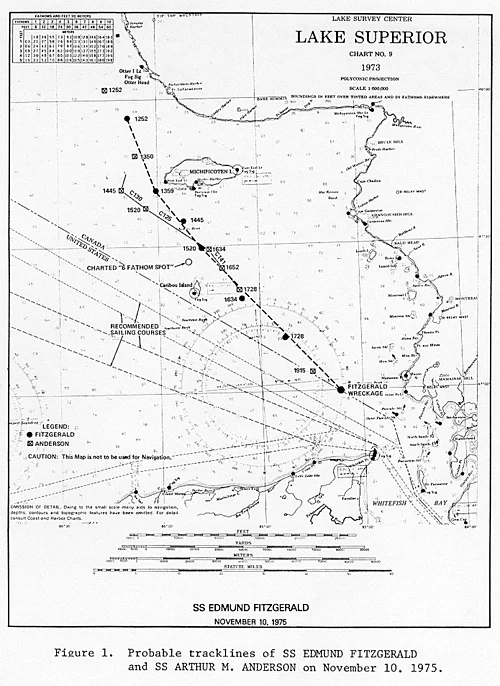
At around 7:10 p.m. on November 10, 1975, the freighter Arthur M. Anderson radioed the ship running about ten miles ahead of it through the dark and snow. Captain Ernest M. McSorley answered from the bridge of the SS Edmund Fitzgerald: "We are holding our own."2,3,4
Within about ten minutes, the Fitzgerald dropped off the Anderson's radar screen and was never heard from again8,5.
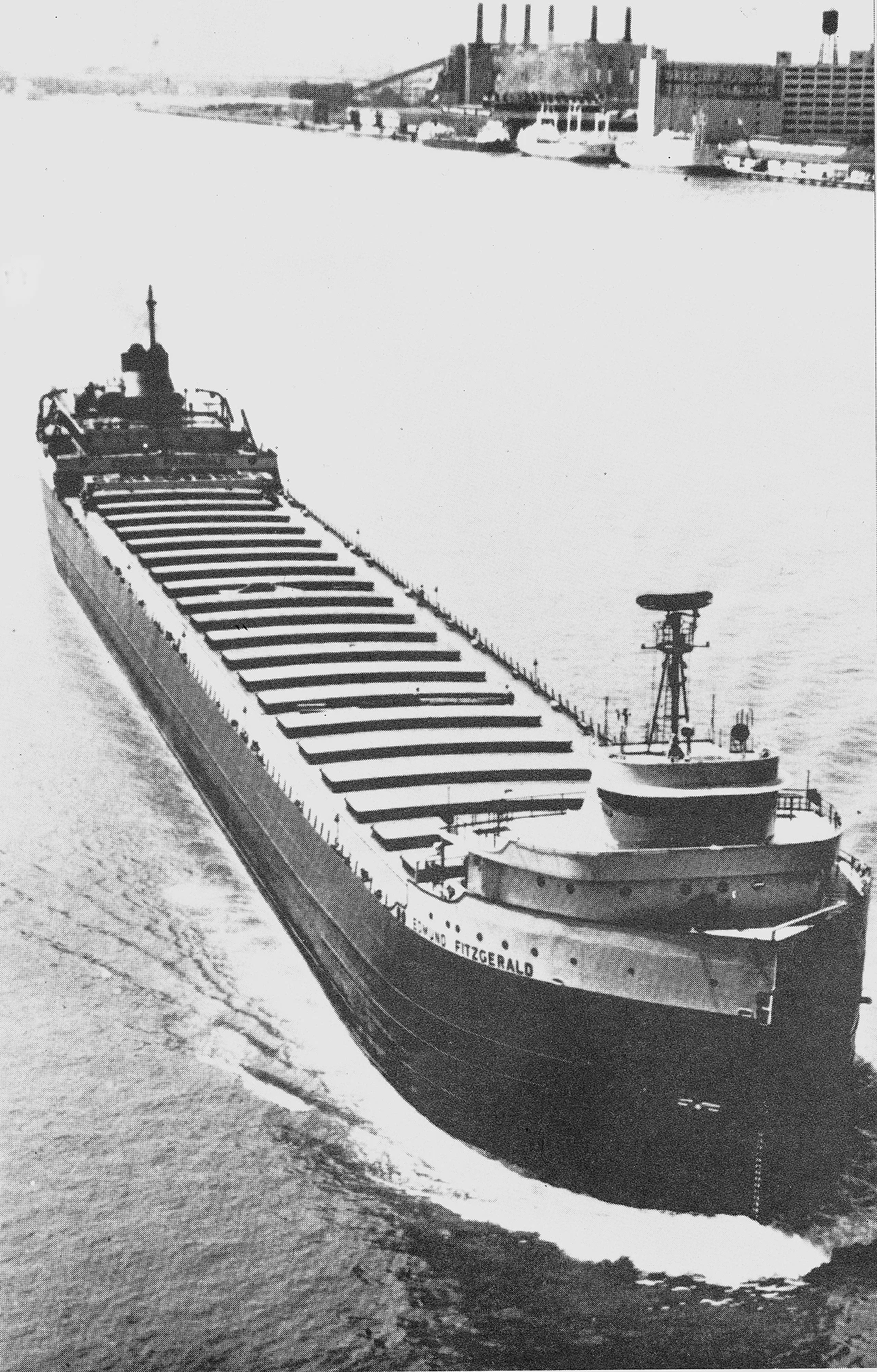
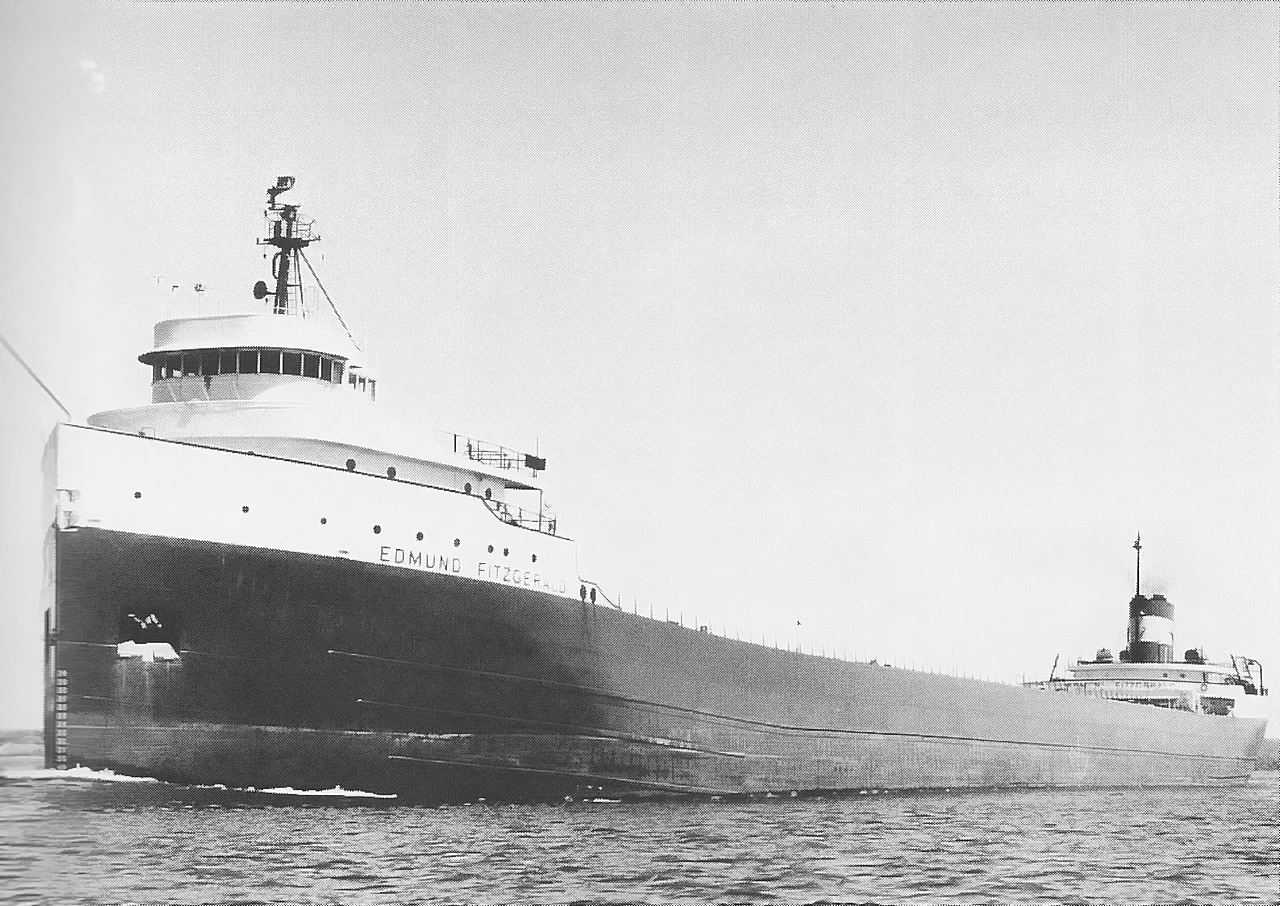
The Fitzgerald had left Superior, Wisconsin, at 2:15 p.m. the day before, loaded with 26,116 long tons of taconite ore pellets bound for a steel mill on Zug Island near Detroit1. At 729 feet, she had been the largest ship on the Great Lakes when launched in 1958, named for the chairman of the board of Northwestern Mutual Life Insurance Company, which had helped finance her construction1,9. McSorley, a veteran of more than forty years on the lakes, was nearing the end of his career10.
The Anderson, under Captain Jesse B. "Bernie" Cooper, joined the Fitzgerald's course that afternoon, and the two ships pushed east across Lake Superior together as the National Weather Service's gale warning hardened into a storm warning, with forecast winds near 48 to 55 knots11. By evening, actual conditions were worse: winds up to 75 miles per hour and waves reported between 18 and 35 feet, driving snow that cut visibility to almost nothing10,3,5.
Around 3:30 p.m., McSorley radioed the Anderson with a list of damage: a fence rail down, two vents lost or damaged, a developing list to starboard. "I'm checking down," he said. "Will you stay by me til I get to Whitefish?"9 Not long after, in a separate exchange picked up by the freighter Avafors, the Fitzgerald's crew could be heard shouting, "DON'T LET NOBODY ON DECK!" McSorley came back on to report he had lost both radars and was taking heavy seas over the deck, calling it one of the worst he'd ever been in9.
With her radar gone, the Fitzgerald slowed and let the Anderson close to within ten miles so Cooper's crew could feed her navigation information by radio, guiding her toward the shelter of Whitefish Bay1,3. The Anderson's crew watched the Fitzgerald's blip on their own screen, intermittently visible through the snow and spray, too far away to do anything but talk and follow3,8.
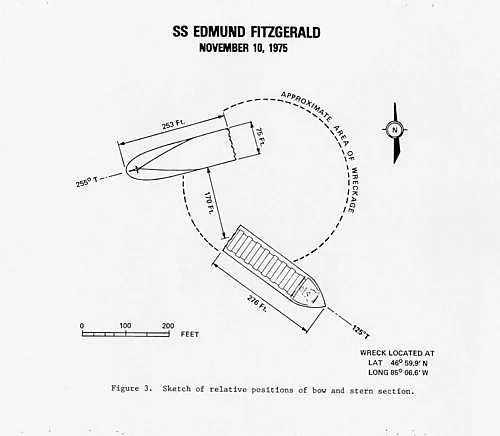
The ship went down so quickly that no one aboard sent a distress call and no lifeboat was launched2,5. Whatever happened in the dark between the Fitzgerald's last radio reply and its disappearance from the Anderson's radar happened to all 29 men at once, and none of them lived to describe it1,6.
The wreck was found four days later, on November 14, by a U.S. Navy aircraft using equipment designed to detect the ship's magnetic signature on the lake floor1,2. It lay in two large broken sections roughly 530 feet down, about 17 miles northwest of Whitefish Point, in Canadian waters1,2,6.
The U.S. Coast Guard's Marine Board of Investigation, reporting in July 1977, pointed to massive flooding of the cargo hold as the most probable cause, likely through hatch covers that failed to hold against the storm, though it stopped short of calling that certain2,7,5. A second inquiry, by the National Transportation Safety Board in 1978, examined the same evidence and reached a similar but not identical conclusion5. Neither board could say exactly what happened between 7:10 p.m. and whenever the water finally took the ship down, because there was no one left to ask5.
The Anderson made it through the night. Its crew kept searching with radar and searchlights for any sign of the other ship, lights, flares, a lifeboat, and found nothing3,8. What they had, instead, was the recording of that last call, and the plain, almost offhand way McSorley had answered it.
Timeline
- 1958-06-07SS Edmund Fitzgerald launched, the largest ship on the Great Lakes1.
- 1975-11-09Fitzgerald departs Superior, Wisconsin, loaded with taconite ore pellets bound for Detroit1,9.
- 1975-11-10 15:30McSorley radios the Arthur M. Anderson reporting a list, lost vents, and a fallen fence rail9.
- 1975-11-10 19:10Final radio contact: McSorley tells the Anderson, 'We are holding our own'2,3,4.
- 1975-11-10 ~19:20Fitzgerald disappears from the Anderson's radar; all 29 crew lost8,5.
- 1975-11-14Wreck located in two sections about 530 feet deep near Whitefish Point1,2.
- 1977-07U.S. Coast Guard Marine Board of Investigation releases its report5.
- 1978-05National Transportation Safety Board releases its findings5.
Pictures


Sources
- SS Edmund FitzgeraldWikipedia
- Edmund Fitzgerald | Sinking, Ship, Bodies, Song, & Facts - BritannicaBritannica
- 🔒 The storm that sank the Edmund Fitzgeraldclickondetroit.com
- The Edmund Fitzgerald sank 50 years ago. How big was the ship?fdlreporter.com
- The Edmund Fitzgerald sank 50 years ago. Its memory lives on.usatoday.com
- 51 years after the Edmund Fitzgerald sank, all 29 men aboard are still rememberedcbsnews.com · 2026
- The last voyage: remembering the Edmund Fitzgerald 50 years onoakvillenews.org
- Edmund Fitzgerald (1958) - WI Shipwreckswisconsinshipwrecks.org
- 44 years after sinking, last communications from Edmund Fitzgerald still hauntpostbulletin.com · 2019
- Sinking of the Edmund Fitzgerald | History | Research Starters | EBSCOhostebsco.com
- How a 1975 storm reached its peak fury on Lake Superior, dooming the Edmund Fitzgeraldlansingstatejournal.com
- The Wreck of the Edmund FitzgeraldWikipedia
Researched and written by Lorelet from the sources above. It cites as it goes, but it can still get things wrong, so check the sources for anything that matters.
Report a problem
More featured lorelets
See all
Today · Food
The Turkey Surplus That Became the TV Dinner
A company drowning in frozen birds found an answer on an airline food cart, or so the story goes for fifty years.

Today · Space
Why Is Jupiter's Great Red Spot Actually Red?
Jupiter is built almost entirely of colorless gas, yet its most famous storm glows orange-red. Scientists have spent decades in the lab trying to fig…

Today · Art & Design
The Aztec Labret Whose Golden Tongue Still Moves
A small gold serpent made for a pierced lip somehow ended up with a tongue that flicks side to side. No one alive has ever seen it worn.