
Featured · Nov 19Art & Design
The Book of Miracles and Its Five Centuries of Silence
A lavish manuscript of comets, monsters, and apocalypse sat unknown for nearly 500 years before it surfaced at a Munich auction house with no name attached to it.

Listen
Read by Wren · 7 min
A Foundling With No Parents
Around 2007, a nearly complete sixteenth-century manuscript turned up in a private Bavarian collection, and in July 2008 it went under the hammer at Kunstauktionshaus Hugo Ruef in Munich2,3. The bookseller handling it said it had come from the library of a small South German Baroque castle2. There was no title page, no dedication, no record of who had owned it before1. Writing about it afterward, critic Marina Warner called it "a gorgeous unheralded surprise: a foundling of unknown parents, a virgin birth"6,7.
That was an odd fate for an object this lavish. It ran to more than 160 full-color paintings of comets, floods, monsters, and the end of the world, the kind of thing that should have left some trace across four and a half centuries1,2. It hadn't, and nobody buying it that day in Munich could say for certain who had made it or for whom.
The book's own story starts much earlier, in Augsburg, a free imperial city in the Holy Roman Empire and a major center of printing, trade, and art in the sixteenth century8. Scholars date the manuscript's production to around 1550 to 1552, partly from watermarks on the paper, partly from the frequency of events near Augsburg described in its captions1. Its German text borrows directly from Martin Luther's 1545 Bible translation, which puts its writing after that date1,9.
Who actually painted it is still an informed guess rather than a settled fact. One page names the Augsburg artist and printmaker Hans Burgkmair, and because Burgkmair the Elder died in the 1530s, art historian Till-Holger Borchert concluded the name must refer to his son, Hans Burgkmair the Younger, a much less documented figure1. Borchert also linked at least two images to the workshop of Heinrich Vogtherr the Younger, suggesting a collaboration that was probably normal for the period but is nowhere spelled out in the manuscript itself1,3.

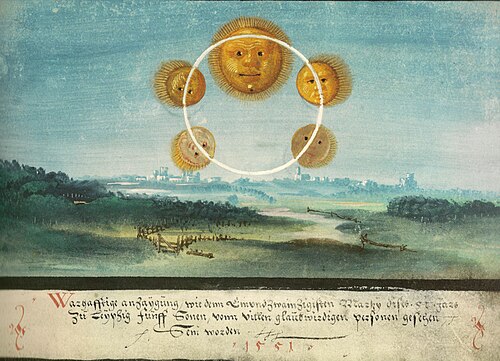
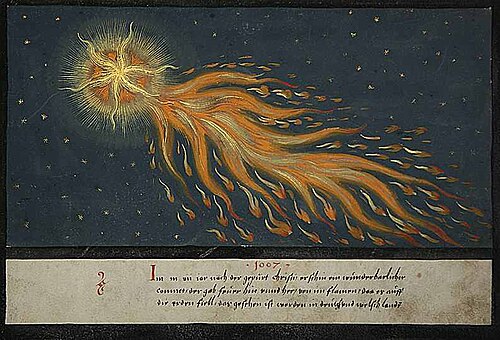
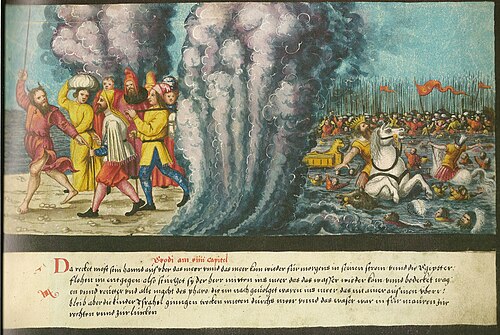
What the collaborators produced was not a short tract but a chronicle. It opens with the Flood, moves through Old Testament history, ancient and medieval wonders, and events from the artists' own century, and ends with nineteen surviving sheets illustrating the Book of Revelation, from John's vision of Christ to the fall of Babylon1,2. Along the way it depicts comets, eclipses, blood-red moons, earthquakes, volcanic eruptions, dragons, giant locusts, and reports of "monstrous births"2,5. One caption describes 1533 reports of over four hundred flying dragons seen together in Bohemia over several days8.
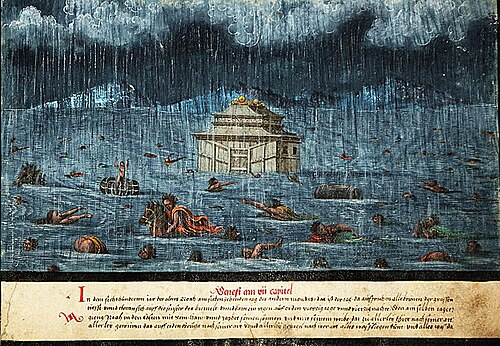
The arrangement is what gives the material its charge. A comet in the manuscript is rarely just a comet. Christie's specialist Eugenio Donadoni has described the sightings and disasters recorded in it as cumulative evidence of a world approaching judgment, part of what he and the auction house have called the sixteenth-century version of doomscrolling6. Joshua P. Waterman, who co-edited the 2013 facsimile with Borchert, makes a similar point: the comets, floods, and plagues depicted were "understood as part of a continuum of divine omens that foretold the coming apocalypse and called upon humanity to do penance for their sins"5.
But the manuscript withholds something a reader of the period would expect. Illustrated broadsheets of the time typically paired a description of an event with an interpretation and a moral warning. Waterman points out that in the Augsburg Book of Miracles, "the last two elements, interpretation and moralistic admonition, are almost completely absent"7. The captions mostly just report: a place, a date, a biblical source where one applies. The paintings do the rest of the work, piling omen on omen without telling the reader exactly what to conclude.
That restraint may be one reason the book went unnoticed for so long. It isn't a sermon with pictures attached. It reads more like a record someone kept because the signs themselves seemed worth keeping, whatever they meant. The manuscript's leaves were rebound in the nineteenth century, some pages were lost, and then it simply vanished from view until the Munich sale brought it back1.
After the 2008 sale, the manuscript passed to London collector James Faber in 2010 and from there into the collection of Connecticut collector Mickey Cartin2. Taschen issued a complete facsimile in 2013, with essays by Borchert and Waterman in English, French, and German, followed by a second edition in 20171. Only then did the full sequence of 167 miniatures become available to anyone outside a small circle of owners and specialists1,10.
Christie's now plans to sell the manuscript itself, as part of the Cartin collection, at its Classic Week sale in London on 10 December 2026, with an estimate of £700,000 to £1,000,0002. Whoever buys it will own an object whose makers, patron, and intended audience remain, in the main, exactly as unrecorded as they were the day it resurfaced in Munich.
Who's Attached to the Book
- Hans Burgkmair the Younger: Augsburg artist and printmaker to whom the manuscript is chiefly attributed, based on a named appearance in the text and stylistic links to his workshop; little independent documentation of his career survives1,8.
- Heinrich Vogtherr the Younger: proposed co-contributor, identified through workshop ties in some of the images; the collaboration is inferred, not confirmed by signature1,3.
- Till-Holger Borchert: Northern Renaissance specialist and chief curator of the Groeningemuseum in Bruges, co-editor of the 2013 and 2017 Taschen editions and the scholar behind the Burgkmair attribution1,7.
- Joshua P. Waterman: expert in German Renaissance art, co-editor of the Taschen editions, who has written on the manuscript's place within Lutheran-era print culture and prophecy traditions5,7.
- Mickey Cartin: Connecticut-based collector who came to own the manuscript, with Christie's now offering it from his collection2,11.
- Eugenio Donadoni: Christie's international specialist in medieval and Renaissance manuscripts, quoted on the book's imagery of signs, wonders, and unexplained phenomena2.
The Book By the Numbers
- 167: the number of painted miniatures Christie's cites in the manuscript as offered for sale2,6.
- 1550 to 1552: the likely window of the manuscript's production in Augsburg1,2,8.
- 123: surviving folios noted by Wikipedia, plus 23 inserts, after losses over the centuries1.
- 19: surviving sheets illustrating the Book of Revelation, covering Revelation 1:12 to 18:31.
- 2007 to 2008: the years the manuscript resurfaced in a Bavarian collection and then sold at auction in Munich2,3.
- £700,000 to £1,000,000: Christie's pre-sale estimate for the 10 December 2026 auction2.
Timeline
- after 1545Manuscript text borrows wording from Luther's German Bible, dating production after that translation1,9.
- c. 1550-1552The illustrated manuscript is produced in Augsburg1,2,8.
- 19th centuryThe manuscript's leaves are rebound; some pages are lost1.
- c. 2007The manuscript surfaces in a private Bavarian collection2,3.
- July 2008It sells at Kunstauktionshaus Hugo Ruef in Munich2.
- 2010London collector James Faber acquires it; it later enters Mickey Cartin's collection2,4.
- 2013Taschen publishes a complete facsimile edited by Till-Holger Borchert and Joshua P. Waterman1.
- 2017A second Taschen edition appears1.
- 10 December 2026Christie's offers the manuscript at its Valuable Books & Manuscripts sale in London, estimate £700,000-£1,000,0002.
Pictures


Sources
- Augsburg Book of MiraclesWikipedia
- Comets, Monsters and the Apocalypse: Christie's to offer The Book of Miracles - Christie'spress.christies.com · 2026
- From comets and eclipses to freakish beasts: the fantastical visions of The Book of Miracleschristies.com
- Comets, Monsters and Burning Cities: The Renaissance “ ...art-insider.com
- The eerie historical visions that predict the apocalypseBBC
- Medieval Readers Saw Floods, Plagues and Comets as Omens of Doom—So They Created a Mysterious Manuscript of Apocalyptic Artworks to Peruse at WillSmithsonian Magazine · 2026
- ‘The Book of Miracles’ | Marina WarnerThe New York Review of Books · 2014
- Behold the Augsburg Book of Miracles, a Brilliantly-Illuminated Manuscript of Supernatural Phenomena from Renaissance Germanyopenculture.com · 2022
- Book of Miraculous Signs - by M. E. Rothwell - Cosmographiacosmographia.substack.com
- Exceptional Works: Wunderzeichenbuchdavidzwirner.com
- Inside the Augsburg Book of Miracles at Christie’s – Meronmeron.design
- The Book of Miracles. Facsimile of the Augsburg ...abebooks.com
- Comets, Monsters and the Apocalypse: Christie's to offer T he Book of Miraclespress.christies.com
Researched and written by Lorelet from the sources above. It cites as it goes, but it can still get things wrong, so check the sources for anything that matters.
Report a problem
More featured lorelets
See all
Today · Food
The Turkey Surplus That Became the TV Dinner
A company drowning in frozen birds found an answer on an airline food cart, or so the story goes for fifty years.

Today · Space
Why Is Jupiter's Great Red Spot Actually Red?
Jupiter is built almost entirely of colorless gas, yet its most famous storm glows orange-red. Scientists have spent decades in the lab trying to fig…

Today · Art & Design
The Aztec Labret Whose Golden Tongue Still Moves
A small gold serpent made for a pierced lip somehow ended up with a tongue that flicks side to side. No one alive has ever seen it worn.