
Featured · Nov 15Space
Buran: The Soviet Space Shuttle's Ghost Flight
For three hours and twenty-five minutes, a Soviet spacecraft flew itself into orbit and home again with nobody at the controls. It would be the only time it ever happened.

Listen
Read by Finch · 10 min
The Spacecraft Flying Itself Home
At Baikonur's Site 251, on the morning of 15 November 1988, a winged spacecraft was coming down out of a cold sky with nobody at the controls3. Its onboard system had already covered 8,000 kilometers of atmosphere, bleeding speed from 28,000 kilometers per hour down toward zero, when at a key point roughly 20 kilometers up it did something its own designers rated at about a 3 percent probability: it broke from the expected glide path and executed a maneuver to stretch the distance and shed extra energy before swinging back onto the runway approach3.
No pilot could have overridden it even if something had gone wrong. The decision was the spacecraft's alone, made in real time, under a crosswind of 61.2 kilometers per hour3.
To understand why a machine was making that call by itself, you have to go back to why the Soviet Union built it in the first place. American concern aside, it was Soviet officials, especially Defense Minister Dmitry Ustinov, who grew alarmed after the US Space Shuttle's first orbital flight in April 19811. They looked at its 30-ton payload capacity and its 15-ton return capacity and concluded the real purpose might be to loft laser weapons into orbit that could knock out missiles from thousands of kilometers away1. A 1976 government resolution authorized a Soviet system to match it1,2.

Two men ran the two halves of that answer. Gleb Lozino-Lozinskiy, a veteran aircraft designer who had worked on the earlier Spiral reusable-aerospace project, became chief designer of the orbiter itself and led the newly formed NPO Molniya6. He later told colleagues, along with engineer Boris Chertok, that the program was military in nature from the start, though its exact intended capabilities remain classified1. Valentin Glushko, one of the Soviet Union's most consequential rocket engine designers, led NPO Energia and built the launch vehicle that would carry the orbiter: a heavy rocket powerful enough, and flexible enough, to fly large uncrewed payloads on its own, with or without a shuttle riding on top2.
The project that followed was staggering in scope. More than 1,200 Soviet enterprises worked on it, over 1,000 companies building the orbiter alone, after construction began in 1980 and the first full-scale vehicle rolled out in 19843. An atmospheric prototype called OK-GLI, fitted with jet engines so it could take off and fly approach patterns under its own power, flew 25 test flights between 1985 and 1988 to prove out exactly the kind of automated landing behavior the real orbiter would need7.
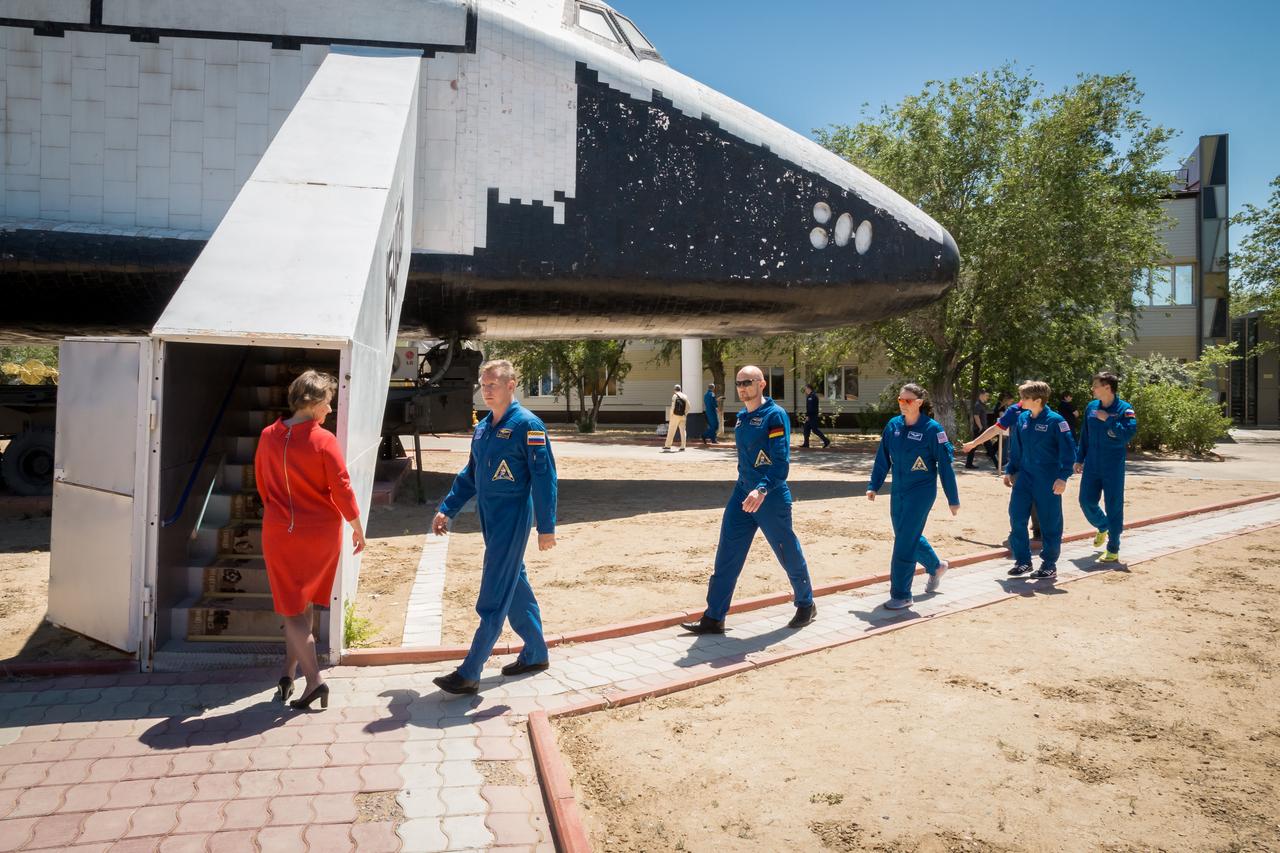
The difference from the American design was fundamental, not cosmetic. Where the US orbiter burned its own engines during ascent, Buran rode up entirely on Energia, using its own three engines only for a short circularization burn and for maneuvering once in orbit3,1. And where NASA's shuttle always flew with astronauts aboard, Buran was built from the outset to fly, land, and roll to a stop with no one aboard at all1.
That design intention became reality on 15 November 1988. Energia lifted Buran from Baikonur launch pad 110/37 at 03:00:02 UTC, placed it in a temporary orbit, and the orbiter separated as programmed3. It circled Earth twice over about 206 minutes, roughly three hours and twenty-five minutes, before beginning its automated return3,8,9.
The landing, the one with the self-corrected approach, came down within 3 meters laterally and 10 meters longitudinally of the target mark, by the most detailed technical account, though a Soviet official at the time cited a figure as tight as 1.5 meters3,5. Alexander Dunayev, head of the Glavkosmos space agency, told Izvestia that the actual flight time differed from the plan by a single second5. Yuri Semenov, a senior Soviet space official, put the achievement in terms of the rivalry that had started it all: "Until this moment, the American shuttle had one advantage: it flew. Today we've matched that advantage"8.
What nobody watching that morning could see was how little time was left to build on it. By November 1988 the Soviet economy was already buckling, and the political structure that had funded a 1,200-company program for over a decade was coming apart with it10. Engineers inside the Soviet space community, including Vostok designer Konstantin Feoktistov, had already written to Mikhail Gorbachev arguing the shuttle's cost would gut other programs; planetary scientist Roald Sagdeev made the same case publicly once glasnost allowed open dissent4. A second uncrewed flight was projected for 1993, lasting 15 to 20 days, but the dissolution of the USSR drained the funding before it could happen, and the program was formally suspended that same year3,1.
The orbiter that had flown itself home in 1988 sat afterward in Baikonur's Rocket Assembly and Fueling Facility, a hangar built decades earlier for the Soviet lunar program3. On 12 May 2002 the building's roof collapsed, falling as much as 260 feet, destroying that Buran along with an Energia test article and killing at least six construction workers, with two more presumed dead and a safety engineer dead of heart failure soon after3,4.
The spacecraft that proved it could fly and land itself never got the chance to do either again. What it left behind was that one morning's three hours and twenty-five minutes, and the moment over Baikonur when, with no one able to stop it or help it, it decided on its own how to come home3.
Who Built It
- Gleb Lozino-Lozinskiy: Chief designer of the Buran orbiter and head of NPO Molniya; had worked earlier on the Spiral reusable aerospace project6.
- Valentin Glushko: Led NPO Energia, which built the Energia heavy launch rocket that carried Buran into orbit2.
- Yuri Semenov: Senior Soviet space official who publicly compared Buran's flight to the US shuttle's record after the 1988 mission8.
- Alexander Dunayev: Head of the Glavkosmos space agency; praised the automated landing's precision to Izvestia5.
- Dmitry Ustinov: Soviet Defense Minister whose concerns about the US Space Shuttle's military potential helped drive the program's approval1.
By the Numbers
- 1976: Year the Soviet government formally authorized the program1,2.
- 1,200+: Soviet enterprises involved in building the Energia-Buran system2.
- 25: Atmospheric test flights of the OK-GLI prototype between 1985 and 19887.
- 206 minutes: Total flight time of Buran's only orbital mission, roughly 3 hours 25 minutes3,8,9.
- 2: Orbits of Earth completed on 15 November 19883.
- 3 meters / 10 meters: Lateral and longitudinal landing accuracy against the target mark, per technical accounts3.
- 1993: Year the program was officially suspended1.
- 2002: Year the orbiter was destroyed in a Baikonur hangar roof collapse that killed at least six workers3,4.
Timeline
- April 1981US Space Shuttle makes its first orbital flight, alarming Soviet officials1.
- 1976Soviet government resolution formally authorizes the Energia-Buran program1,2.
- 1980Construction of the Buran orbiter begins3.
- 1984First full-scale orbiter rolled out3.
- 1985-1988OK-GLI atmospheric prototype completes 25 test flights7.
- 15 November 1988Buran launches uncrewed on Energia, orbits Earth twice, and lands automatically at Baikonur3.
- 1993Buran program officially suspended after Soviet collapse1.
- 12 May 2002Hangar roof collapse at Baikonur destroys the Buran orbiter, killing at least six workers3,4.
Pictures


Sources
- Buran programmeWikipedia
- Buran reusable shuttlerussianspaceweb.com
- Buran (spacecraft)Wikipedia
- The Soviet Buran Shuttle: One Flight, Long Historyairandspace.si.edu · 2013
- Soviet Shuttle Almost Right on Moneylatimes.com
- Gleb Lozino-Lozinskiy - WikipediaWikipedia
- Buran: The Soviet Space Shuttle Storynewspaceeconomy.ca
- Soviet Space Shuttle Orbits and Returns In Unmanned DebutThe New York Times
- Buran Program – Space Launches Livespacelaunchlive.com
- Buran in the spotlightlink.springer.com · 2007
- Buran | Space Shuttle, Reusable Launch Vehicle, Soviet UnionBritannica
- Abandoned Soviet space shuttles rust in Kazakhstanedition.cnn.com
- The first and only space flight of Buranvpk.name
- The First Flight of "Buran": Where Did 16 Billion Rubles Go?www1.ru
Researched and written by Lorelet from the sources above. It cites as it goes, but it can still get things wrong, so check the sources for anything that matters.
Report a problem
More featured lorelets
See all
Today · Food
The Turkey Surplus That Became the TV Dinner
A company drowning in frozen birds found an answer on an airline food cart, or so the story goes for fifty years.

Today · Space
Why Is Jupiter's Great Red Spot Actually Red?
Jupiter is built almost entirely of colorless gas, yet its most famous storm glows orange-red. Scientists have spent decades in the lab trying to fig…

Today · Art & Design
The Aztec Labret Whose Golden Tongue Still Moves
A small gold serpent made for a pierced lip somehow ended up with a tongue that flicks side to side. No one alive has ever seen it worn.