
Featured · Nov 11Space
Voyager 1 and the Two-Day Hello
As NASA's oldest interstellar traveler closes in on a distance so vast that light itself needs a full day to cross it, a brief silence in October 2026 showed exactly what that distance costs.

Listen
Read by Finch · 9 min
Voyager 1 and the Two-Day Hello
On October 18, 2026, engineers at NASA's Deep Space Network listened for Voyager 1 and heard nothing. They tried again twenty-four hours later, on a second scheduled pass, and still heard nothing3. The spacecraft, by then about 16 billion miles out, had gone silent during two separate contact windows before its signal reappeared on October 203.
Nobody at NASA could simply call and ask what had happened. A question sent toward Voyager 1 takes nearly a full day to arrive, and any answer takes just as long to come back3. For two days, the most distant thing humans have ever built was unreachable, and the people who run it could do nothing but wait.
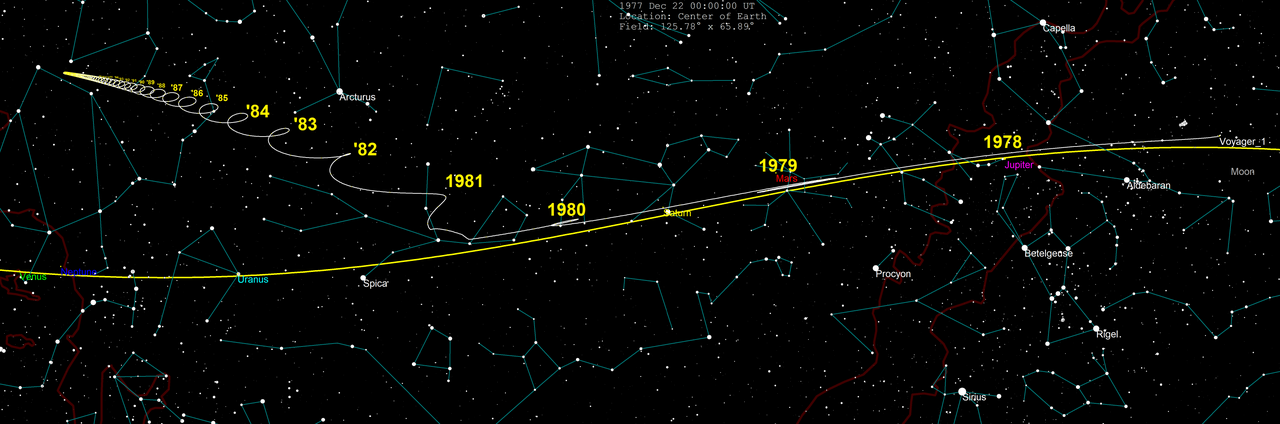
Voyager 1 launched from Cape Canaveral on September 5, 1977, at 12:56:01 Universal Time, built for a mission to Jupiter and Saturn that was expected to last a few years5. It outlived that plan by nearly five decades, flying past both planets in 1979 and 1980, crossing into interstellar space in August 2012, and becoming the most distant human-made object from Earth5,6. None of that explains a radio dead zone decades later.
The silence came at an awkward moment. Weeks earlier, in September 2026, engineers had finished a months-long maneuver nicknamed the "Big Bang," swapping three power-hungry devices for lower-power alternatives to stretch Voyager 1's dwindling electricity supply, which drops by about four watts a year as its plutonium power source decays3. The swap was meant to buy the spacecraft's remaining science instruments more time, not to introduce new risk, but it left little room for anything to go wrong.
When engineers finally pieced together what had happened during the blackout, they found that one set of thrusters had gone offline and backups had switched on automatically, a safety response called fault protection that puts the spacecraft into a stable holding pattern while it waits for help3. "This is the first time we've seen the spacecraft do something like this, but we are also at a point in the mission where we have to expect the unexpected," said Kareem Badaruddin, Voyager mission manager at NASA's Jet Propulsion Laboratory3. The team never learned the root cause before the spacecraft fixed itself and resumed contact3.
That two-day silence was a preview of the mathematics that now define the mission. Voyager 1 is set to cross one light-day from Earth, about 16.094 billion miles or 25.902 billion kilometers, on November 18, 2026, at 5:16:07 a.m. Eastern time1,2. At that distance, a signal travels about 24 hours each way, so Suzanne Dodd, Voyager project manager at JPL, put it simply: "If you want to say 'hello' to Voyager, you send your message and then you go home and you wait two days before you finally get a response"3.
A Five-Year Mission That Didn't Stop
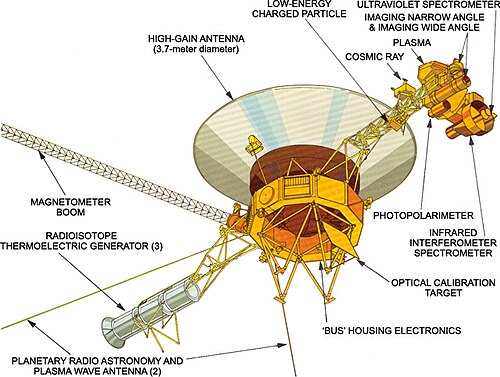
Voyager 1 was never meant to still be flying. NASA designed it for a planetary tour of roughly five years, aimed at Jupiter and Saturn7. It launched on a Titan IIIE rocket on September 5, 1977, sixteen days after its twin, Voyager 2, and still beat that twin to both planets by taking a shorter route6.
At Jupiter in 1979, Voyager 1 found active volcanoes on the moon Io, a surprise nobody had expected going in6. At Saturn in November 1980, it studied the planet's rings, atmosphere, and its large moon Titan from as close as about 124,000 kilometers6. On February 14, 1990, long after its planetary work was done, it turned its cameras homeward and captured the family of images that included the "Pale Blue Dot," after which NASA shut the cameras down for good to save power6,5.

The spacecraft crossed the heliopause, the boundary where the Sun's influence gives way to interstellar space, on August 25, 2012, becoming the first human-made object to do so6,5. Its twin followed in 2018. Both still send data back using 1970s-era computers and a communications system built for a mission that was supposed to end decades ago6,3.
The 2023 Breakdown Nobody Could Fix in a Phone Call
The most serious recent crisis predates the October 2026 blackout. In November 2023, Voyager 1's Flight Data System, the onboard computer that organizes information before transmission, began sending unreadable data, reportedly traced to a corrupted memory location or chip7. The spacecraft kept flying and kept responding to commands, but nothing it sent back made sense.
Engineers had to diagnose the fault without the usual back-and-forth of normal troubleshooting. At the time, the one-way delay already exceeded 22 hours, meaning every test command and its result consumed nearly two full days7. The repair effort stretched across roughly five months before the team restored meaningful data7.
That episode set the pattern now playing out again as Voyager 1 approaches one light-day: every problem on the spacecraft becomes, first and foremost, a problem of patience.
The Scale of It
- Distance at the milestone: 16.094 billion miles, or 25.902 billion kilometers1,2
- Exact moment: November 18, 2026, 5:16:07 a.m. EST (2:16:07 a.m. PST)1,8
- One-way radio delay: about 24 hours; round trip, about 48 hours3,4
- Voyager 1's speed: about 38,000 mph (61,155 kph)3
- Launch date: September 5, 1977, 12:56:01 UT5
- Power loss: roughly 4 watts per year as its plutonium generators decay3
- Voyager 2's turn: projected to reach one light-day in November 20352
Who's Running the Mission
- Suzanne Dodd: Voyager project manager at NASA's Jet Propulsion Laboratory, who described the two-day wait for a reply from the spacecraft3.
- Kareem Badaruddin: Voyager mission manager at JPL, who called the October 2026 thruster swap something the team had never seen before3.
- Jet Propulsion Laboratory (JPL): builds and operates the Voyager spacecraft and manages NASA's Deep Space Network, the antenna system used to communicate with them4.
- NASA's Heliophysics Division: funds the Voyager mission out of NASA Headquarters in Washington4.
- Jamie Rankin, Jonathan Lunine, Nicky Fox: scheduled to join a public discussion of the mission's status at JPL on November 19, 20264.
Marking the Moment
NASA built two public events around the crossing. On the evening of November 17, 2026, it invited people worldwide to "Shine Bright for Voyager's Light-Day," flashing the spacecraft's call sign, V-G-R, in Morse code toward the sky with phones, flashlights, or building lights1. The gesture is symbolic; NASA's own materials do not claim the light would be visible to or detected by the spacecraft itself1.

The following day, on November 19, JPL planned a moderated discussion at its von Kármán Auditorium, the same room used for Voyager briefings during the probes' original tour of the outer planets, featuring mission members and NASA leadership along with a preview of a documentary planned for the mission's 50th anniversary in 20274.
Timeline
- 1977-09-05Voyager 1 launches from Cape Canaveral at 12:56:01 UT5.
- 1979Close encounter with Jupiter reveals volcanic activity on Io5,6.
- 1980-11-12Closest approach to Saturn, within about 124,000 kilometers6.
- 1990-02-14Voyager 1 captures the 'Pale Blue Dot' image, then its cameras are shut off6,5.
- 2012-08-25Voyager 1 crosses the heliopause into interstellar space6,5.
- 2023-11Flight Data System failure sends unreadable data to Earth7.
- 2026-09The 'Big Bang' power-saving device swap is completed3.
- 2026-10-18Deep Space Network loses contact with Voyager 1 during two scheduled passes3.
- 2026-10-20Signal reappears; cause traced to a thruster fault-protection swap3.
- 2026-11-17Public 'Shine Bright for Voyager's Light-Day' event after sunset1.
- 2026-11-18Voyager 1 reaches one light-day from Earth at 5:16:07 a.m. EST1,2.
- 2026-11-19JPL hosts a public discussion on the mission's status4.
Pictures


Sources
- Shine Bright for Voyager’s Light‑Day - NASA ScienceNASA · 2026
- Voyager 1: What Is a Light-Day - NASA ScienceNASA · 2026
- NASA’s Voyager 1 Conserves Power, Resolves Brief Communications Pause | NASA Jet Propulsion Laboratory (JPL)NASA · 2026
- NASA Invites Media, Public to Join Voyager 1 One-Light Day Activities - NASANASA
- Voyager 1: The Farthest SpacecraftNASA
- Voyager 1Wikipedia
- Voyager 1 to Reach One Light-Day From Earth on November 18chosun.com
- Where Are Voyager 1 and 2 Now? - NASA ScienceNASA · 2024
Researched and written by Lorelet from the sources above. It cites as it goes, but it can still get things wrong, so check the sources for anything that matters.
Report a problem
More featured lorelets
See all
Today · Food
The Turkey Surplus That Became the TV Dinner
A company drowning in frozen birds found an answer on an airline food cart, or so the story goes for fifty years.

Today · Space
Why Is Jupiter's Great Red Spot Actually Red?
Jupiter is built almost entirely of colorless gas, yet its most famous storm glows orange-red. Scientists have spent decades in the lab trying to fig…

Today · Art & Design
The Aztec Labret Whose Golden Tongue Still Moves
A small gold serpent made for a pierced lip somehow ended up with a tongue that flicks side to side. No one alive has ever seen it worn.