Featured · TodayTechnology
Captain Midnight: The Night a Dish Dealer Hijacked HBO
A broke satellite dealer in Ocala, Florida, pointed a 30-foot dish at a communications satellite and bumped HBO off the air for a protest message, exposing how little stood between anyone with an uplink and national television.

Listen
Read by Wren · 6 min
Four and a Half Minutes Over Ocala
Just after midnight on April 27, 1986, HBO subscribers across the eastern two-thirds of the country watching The Falcon and the Snowman saw the movie vanish. In its place: color bars and five lines of blocky white capital letters, addressed to HBO by someone calling himself "Captain Midnight"1,2.
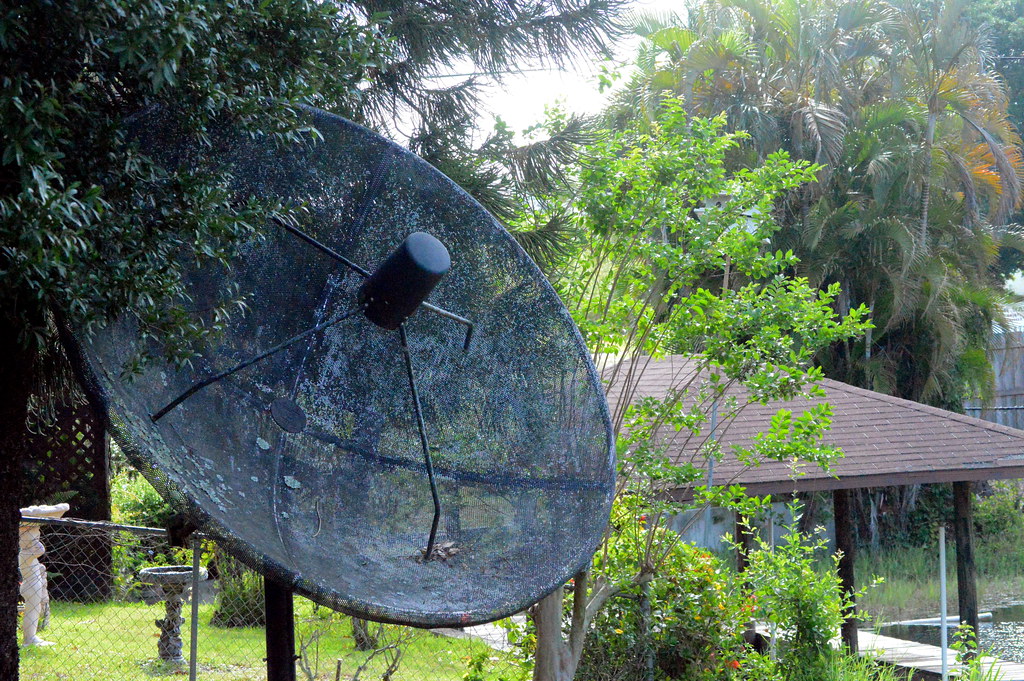
The man behind the pseudonym was John R. MacDougall, a 25-year-old satellite-dish dealer from Ocala, Florida, who moonlighted as an operations engineer at a local uplink facility called Central Florida Teleport4,7. That night he had just finished uplinking Pee-wee's Big Adventure for a pay-per-view service, and before signing off, he swung the facility's 30-foot transmission dish toward Galaxy 1, the satellite carrying HBO's signal1,2.
The message was blunt: HBO's new $12.95-a-month fee for satellite-dish owners was unacceptable, and Showtime and The Movie Channel had better take note. According to Wikipedia's account, a technician at HBO's Hauppauge, New York, communications center tried to fight back by cranking up uplink power, then backed off for fear of damaging the satellite itself1. MacDougall held the channel for roughly four and a half minutes before letting go1,2, though some accounts put it closer to three minutes3, a discrepancy likely tied to exactly when counting started.
The timing was not impulsive. MacDougall had tested the water a week earlier, briefly superimposing a color-bar pattern on HBO's signal in the dead of night when almost nobody was watching1. HBO did not even investigate that first intrusion. The second one, aimed at a late-night audience and carrying an explicit political message, could not be ignored.
Why a Dish Dealer Declared War on HBO
The dispute had been building for months. Through the late 1970s and early 1980s, home satellite dishes let hobbyists and small-business owners pull premium cable programming out of the sky for free, and an entire retail industry, including MacDougall's own shop, grew up around selling the hardware1.
That ended on January 15, 1986, when HBO began scrambling its signal around the clock and charging dish owners $12.95 a month, plus roughly $395 for a descrambler, to keep watching1. For cable subscribers the fee was comparable to what they already paid, but for dish owners, who had bought and maintained their own equipment, it felt like a bait and switch. Dish sales collapsed, satellite dealers across the country closed shop, and dish owners staged protests, including a March 1986 gathering in Washington, D.C.1.
MacDougall's own business, MacDougall Electronics, took the hit directly. With customers gone, he cut his advertising, turned off the air conditioning, and leaned on his part-time teleport job to cover bills1. He wrote protest letters to legislators. None of it moved HBO's pricing, and by late April he had access to the one piece of leverage none of HBO's other critics had: a transmitter big enough to talk back.
Who Was Involved
- John R. MacDougall: Ocala satellite-dish dealer and part-time uplink engineer who transmitted the intrusion under the name "Captain Midnight"1,4.
- HBO: The premium cable network whose satellite feed was overridden; its new dish-owner fees were the trigger for the protest1,8.
- Federal Communications Commission: Led the technical investigation, tracing the distinctive character generator used in the broadcast to identify possible uplink sites1,5.
- Federal Bureau of Investigation: Assisted the FCC, treating the case as a federal communications offense1,6.
- Central Florida Teleport: The Ocala uplink facility where MacDougall worked and from which he transmitted the intrusion1,4.
How the FCC Found Him
MacDougall's one real mistake, from an investigator's point of view, was leaving a signature. The text on screen had been generated with a Quanta Corporation Microgen MG-100 character generator, a specific, identifiable piece of broadcast gear1. The FCC worked backward from that detail, compiling a list of facilities equipped with that model and narrowing in on Central Florida Teleport5.
Accounts of the investigation also mention a traveler who reportedly overheard MacDougall talking about the intrusion at a payphone near Interstate 75, though sources differ on how much weight that tip actually carried in cracking the case9. What is clear is that MacDougall surrendered once investigators zeroed in on him, and on July 23, 1986, he pleaded guilty in federal court to unlawfully transmitting an interfering signal4,7.
The sentence was light by any modern standard: a $5,000 fine, one year of unsupervised probation, and a one-year suspension of his amateur-radio license1,6. He served no jail time, and reporting at the time noted that his protest did not change HBO's pricing3.
What Sources Disagree On
- Duration: Most accounts, including Wikipedia and the Internet Archive's description, say the intrusion lasted about 4.5 minutes1,2. The AV Club put it at three minutes3, and other summaries round it to "nearly five"10. The gap likely comes down to whether the count starts with the color-bar test pattern or only with the written message.
- How much credit the overheard phone call deserves: Some retellings treat the payphone conversation near Interstate 75 as a key break in the case9, while the fuller account of the investigation centers almost entirely on the character-generator trace1,5. It is possible both contributed, but the available sourcing does not clearly rank their importance.
- The Electronic Communications Privacy Act connection: Wikipedia states that Congress passed the Electronic Communications Privacy Act of 1986 as a consequence of the incident, making satellite hijacking a felony1. This is a stronger causal claim than other sources support directly, and it should be treated as the kind of after-the-fact legislative narrative that is easy to overstate. The clearly documented outcome is MacDougall's own prosecution and plea, not a demonstrated single-cause link to the statute.
Timeline
- 1983MacDougall opens MacDougall Electronics, a satellite-dish dealership in Ocala, Florida1.
- January 15, 1986HBO begins scrambling its signal around the clock and charging dish owners $12.95 a month1.
- April 20, 1986MacDougall briefly superimposes a test pattern on HBO's signal overnight as a trial run1.
- April 27, 1986MacDougall overrides HBO's satellite feed for roughly 4.5 minutes with the "Captain Midnight" message1,2.
- July 23, 1986MacDougall pleads guilty in federal court to unlawfully transmitting an interfering signal4,7.
Pictures
Sources
- Captain Midnight broadcast signal intrusionWikipedia
- Captain Midnight HBO Broadcast Intrusion : Free Download, Borrow, and Streaming : Internet ArchiveInternet Archive
- 30 years ago today, a disgruntled Floridian interrupted HBO’s signalavclub.com · 2016
- 'Captain Midnight' Enters Plea of Guilty to Video Piracy Countlatimes.com
- The Mystery of the Creepiest Television Hackvice.com
- Flashback: Hacker interrupts HBO's film in 1986cbsnews.com
- MAN ADMITS OVERRIDING HBO SIGNALThe New York Times
- VIDEO PIRATE INTERRUPTS HBOThe New York Times
- Captain Midnight broadcast signal intrusion - WikipediaWikipedia
- On the Air Live with Captain Midnight (1979) - IMDbimdb.com
- Broadcast signal intrusion - Ultimate Pop Culture Wiki - Fandomultimatepopculture.fandom.com
Researched and written by Lorelet from the sources above. It cites as it goes, but it can still get things wrong, so check the sources for anything that matters.
Report a problem
More featured lorelets
See all
Today · Sports
The Perfect Game Nobody Saw Coming
A journeyman pitcher with a losing record and a reputation for late nights found a baseball in his shoe one October morning and threw the only perfec…

Today · Space
Weaving the Moon Landing: Hamilton's Apollo Code
Three minutes before Apollo 11 touched down, the lunar module's computer started screaming alarms. The reason it didn't abort traces back to a woman…

Oct 7 · History
Operation Breakthrough: When the Cold War Thawed for Three Whales
In October 1988, a hunter's chance discovery near Point Barrow turned into a 20-day international scramble that put Soviet icebreakers, Greenpeace vo…