
Featured · TodayHistory
The Morning the Gateway Arch Almost Didn't Fit
On October 28, 1965, crews in St. Louis had to beat the sun to finish America's tallest monument, and the schedule changed before most spectators even arrived.
Listen
Read by Finch · 5 min
A Schedule Moved Up by the Sun
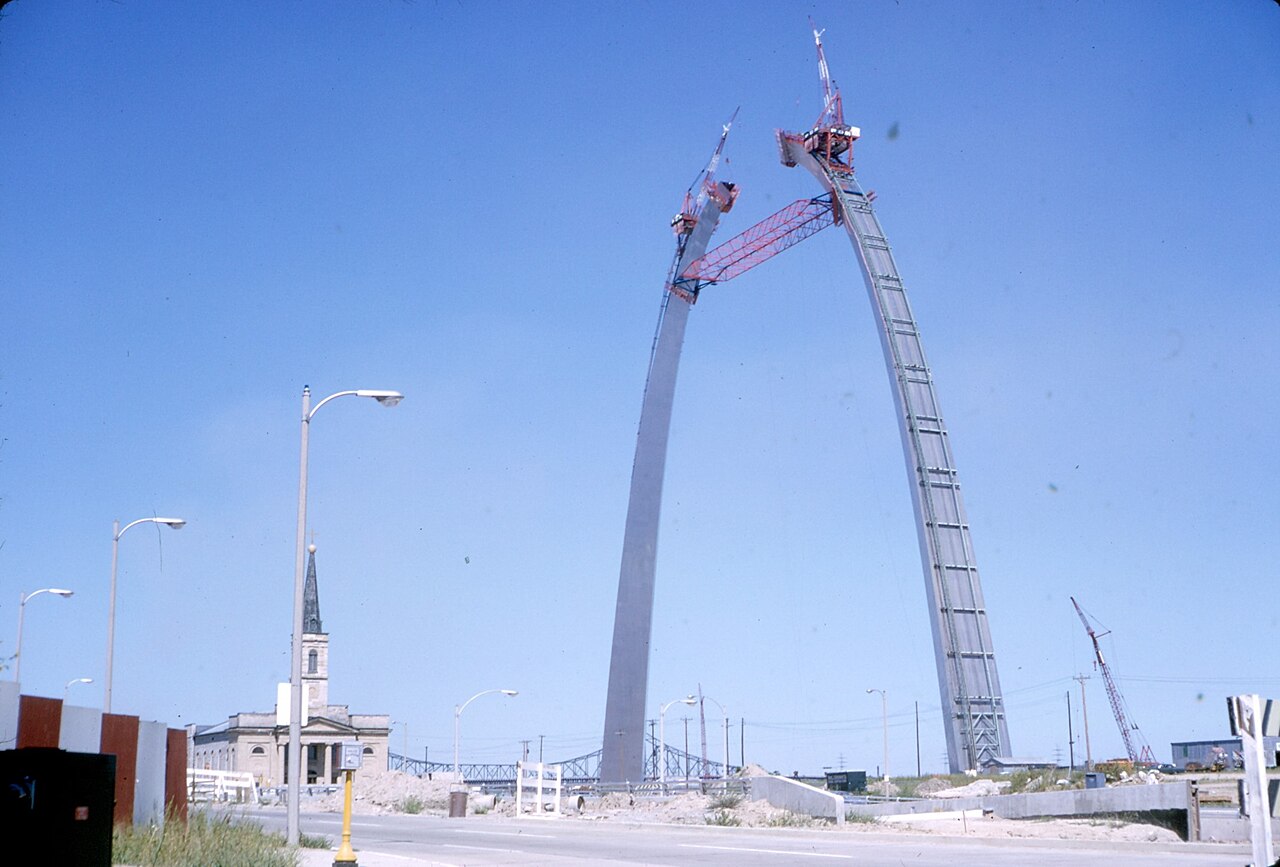
The plan had called for the Gateway Arch's final section to go in at 10:00 a.m. on October 28, 1965. Instead, the operation began roughly 30 minutes early, because the morning sun had already begun heating the stainless steel of the south leg and the gap it was supposed to fit into was shrinking3. Fire hoses were run to the top of that leg so crews could spray it with water, trying to cool the metal back down before the keystone arrived3.
Something about the plan had already slipped before most of the crowd gathered along the Mississippi riverfront realized it.
The Arch had been three years in the making by that point. Eero Saarinen, the Finnish-American architect who designed it, had won the 1947 competition for the Jefferson National Expansion Memorial with a submission simply numbered 144, beating out 172 entries7,5. He never saw it built. Saarinen died in 1961, of a brain tumor, two years before groundbreaking even happened in June 1959 led to steel going up5,2.

Construction itself started slow and got systematic. The first triangular stainless-steel section went onto the south leg on February 12, 1963, and from there crews alternated between the two legs, section by section, so the structure stayed balanced as it rose8,9. Each leg eventually held 71 sections, raised by cranes and creeper derricks that climbed the Arch's own curvature as it grew4,8.
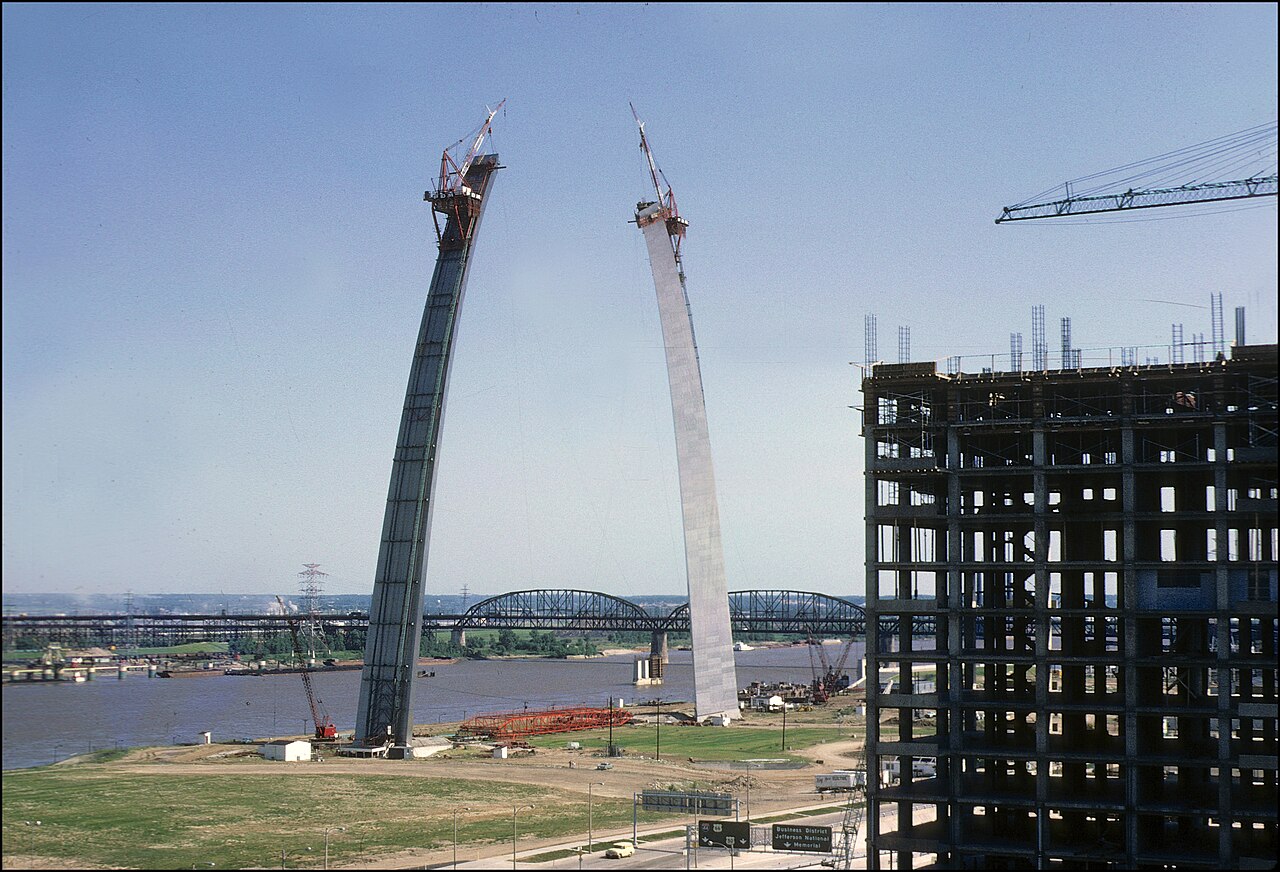
By October 19, 1965, only the next-to-last eight-foot section remained to be set at the top10. The final piece was meant to close an opening about 8.5 feet wide, but the two legs had only about 2.5 feet of clearance between their upper ends after all the preceding work, so hydraulic jacks were needed just to force them apart far enough11. That gap was never fixed and stable; one account puts the morning's thermal narrowing at about five inches, steel expanding as the sun warmed it and curving the legs slightly inward12.
That is why the hoses went up before the keystone did. Cooling the south leg made it contract, buying back the clearance the heat had taken away, while a jacking frame pushed against both legs to widen the gap further still3,4,13. The two fixes ran at once: water lowering the temperature, hydraulics doing the rest, for an operation that took roughly three hours while spectators on both sides of the river watched3,8.
The piece being lowered into that narrow, shifting gap was no ornament. It was a stainless-steel section weighing about 10 tons, lifted by crane to the top and slid into place between the legs once the opening was wide enough3,10. When it seated, the gap vanished and the Arch became one continuous 630-foot structure, as the National Park Service later put it: "The last section of the Arch was slipped into place"1.
Then Vice President Hubert Humphrey watched the topping-out from a helicopter, according to later historical accounts, though no source here gives a verified transcript of what he said12. The day before, officials had sealed a metal box containing signatures from about 762,000 St. Louisans, many of them schoolchildren, inside the monument6. The schedule that morning had moved up by half an hour because the sun got there first, and for three hours afterward, nobody watching from the riverbank could have been fully sure the keystone would fit.
Timeline
- 1947Eero Saarinen's design wins the Jefferson National Expansion Memorial competition.
- June 1959Groundbreaking for the Gateway Arch.
- February 12, 1963First stainless-steel triangular section set on the south leg.
- October 19, 1965Next-to-last eight-foot section fitted at the top.
- October 27, 1965A metal box with about 762,000 signatures sealed inside before final installation.
- October 28, 1965Final 10-ton keystone section installed, completing the Arch.
Pictures


Sources
- The Gateway Arch Celebrates 50th Year of Completion - Gateway Arch National Park (U.S. National Park Service)nps.gov
- Gateway Arch National Park Purpose and Significance - Gateway Arch National Park (U.S. National Park Service)nps.gov
- St. Louis 'tops off' lofty 'Gateway Arch' - UPI Archivesupi.com
- Arch Architecture - Gateway Arch National Park (U.S. National Park Service)nps.gov
- Eero SaarinenWikipedia
- 50 Things You Never Knew About The Archstlmag.com
- Gateway ArchWikipedia
- Building America’s Tallest Monumentjnpa.blog
- [PDF] Jefferson National Expansion Memorial Gateway Arch - NPGallerynpgallery.nps.gov
- Gateway Arch 'Biography' Reveals Complex History Of An ...kpbs.org
- A Lesson in Gateway Arch Architecturegatewayarch.com
- Gateway Arch - WikipediaWikipedia
- Today in history: Oct. 28southernminn.com
Researched and written by Lorelet from the sources above. It cites as it goes, but it can still get things wrong, so check the sources for anything that matters.
Report a problem
More featured lorelets
See all
Today · Business
Willie Nelson and the Indiana Steakhouse That Borrowed Texas
A country outlaw, a poker game, and a chain that needed a little more Lone Star in its blood.

Today · Art & Design
What Was Hiding Behind Odilon Redon's Night
When conservators lifted a century-old mural off a monastery library wall for a loan to Paris, they weren't expecting to find anything behind it at a…
Oct 27 · History
The Battleship Britain Pretended Not to Lose
A brand-new dreadnought went down within sight of an ocean liner full of passengers and cameras, and the Admiralty decided the best response was to s…