
Featured · TodayHistory
The Battleship Britain Pretended Not to Lose
A brand-new dreadnought went down within sight of an ocean liner full of passengers and cameras, and the Admiralty decided the best response was to say nothing at all.
Listen
Read by Wren · 6 min
Cameras on the High Decks
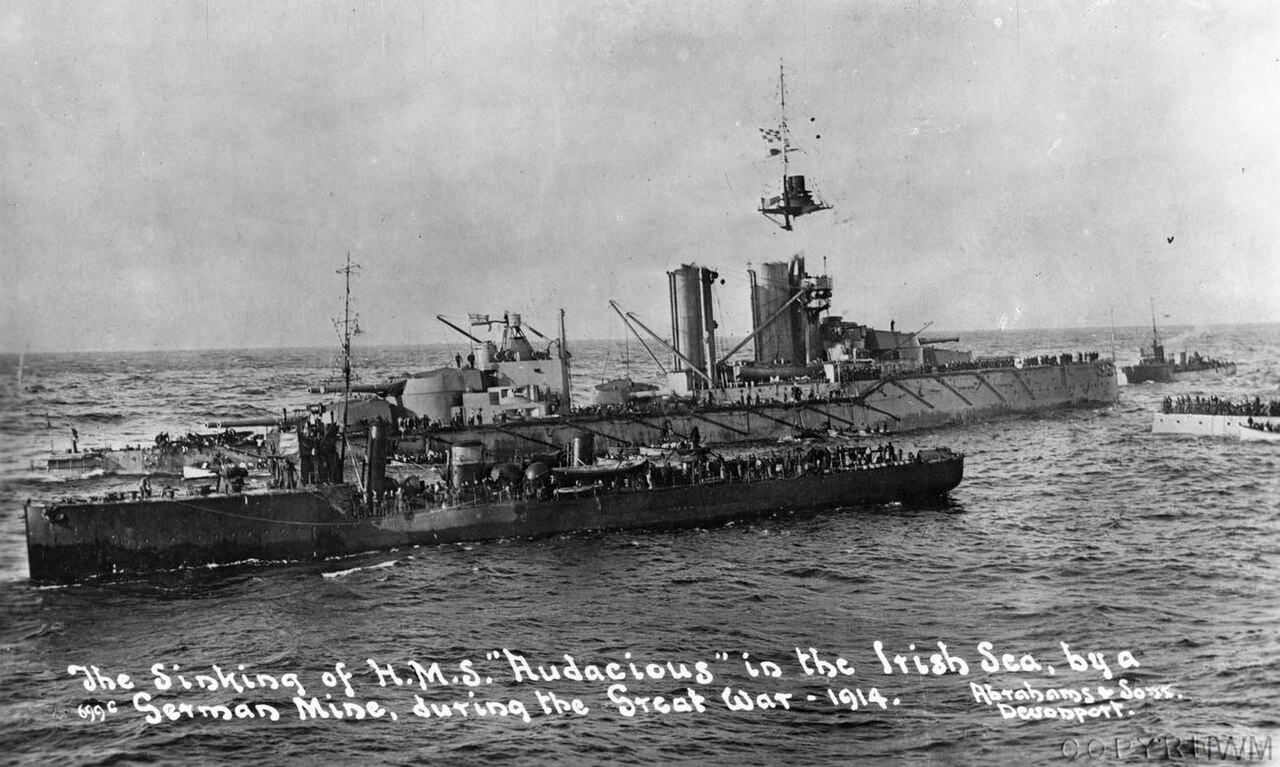
On the morning of 27 October 1914, passengers aboard the White Star liner RMS Olympic had a view most Royal Navy secrets never got: a modern British battleship, listing and burning, off the north coast of Ireland6,7. Olympic, sister ship to Titanic, had picked up the stricken ship's distress calls and come alongside to help3,7. Among those watching from the high decks were American tourists, cameras in hand, recording the whole slow disaster as it happened3,6,7.
What they captured that day was supposed to never reach a newspaper3,7.
Audacious was barely a year old. She was the fourth and last of the King George V-class dreadnoughts, built by Cammell Laird at Birkenhead and commissioned on 21 October 1913, armed with ten 13.5-inch guns and costing just under £1.92 million3,1. By October 1914 she was assigned to the Grand Fleet's 2nd Battle Squadron under Admiral Sir John Jellicoe, doing gunnery practice near Tory Island when she ran onto a mine laid by the German auxiliary minelayer SMS Berlin3,2,9.

The mine struck at around 8:45 a.m. and the ship did not go down quickly9,10. She took on a port list that crews fought with counter-flooding, and her captain, believing he could beach her, turned south for Lough Swilly and covered fifteen miles before the engine rooms flooded and she drifted to a stop3. Destroyers and tugs came out to help, Olympic's boats assisted in taking off crew, and by two in the afternoon only 250 men remained aboard3. A tow line went across from Olympic that afternoon, and later the battleship Exmouth was sent out once Jellicoe learned there was no submarine threat in the area after all3. The whole crew got off alive; the sole casualty was a petty officer aboard the cruiser Liverpool, killed by debris when Audacious's magazine finally exploded that evening, between roughly 800 metres from the wreck by one account3,7.
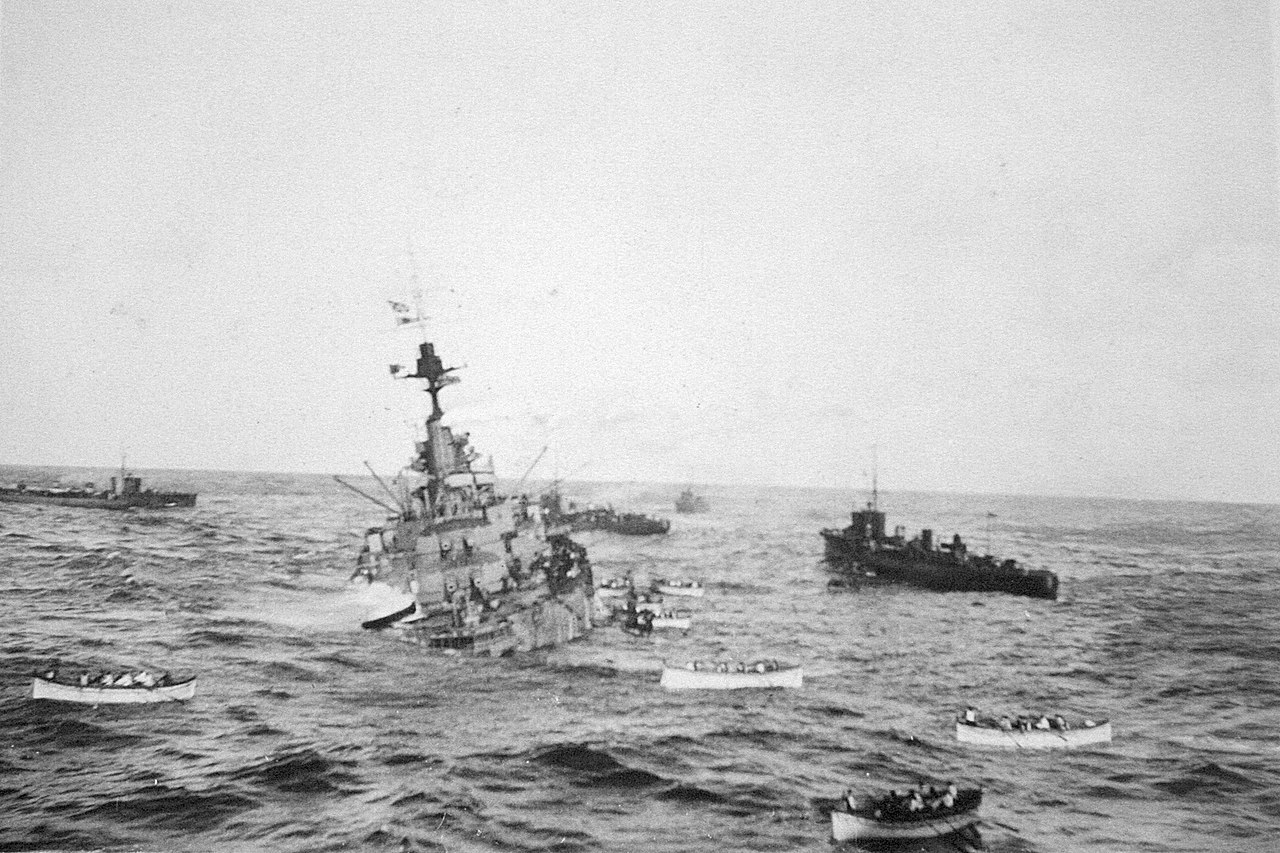
Jellicoe's response to all this was immediate: he proposed that the sinking be kept secret, and the Board of Admiralty and the Cabinet agreed3,1,5. The logic was strategic rather than embarrassed. Audacious had been mined, not torpedoed, so Germany might not have firm confirmation she was gone, and admitting the loss would tell Berlin that the Grand Fleet's strength had just dropped by one modern dreadnought1. British newspapers were asked not to print the story, and they didn't; Audacious stayed on the Navy's published fleet lists for the rest of the war as if she still floated1,4.
The trouble was that the people who had watched her sink were not under Jellicoe's authority. Many of the Olympic's passengers were American, and the United States was neutral3,7. Jellicoe tried to have the passengers' film seized, but Americans beyond British jurisdiction simply kept theirs and talked7. By 28 November 1914, barely a month after the sinking and a full four years before Britain admitted anything, Scientific American published an article on the loss, illustrated with one of the amateur photographs taken from Olympic's deck7. The pictures had already spread into American and neutral newspapers1,6.
Germany, for its part, appears to have had the loss more or less confirmed by mid-November 1914, and its own naval command later approved of Britain's silence on the matter: Admiral Reinhard Scheer wrote after the war that he approved of the English not revealing a weakness to the enemy, since accurate knowledge of the other side's strength shapes decisions3. The censorship, in other words, worked mainly as domestic theater: British readers were kept in the dark for four years, while American magazine readers could see the ship going down within weeks.
The formal admission came only on 14 November 1918, four days after the Armistice, when The Times finally reported the loss and explained, in its own words, that it had been "kept secret at the urgent request of the Commander-in-Chief, Grand Fleet, and the Press loyally refrained from giving it any publicity"8.

For four years, then, the official British record held that Audacious was still afloat, while a Scientific American reader in 1914 could flip past a photograph of her sinking, taken from the deck of the ship that was supposed to be rescuing her quietly.
Timeline
- 1913-10-21HMS Audacious is commissioned into the Royal Navy3.
- 1914-10-27, morningAudacious strikes a German mine off the north coast of Ireland near Tory Island3,9.
- 1914-10-27, afternoonRMS Olympic and nearby destroyers assist in evacuating the crew; a tow attempt fails3.
- 1914-10-27, eveningAudacious's magazine explodes and the ship sinks; one man is killed by debris aboard HMS Liverpool3,7.
- 1914-11-19 (approx.)Germany is understood to have accepted the loss had occurred3.
- 1914-11-28Scientific American publishes an account of the sinking illustrated with an Olympic passenger's photograph7.
- 1918-11-14The Times publicly reports the loss, four days after the Armistice8.
Pictures

Sources
- Naval Censorship In 1914usni.org
- HMS Audacious Wreck: Location, Depth & History — Wreck Intelligencewreckintelligence.com
- HMS Audacious (1912)Wikipedia
- Wartime censorship in the First: techniques and sourcespropagandaarchive.org
- HMS Audacious in the Great Warwartimememoriesproject.com
- HMS Audacious — Lough Swilly mine, the Olympic stood bynaufragia.app
- October 27: Audaciousonthisdateinphotography.com · 2017
- [PDF] Causing Unnecessary Anxiety? British Newspapers and the Battle of ...researchonline.ljmu.ac.uk
- Audacious (Schiff, 1913) – WikipediaWikipedia
- What Happened to HMS Audacious? - Roads to the Great Warroadstothegreatwar-ww1.blogspot.com
Researched and written by Lorelet from the sources above. It cites as it goes, but it can still get things wrong, so check the sources for anything that matters.
Report a problem
More featured lorelets
See all
Today · History
Blaise Pascal and the World's First Bus Line
In 1662 a sickly mathematician built Paris a transit network with fixed routes, schedules, and a flat fare. It worked almost immediately.

Today · Art & Design
The Painting Over the Hotplate
An auctioneer had seven days to empty a house in northern France before its contents went to the dump. One grimy panel over the kitchen hotplate almo…

Oct 26 · History
Baron von Toll and the Island That Wasn't There
An Arctic ship sat trapped in ice, ninety miles from four men waiting on a remote island for a rescue that could not come.