
Featured · TodayHistory
Baron von Toll and the Island That Wasn't There
An Arctic ship sat trapped in ice, ninety miles from four men waiting on a remote island for a rescue that could not come.

Listen
Read by Finch · 9 min
Ninety Miles of Ice
By September 1902 the schooner Zarya had fought its way north through the Laptev Sea with two days of coal left in its bunkers, trying to reach Bennett Island, where Eduard von Toll and three companions were waiting8. The ice would not let it closer than ninety miles8. Captain Fyodor Matisen turned the ship south toward Tiksi Bay, where it ran aground on a shore that had no harbor to speak of8.
The men Zarya left behind did not know yet that no ship was coming. They had provisions, a small hut they had built themselves, and a job to finish.
Eduard von Toll was no newcomer to this coast. Born in Reval in 1858, he had spent nearly two decades mapping Siberia's Arctic edge, first as a young geologist on an 1885 to 1886 survey of the New Siberian Islands, where he found frozen mammoth bone and a buried tree still holding its leaves1. It was on that same trip, in 1886, that he reported seeing land to the north of Kotelny Island, four peaks strung across the horizon roughly 150 kilometers away4.

That sighting mattered because of something a Yakut hunter named Yakov Sannikov had claimed eighty years earlier. Sannikov and the surveyor Matvei Hedenstrom, working the same stretch of coast in 1808 to 1810, had reported high stone mountains rising over the sea north of Kotelny3,4. Sannikov even traveled to St. Petersburg in 1812 asking for funds to go find it properly, but the Napoleonic invasion swallowed the money and the question went unanswered for decades4. The phantom land got a name anyway: Zemlya Sannikova, Sannikov Land, and a dotted line on Russian maps3,4.
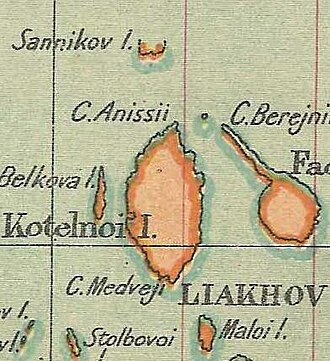
Toll's own glimpse of distant peaks felt, to him, like confirmation. "The report of Sannikov has been fully confirmed," he wrote in his diary at the time, convinced the mapmakers were right to draw that dotted line4. He spent the next years lobbying for an expedition that could finally land on the place, and in 1900 the Imperial Academy of Sciences backed him1,2.
The ship built for the job was Zarya, "Dawn," and it left Kronstadt on 4 July 1900 under Toll's command, with naval officer Alexander Kolchak as second-in-command and Nikolai Kolomeitsev as its first captain1,4. Kolomeitsev left after friction with Toll and Fyodor Matisen took over the helm1. The ship wintered twice in the ice, and in August 1901 it pushed into the Laptev Sea toward the New Siberian Islands, only to be boxed in by pack ice before it ever got near the land Toll was after3.

By February 1902 Toll had shifted his plan. Sannikov Land, if it existed, lay somewhere beyond reach by ship that season. Bennett Island, surveyed by no one since its discovery in 1881, became the new target, a place he could examine on foot while the ice made up its mind9. On 5 June 1902, Toll, astronomer Friedrich Seeberg, and guides Vasily Gorokhov and Nikolai Protodyakonov set off by sledge and kayak, leaving Zarya anchored at Nerpichья Bay on Kotelny Island8. They reached Bennett Island on 3 August, two months after setting out, and began surveying its geology and wildlife while they waited for the ship8.
The ship never came. What Toll did not know, and what later searches would make clear, is that the land he had spent two decades chasing was probably never there at all. Modern mapping, repeated search voyages (including a Soviet icebreaker's sweep in 1937), and the physics of Arctic light point to a mirage, a trick of refraction known as fata morgana, or simply a distant misreading of Bennett Island itself3. A minority of geographers still argue Sannikov Land once existed as low ground that eroded into a sand shoal, the way other islands in that archipelago have vanished within living memory3, but no landing, no soil sample, no photograph ever confirmed solid ground where the dotted line sat on the map.
On Bennett Island, Toll's party waited through the brief Arctic summer and into autumn. On 26 October 1902, by polar night, with the temperature near thirty degrees below, they gave up waiting and started back toward the New Siberian Islands on foot and by kayak across the ice4,8. The last entry in Toll's diary, found later in the hut he had built, read: "We are leaving today for the south. We have provisions for 14 to 20 days. All are healthy"4,7.
No trace of the four men turned up after that. Search parties went out in 1903, one under engineer Mikhail Brusnev along the New Siberian coast, another under Alexander Kolchak by whaleboat to Bennett Island itself, where they recovered the diaries, specimens, and that last note but no bodies1,6. Kolchak's search party left a stone cairn on the island in 1903, and a wooden cross went up there a decade later8. The ship that had sat ice-bound ninety miles away never got a second chance to close that distance.
Who Was Who
- Eduard von Toll: Baltic German geologist and expedition leader, convinced since 1886 that he had seen Sannikov Land himself1.
- Yakov Sannikov: Yakut hunter and explorer whose early 1800s sighting gave the phantom island its name3,4.
- Matvei Hedenstrom: Surveyor who reported the same distant land alongside Sannikov around 1808 to 18103,4.
- Alexander Kolchak: Naval officer and second-in-command of the expedition, who later led the 1903 search party to Bennett Island1,6.
- Fyodor Matisen: Naval officer who captained Zarya after Nikolai Kolomeitsev's departure, and brought the ship back when it could not reach Bennett Island1,8.
- Friedrich Seeberg: Astronomer and meteorologist who accompanied Toll to Bennett Island and vanished with him8.
- Vasily Gorokhov and Nikolai Protodyakonov: Guides and sled drivers on the final journey, also lost with Toll8.
What Happened to the Land, and the Men
Sannikov Land itself is now treated by most historians and geographers as never having existed in any fixed form, the product of mirage, atmospheric refraction, or a misread sighting of Bennett Island3. A minority view holds that low, ice-rich ground once stood there and eroded away, as other islands in the New Siberian group have done within recorded memory3. No expedition, Toll's included, ever confirmed solid land at the location marked on the maps.
The fate of Toll's party is similarly unresolved. The diary and final note recovered on Bennett Island establish that the four men left on 26 October 1902 with two to three weeks of food, intending to cross the ice toward the New Siberian Islands4,7,8. What happened after that was never documented. No bodies, graves, or further notes have been found, and no source claims otherwise.
Timeline
- 1808-1810Yakov Sannikov and Matvei Hedenstrom report sighting distant land north of Kotelny Island3,4.
- 1886Eduard von Toll, on an earlier survey expedition, reports seeing the same land and treats it as confirmation1,4.
- 4 July 1900Zarya leaves Kronstadt under Toll's command at the start of the Russian Polar Expedition1,4.
- August 1901Zarya reaches the New Siberian Islands area but is blocked by pack ice before it can search for the land3.
- 5 June 1902Toll, Seeberg, Gorokhov, and Protodyakonov leave Zarya by sledge and kayak for Bennett Island8.
- 3 August 1902Toll's party reaches Bennett Island and begins survey work while awaiting the ship8.
- September 1902Zarya, blocked by ice ninety miles from Bennett Island and low on coal, turns back toward Tiksi Bay8.
- 26 October 1902Toll's party leaves Bennett Island on foot, according to the final diary entry, with 14 to 20 days of food4,7.
- 1903Search parties under Mikhail Brusnev and Alexander Kolchak recover diaries and the final note but find no trace of the four men1,6.
- 1937A Soviet icebreaker search finds no sign of Sannikov Land3.
Pictures


Sources
- Eduard von TollWikipedia
- Russian polar expedition of 1900–1902 - WikipediaWikipedia
- Sannikov LandWikipedia
- 125 лет назад на поиски загадочной Земли Санникова отправилась экспедиция Эдуарда Толля - Родинаrodina-history.ru · 2025
- 125 лет назад началась экспедиция выдающегося арктического ...arctic.narfu.ru
- Baron Eduard Vasilievich von Toll: Encyclopedia Arctica 15: Biographiescollections.dartmouth.edu
- Дневники барона Эдуарда Толля. Русская полярная экспедиция ...livelib.ru
- В поисках Толляexo-ykt.ru · 2018
- Baron Eduard Vasilievich von Toll Encyclopedia Arctica 15: Biographiescollections.dartmouth.edu
Researched and written by Lorelet from the sources above. It cites as it goes, but it can still get things wrong, so check the sources for anything that matters.
Report a problem
More featured lorelets
See all
Today · History
Ali Maow Maalin and the Last Case of Smallpox
In 1977 a hospital cook in a small Somali port came down with a fever that doctors first called malaria. What his case set in motion would end one of…

Today · History
The Sign That Promised More Than a Movie
On opening day in 1921, Chicago crowds lined up hours early for a new movie palace on State Street. The real draw wasn't only on the screen.

Oct 25 · History
The Zinoviev Letter and Britain's 1924 Red Scare
Four days before a general election, a newspaper published a secret document said to prove Moscow was plotting with Britain's governing party. Decade…