
Featured · TodayHistory
Blaise Pascal and the World's First Bus Line
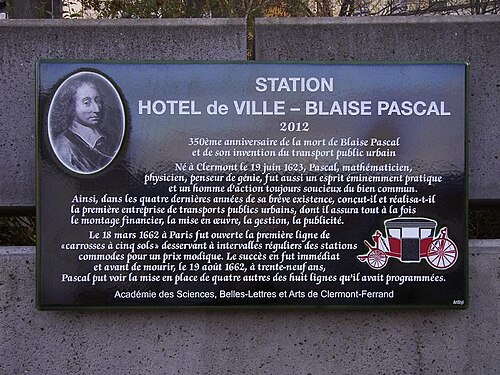
In 1662 a sickly mathematician built Paris a transit network with fixed routes, schedules, and a flat fare. It worked almost immediately.
Listen
Read by Finch · 6 min
Seven Coaches at Porte Saint-Antoine
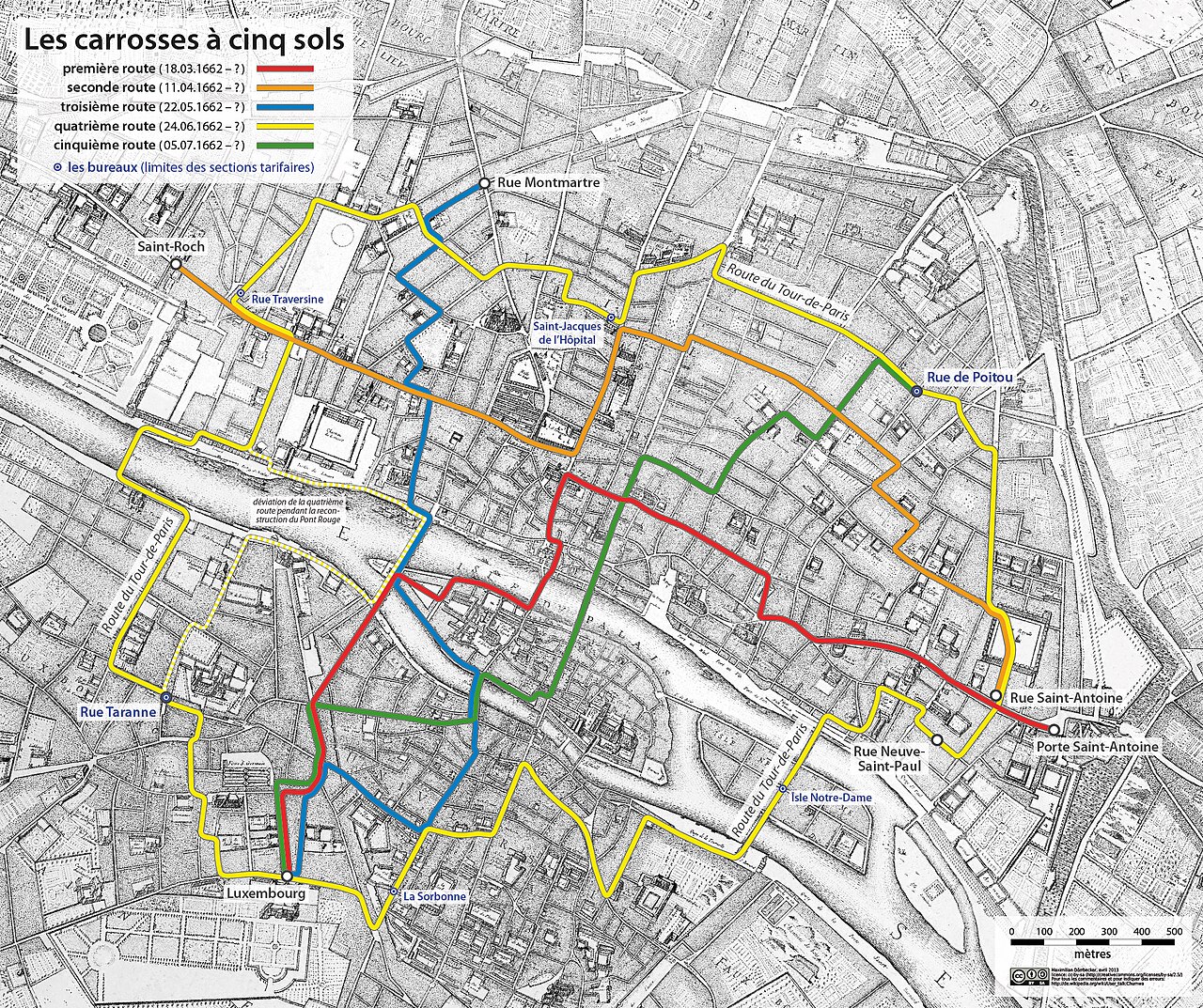
On the morning of 18 March 1662, seven coaches stood ready at the Porte Saint-Antoine, bound for the Luxembourg gardens by way of the Pont au Change, the Pont Neuf, and the Rue Dauphine1,6. Blaise Pascal's sister, Gilberte Périer, was there to see it off. The launch began at seven in the morning, she wrote, "with a brilliance and pomp that were marvelous," as the seven carriages assigned to the route filled with passengers4,5.
By the time Parisians had finished lunch, the crowds waiting for a seat were too large to even approach the coaches, Gilberte recorded, and the days after opening were no different4,5. The city's own biggest complaint, she noted, was not that the system failed but that it succeeded too well: only seven coaches ran the route, nowhere near enough for everyone who wanted one5. It looked, for a moment, like Paris had solved a problem it didn't yet have a name for.
The man behind the scheme was already one of the most famous minds in France. Blaise Pascal had been a child prodigy, publishing serious mathematics at sixteen, inventing a mechanical calculator in his twenties, and corresponding with Pierre de Fermat on the theory of probability7. By 1662 he was also gravely ill, the latest chapter in a lifetime of poor health, and he would die that August at thirty-eight7,2. According to a 2023 account in Geo, he had nearly drowned crossing the Pont de Neuilly in his own carriage in 1654, and had watched Paris traffic from his apartment on the Rue Monsieur-le-Prince with something like alarm: jostling crowds, falling roof tiles, slick cobblestones, herds of cattle, the occasional robbery6. Keeping a private coach and horses was expensive even for a wealthy man, let alone an ordinary one, and Pascal reportedly set out to build something cheaper, partly to help the poor and disabled move around the city more safely6.
What he designed was not simply a cheaper coach. It was a system: carriages that would run the same route every time, depart at fixed hours whether full or empty, and charge every rider the same five sols regardless of how many seats were taken1,8. A corporation founded in November 1661 on Pascal's initiative, together with the Duke of Roannez, the Marquis de Sourches, and the Marquis de Crenan, petitioned for the right to run exactly this kind of service1. Louis XIV signed the letters patent on 19 January 1662, granting the group exclusive rights to operate it1,3. The Parlement of Paris registered the authorization on 27 February, though it moved quickly to narrow what the king had granted1,9.

The narrowing came on 27 March 1662, nine days after the launch at Porte Saint-Antoine. The Parlement barred soldiers, servants, liveried retainers, and pages from riding, "to assure the greater comfort and freedom of the bourgeois and meritorious classes," according to Wikipedia's summary of the order1. The nobility, for its part, simply refused to share a coach with commoners at all6. A system built, by its founders' own account, to let "the people who enjoy that commodity" travel without paying for empty seats around them, had been redirected toward exactly the people who needed it least1.
Pascal did not stop building. Between April and July 1662 he opened four more routes, reaching the busy Châtelet and Louvre districts, reportedly at the king's own request6. One new line introduced distance-based fares on a circular route divided into six sections1. A Marais theater troupe staged a hit comedy that spring mocking the whole craze, L'Intrigue des carrosses à cinq sols, proof the coaches had become a genuine part of Parisian conversation6,9. But the fare was later raised from five to six sols, and public goodwill curdled as the restrictions took hold1. Pascal died that August, before any of this played out2. The company tried and failed to export the model to Lyon and Amsterdam6. According to the historian Marc Gaillard, the service lingered until 1677, about fifteen years after that first cheering crowd at Porte Saint-Antoine, though no contemporary source records precisely when the last coach stopped running1,2.
Who Was Involved
- Blaise Pascal: Mathematician, physicist, and inventor who designed the system's fixed routes, schedules, and flat fare, reportedly motivated partly by concern for the poor and disabled7,2,6.
- Armand/Artus Gouffier de Roannez, Duke of Roannez: Pascal's friend and a principal aristocratic sponsor named in the royal concession2,9.
- Marquis de Sourches: Grand Provost of the Hôtel, named alongside Roannez in the 1662 letters patent; his men reportedly provided guards for the coaches1,6.
- Marquis de Crenan: The third named concessionaire in the royal authorization1,9.
- Gilberte Périer: Pascal's sister, present at the 18 March 1662 launch and the source of the most vivid surviving eyewitness account of it4,5.
- Louis XIV: Signed the letters patent authorizing the monopoly on 19 January 16621,3.
- The Parlement of Paris: Registered the king's authorization but imposed the class-based restrictions that undercut the service1,6.
By the Numbers
- 5 sols: the uniform fare for a ride on the carrosses à cinq sols1,10.
- 19 January 1662: date Louis XIV signed the letters patent authorizing the service1,3.
- 18 March 1662: date the first route opened, between Porte Saint-Antoine and the Luxembourg1,6.
- 7: number of coaches reportedly operating on the first route at launch1,4.
- 5: number of routes the network expanded to by mid-16621,11.
- 27 March 1662: date the Parlement barred soldiers, servants, liveried men, and pages from riding1,6.
- 1677: year the service is commonly said to have disappeared, roughly fifteen years after launch, according to historian Marc Gaillard1,2.
Timeline
- November 1661A corporation is founded on Pascal's initiative with aristocratic partners to pursue the project1.
- 19 January 1662Louis XIV signs letters patent authorizing the carrosses à cinq sols as a monopoly1,3.
- 27 February 1662The Parlement of Paris registers the royal authorization, with restrictions1,10,9.
- 18 March 1662The first route opens between Porte Saint-Antoine and the Luxembourg with seven coaches1,6,4.
- 27 March 1662The Parlement bars soldiers, servants, liveried retainers, and pages from riding1,6.
- 11 April to July 1662Four more routes open, expanding the network to five lines1,6.
- 19 August 1662Blaise Pascal dies in Paris at age 387,2.
- 1677The service is commonly said to have ended, about fifteen years after launch1,2.
Pictures


Sources
- Carrosses à cinq solsWikipedia
- Today in History March 18 | Blaise Pascal's “Bus” SystemBritannica
- Il était une fois dans le 12e n°3 Les carrosses à 5 sols- ...histoireetpatrimoinedu12.fr
- Cómo nació el primer sistema de transporte colectivo del mundo - BBC News MundoBBC · 2018
- Como nasceu o primeiro sistema de transporte coletivo do mundo - BBC News BrasilBBC · 2018
- Le jour où Pascal inventa les transports en commungeo.fr · 2023
- Blaise PascalWikipedia
- Les carrosses à 5 sols - Blaise Pascalblaisepascal.bibliotheques-clermontmetropole.eu
- Les carrosses à cinq sols/Texte entier - Wikisourcefr.wikisource.org
- Podcast / C'est arrivé le. 18 mars 1662 : Blaise Pascal ...estrepublicain.fr
- Les bus parisiens, cinq siècles d'histoireparis.fr
Researched and written by Lorelet from the sources above. It cites as it goes, but it can still get things wrong, so check the sources for anything that matters.
Report a problem
More featured lorelets
See all
Today · History
The Battleship Britain Pretended Not to Lose
A brand-new dreadnought went down within sight of an ocean liner full of passengers and cameras, and the Admiralty decided the best response was to s…

Today · Art & Design
The Painting Over the Hotplate
An auctioneer had seven days to empty a house in northern France before its contents went to the dump. One grimy panel over the kitchen hotplate almo…

Oct 26 · History
Baron von Toll and the Island That Wasn't There
An Arctic ship sat trapped in ice, ninety miles from four men waiting on a remote island for a rescue that could not come.