
Featured · TodaySpace
The Thousand-Mile Cloud That Shouldn't Exist
A white streak kept appearing beside a Martian volcano, growing fast and vanishing by lunch. It took eight years and a small army of orbiter images to figure out what was actually making it.

Listen
Read by Finch · 7 min
A Streak Beside the Volcano
On 13 September 2018, the Visual Monitoring Camera aboard ESA's Mars Express sent back an image with something odd in it: a long, bright white feature stretching away from Arsia Mons, a 20-kilometre volcano near the Martian equator1,2,7. The camera was never built for serious atmospheric science. It had been installed mainly to watch the Beagle 2 lander separate from the spacecraft years earlier, and its job since then had mostly been wide, workmanlike shots of the planet2,8.
Nothing about the feature screamed danger. It did not behave like smoke or ash, and nobody thought Arsia Mons, long dormant, had come back to life. But the shape was wrong for an ordinary cloud: too long, too fast, too exactly tied to one slope of one mountain. It did not look like anything else anyone had catalogued on Mars.
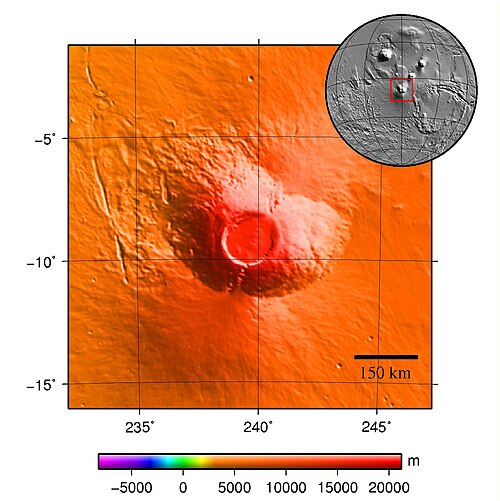
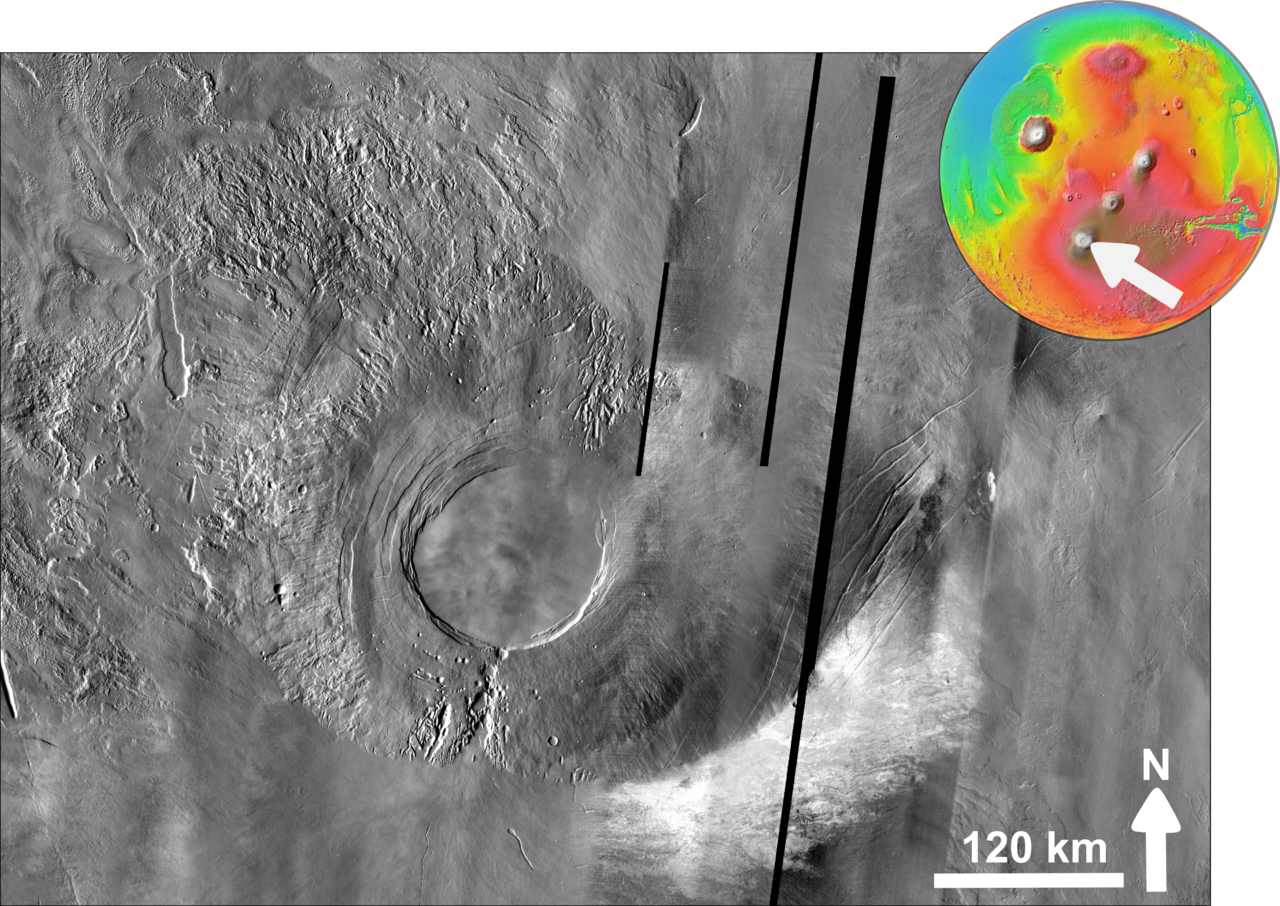
Arsia Mons sits at the southern end of the Tharsis Montes, a line of three giant shield volcanoes near the planet's equator, and it ranks among the largest volcanoes in the solar system, roughly thirty times the volume of Hawaii's Mauna Loa9. Mars Express has orbited the planet since 2003, carrying several cameras, and by 2018 scientists had already seen hints of a seasonal cloud near Arsia Mons in archived images from 2009, 2012, and 20152. What made September 2018 different was that researchers were now watching closely enough to catch it building in real time, during the tail end of a planet-wide dust storm whose fading haze seems to have made the cloud unusually vivid that year9.

The cloud kept growing through the following weeks. By 21 September it had been photographed clearly enough to document its structure10, and by 10 October it reached about 1,500 kilometres west of the volcano, roughly six times the volcano's own 250-kilometre diameter1,2. ESA scientists, including Agustin Sanchez-Lavega of the University of the Basque Country and Mars Express project scientist Dmitri Titov, described it publicly as a recurring, seasonal water-ice cloud tied to the volcano's leeward slope, not to any eruption2.
A sequence of images taken between 20 October and 1 November 2018 pinned down its daily rhythm. The cloud began growing before sunrise on the volcano's western slope, expanded westward for about two and a half hours at over 600 kilometres per hour, then detached from the volcano and drifted further on high-altitude winds before evaporating by late morning as the sun warmed the air4. Researchers eventually measured its maximum extent at about 1,800 kilometres long and 150 kilometres wide, at an altitude near 45 kilometres, nearly twice the length of Great Britain, vanishing and reforming every day for months each Martian year3,5.
Mars Express kept returning to it. A 2021 study combining years of camera data confirmed the cloud's seasonal pattern around the southern solstice11, and in June 2024 the orbiter's High Resolution Stereo Camera photographed it again, catching a 980-kilometre version of the same feature in exquisite detail6. By then the AMEC had been observed, in one form or another, across more than a decade of Martian years.
What still wasn't settled was how a cloud could form this fast, this far from any dust, at an altitude where the Martian atmosphere is almost unbearably thin. In October 2026, a team led by Jorge Hernandez-Bernal of LMD/CNRS/Sorbonne Universite published modelling results in Nature Geoscience that gave an answer nobody had expected. On Earth and, as far as anyone knew, everywhere else, clouds form around something: a speck of dust, soot, or salt that water vapour can cling to. The AMEC's water vapour appeared to skip that step entirely, freezing directly into ice crystals in open air, a process called homogeneous nucleation that textbooks describe but that had never actually been observed happening in any planet's atmosphere3. Hernandez-Bernal compared it to condensation appearing in the middle of a room instead of on a window3. The model showed wind hitting Arsia Mons generating a wave that shoves moist air several kilometres upward within minutes, dropping its temperature by 30 degrees in ten minutes and spiking the humidity to levels over 100,000 times anything routinely experienced on Earth3.
It took Mars Express, a camera never meant for this job, eight years of patient repeat visits to turn one strange white streak into evidence of a kind of cloud formation nobody had caught in the act before3,2.
Timeline
- 13 September 2018Mars Express's Visual Monitoring Camera first captures the elongated cloud beside Arsia Mons.
- 21 September 2018A clear image documents the cloud's structure during orbit 18627.
- 10 October 2018The cloud is photographed extending about 1,500 km westward of the volcano.
- 20 October - 1 November 2018A VMC image sequence reveals the cloud's full daily growth-and-evaporation cycle.
- 2019ESA reports continued monitoring, confirming the cloud as a regular seasonal feature.
- 2021A long-term study using VMC and other orbiter data measures the cloud's maximum size at about 1,800 x 150 km.
- 24 June 2024Mars Express's High Resolution Stereo Camera photographs a 980 km version of the cloud in detail.
- October 2026New modelling proposes homogeneous nucleation as the cloud's formation mechanism.
Pictures



Sources
- Elongated cloud on Mars – 10 October (annotated) - Mars Express - Science Portalsci.esa.int
- Mars Express keeps an eye on curious cloud - Mars Express - Science Portalsci.esa.int
- Mars’s oddest cloud may be even odder than we thoughtesa.int
- Evolution of the Arsia Mons Elongated Cloudesa.int
- ESA - Mars Express unlocks the secrets of curious cloudesa.int
- Mars Express views the most striking cloud on Marsesa.int
- [PDF] Dynamics of the extremely elongated cloud on Mars Arsia Mons ...elib.dlr.de
- Using the ESA’s Planetary Science Archive to Search for Mars Express VMC Data of an Elongated Cloud near Arsia MonsScholarly work (preprint) · 2021
- Arsia MonsWikipedia
- The Arsia Mons Elongated Cloud as seen by Mars Express - ESAesa.int
- ESA - Profile of the Arsia Mons Elongated Cloudesa.int
Researched and written by Lorelet from the sources above. It cites as it goes, but it can still get things wrong, so check the sources for anything that matters.
Report a problem
More featured lorelets
See all
Today · History
The Zinoviev Letter and Britain's 1924 Red Scare
Four days before a general election, a newspaper published a secret document said to prove Moscow was plotting with Britain's governing party. Decade…

Today · Science
Trapping Antimatter: The Hunt for Cosmic Asymmetry
At CERN, physicists have learned to hold antiprotons in magnetic bottles for months and measure them with brutal precision. The numbers keep coming b…

Oct 24 · Sports
The Battle of the Buffet: Who Hit Ferguson With Pizza?
A Premier League match that ended a historic unbeaten run spilled into the Old Trafford tunnel, where someone hit Sir Alex Ferguson with a flying sli…