Featured · TodayScience
When the Continents Marched in Lockstep
Rocks on five continents once recorded the same impossible motion, fast, synchronized, and in the same direction. Figuring out what could do that meant rethinking what a planet is allowed to do.

Listen
Read by Finch · 8 min
A Rotation Too Fast to Be Normal
Sometime between 450 and 440 million years ago, rocks now scattered across South China and four other continents locked in a record of motion that should not have been possible. Researchers compiling paleomagnetic data from those separate landmasses found they had all drifted in the same direction, at the same time, at speeds reaching about 55 centimeters a year, adding up to a wholesale rotation of roughly 50 degrees3.
Ordinary continents do not move like that. Plate tectonics shuffles landmasses at a few centimeters a year, each plate answering to its own collisions and spreading ridges, not marching in lockstep with the others3. Multiple isolated continents moving rapidly, synchronously, and in one direction pointed to something else entirely, researchers argued3.
That distinction matters more than it sounds. Plate motion is continents shoving against each other at their edges. Apparent polar wander is just what a continent's magnetic record looks like after the fact, a readout that can be produced by plate motion, true polar wander, or both tangled together1,2. True polar wander is the rarer and stranger thing: the crust and mantle reorienting together relative to the spin axis, so every continent on the planet drifts in latitude at once, in a coordinated way that ordinary drift cannot fake1,2.

The reorientation happens because Earth is not a perfectly balanced sphere. Its rotation is most stable when the planet's greatest moment of inertia lines up with the spin axis, roughly the way a thrown brick settles into tumbling around its shortest dimension1. Mantle convection, rising plumes, sinking slabs, the clustering of continents into a supercontinent, even ice sheets, can all shift that balance. When they shift it enough, the whole solid shell reorients itself, crust and mantle together, while the liquid outer core underneath stays coupled to it gravitationally and electromagnetically rather than acting as a fixed base to slide over1,2.
None of this is directly observable across hundreds of millions of years. What scientists have instead is paleomagnetism: the direction Earth's magnetic field was pointing gets frozen into cooling lava or settling sediment, preserving a rough fix on a rock's ancient latitude and orientation5. A true polar wander event becomes a credible claim only when several far-flung rock sequences, independently dated, show the same coordinated swing in that magnetic record, too fast and too synchronized to be explained by each continent going its own way2,3.
That is exactly what the 2022 study claimed to find, and the timing is what makes it more than a rotational curiosity. The 450 to 440 million year event overlaps the onset of the Late Ordovician glaciation and the end-Ordovician mass extinction, one of the five biggest die-offs in the fossil record3. The researchers proposed that as the whole solid Earth rotated, continents that had been sitting in warm latitudes could be carried rapidly toward the poles, while others swung the opposite way into the tropics, rearranging where ice sheets could grow, where sea level would fall, and which habitats would survive the transition3.
The paper's authors were careful about what they were and were not claiming. True polar wander did not reach down and kill species directly. What it could do, in their reconstruction, was redraw the map fast enough that glaciation and ecological disruption piled on top of each other within something like ten million years, a blink in geological terms even if it is far too slow for any observer to have felt it happen3. The puzzle that opened with five continents moving in eerie unison ends, in this telling, with the ground itself rearranging the planet's climate zones out from under everything living on it.
Other Times the Planet May Have Tipped
The 450-440 million year event is the best-supported recent case, but it is not the only one proposed. A 2022 study of South China's rock record argued for an even faster episode between 832 and 821 million years ago, with the solid Earth reorienting by more than 5 degrees per million years, a rate that would carry a surface point roughly 555 kilometers in latitude per million years if it moved straight along a meridian4.
Further back still, geologist Robert Evans proposed in a 2003 synthesis that the long interval from about 1.2 billion to 200 million years ago shows TPW tangled up with the assembly of the supercontinents Rodinia and Gondwana, with Laurentia and other fragments recording rapid, sometimes oscillating shifts in latitude as those landmasses came together6. A separate modeling study by Shijie Zhong and colleagues in 2007 showed how continents themselves can help organize mantle convection into the large-scale patterns that drive this kind of reorientation across the supercontinent cycle7.
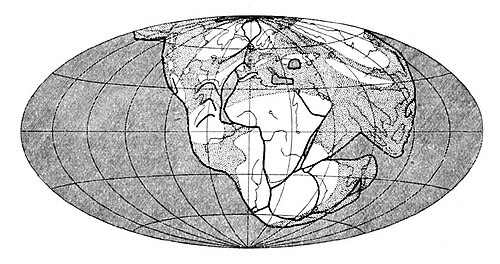
A Mesozoic episode has also been proposed, between roughly 195 and 145 million years ago, when geophysicists Bernhard Steinberger and Trond Torsvik identified an apparent 18-degree clockwise rotation of the continents around an axis running near 10 to 20 degrees west longitude, during the breakup of Pangaea2. In each case the logic is the same: look for rock records on different continents that shift in paleolatitude together, too fast and too coherent for ordinary drift, then check whether independent evidence, like glacial deposits or sea level changes, moves in step.
What's Still Argued Over
Not every proposed TPW event has held up. A paper pointedly titled "Late Cretaceous True Polar Wander: Not So Fast" challenged an earlier claim of a rapid Late Cretaceous oscillation, and later work found no evidence for that specific swing, questioning what it would mean for Earth's long-term stability relative to its rotation axis2.
The underlying problem is that paleomagnetism is a fragile kind of evidence. Magnetic directions can be scrambled if a rock is reheated later, continents can rotate or deform on their own, Earth's magnetic field does not always behave as a simple dipole, and sloppy radiometric dating can manufacture a "rapid" event that never happened2. A 2023 review in Science China Earth Sciences noted that the whole concept spent decades treated like, in the authors' words, a "ghost process that may or may not exist," even though its physical basis is no longer seriously disputed2.
What remains contested is not whether true polar wander happens (it does, and is measurable today) but how often it happened at large scale across deep time, how fast, and how directly it shaped past climate and extinction events2,3. Different research groups reading the same rocks can land on very different stories, which is why each new claim tends to arrive with a rebuttal close behind.
Timeline
- ~832-821 million years agoA proposed rapid TPW event recorded in South China, exceeding 5 degrees per million years4.
- ~450-440 million years agoA roughly 50-degree TPW event proposed from paleomagnetic data on five continents, overlapping the Late Ordovician glaciation and mass extinction3.
- ~195-145 million years agoA Mesozoic TPW episode proposed by Steinberger and Torsvik, an 18-degree rotation during Pangaea's breakup2.
- 2000A Science paper challenges an earlier claim of rapid Late Cretaceous TPW oscillation2.
- 2022Studies report both the 832-821 Ma and 450-440 Ma TPW events using updated paleomagnetic and geochronologic data4,3.
Pictures


Sources
- True polar wanderWikipedia
- True polar wander in the Earth system - Science China Earth Scienceslink.springer.com · 2023
- Ordovician–Silurian true polar wander as a mechanism for severe glaciation and mass extinction - Nature CommunicationsNature · 2022
- True dipole wanderacademic.oup.com
- PaleomagnetismWikipedia
- True polar wander and supercontinentsui.adsabs.harvard.edu
- Late Cretaceous True Polar Wander: Not So FastScience
- [PDF] Evidence for a Large-Scale Reorganization of Early Cambrian ...earth.yale.edu
- Ordovician-Silurian true polar wander as a mechanism for severe glaciation and mass extinction.Scholarly work · 2022
- No Late Cretaceous true polar wander oscillation and implications for stability of Earth relative to the rotation axissciencedirect.com
Researched and written by Lorelet from the sources above. It cites as it goes, but it can still get things wrong, so check the sources for anything that matters.
Report a problem
More featured lorelets
See all
Today · Film & TV
The Princess Diana Pay-Per-View Seance
In March 2003, two British psychics claimed to put viewers in touch with a dead princess. What they were allowed to broadcast depended entirely on wh…

Today · History
Harvie's Dyke and the Fight for the Clyde Path
A Glasgow distiller walled off a riverside path his neighbors had walked for generations. What happened next took six years, a mob, and the House of…

Oct 19 · Technology
The Company That Tried to Own ‘Cyberspace’
A software firm wanted the word from William Gibson's novels for its own virtual reality project. His response became one of the stranger footnotes i…