
Featured · Oct 29History
The Secret Fingerprints of China's Terracotta Army
Farmers digging a well outside Xi'an in 1974 uncovered an underground army of thousands. More than fifty years later, scientists are still reading the hands that made it.

Listen
Read by Finch · 9 min
A Well, Some Arrows, an Army
In 1974, farmers digging a well about a kilometer and a half east of Qin Shi Huang's tomb mound at Mount Li hit something that was not groundwater8. It was pottery fragments and bronze arrows, buried in ground riddled with old springs and watercourses1,8. The diggers, identified in later accounts as Yang Zhifa, his five brothers, and a neighbor named Wang Puzhi, had no way of knowing they had just reached the edge of an underground military formation built more than two thousand years earlier8.
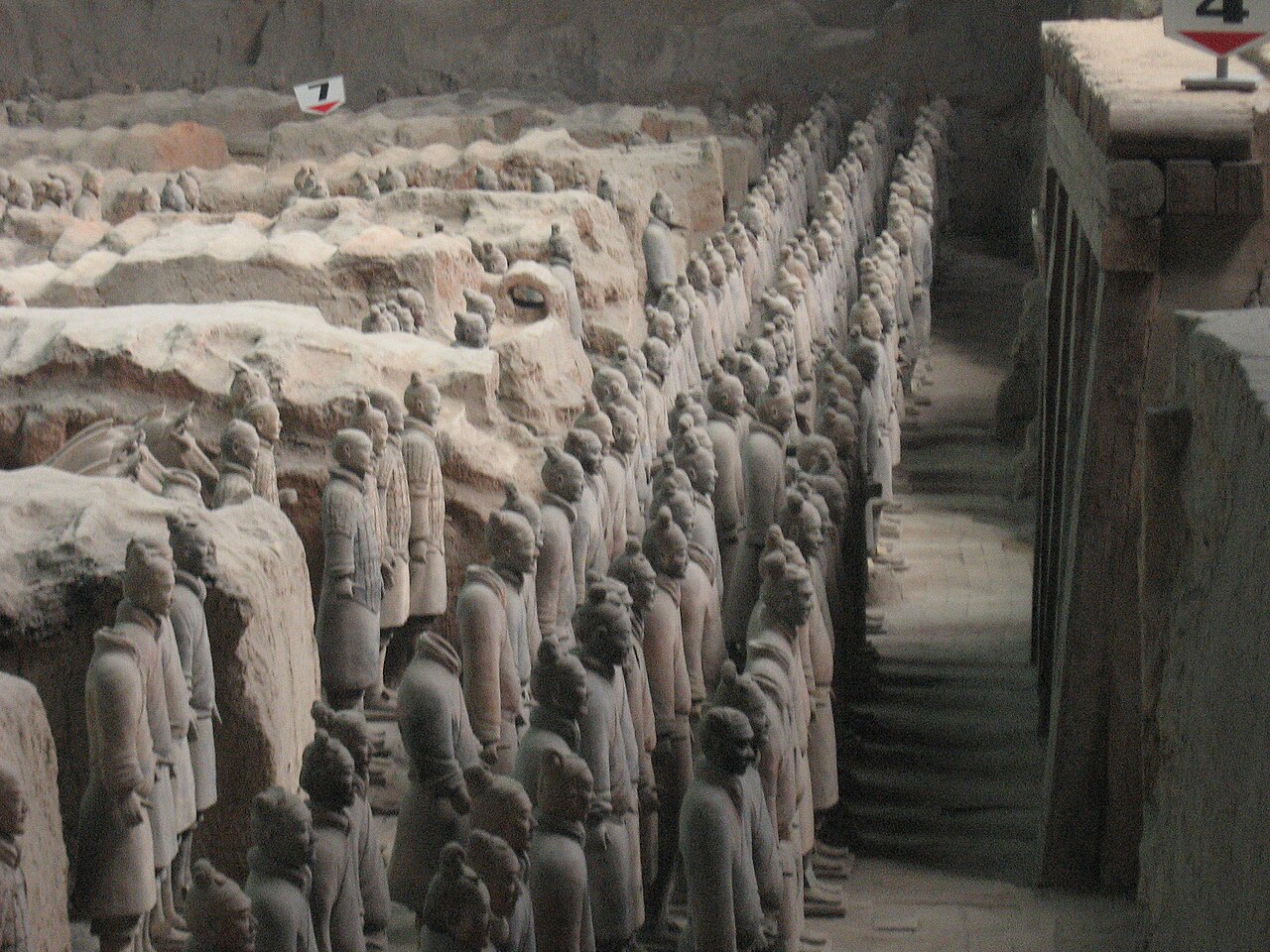
What they had found, archaeologists would discover, was one piece of a vast funerary project: thousands of life-size clay soldiers, horses, and chariots arranged in battle order to guard the First Emperor of China in death1,8. For decades afterward, the obvious question, who actually made all this, got a fairly obvious answer. Qin military and labor records are dominated by men, the figures themselves are soldiers, and so the default assumption was an all-male workforce of conscripts and craftsmen2,9.
The army was manufactured in government workshops using local materials, with heads, arms, legs, and torsos built separately and then joined together before firing8. Sima Qian's Records of the Grand Historian, written about a century after the mausoleum was finished, says 700,000 conscripted workers eventually worked on the larger tomb complex, though that account never mentions the terracotta figures directly8,10. Full-scale construction began after Qin Shi Huang unified China in 221 BCE, and the emperor died and was buried in 210 BCE, work on the mausoleum having started back in 246 BCE when he was a 13-year-old king10,1.

The clay itself held a different kind of record. Workers pressed their fingers into the wet surfaces while shaping, molding, and assembling the figures, and when the clay was fired those impressions became permanent9,11. A team led by archaeologist Xiaoxi Li at the Emperor Qinshihuang's Mausoleum Site Museum, working with Shandong University, went looking for exactly that evidence: not names, not faces, just ridges in fired clay3,12.
They focused on Unit T23 in Pit 1 and pulled 79 well-preserved fingerprints from 36 warriors, found on arms, armor, bodies, and heads2,9. Of those, 73 prints looked like they came from shaping, molding, or assembling the clay body itself, while six came from pressing pre-made decorative pieces, like armor rivets and belts, into place3. Ridge spacing tends to widen as a person grows from childhood into adulthood, so the researchers measured that spacing across all 79 prints and ran the results through a Bayesian mixture model to estimate who had left them9,7.

The model's answer broke the old assumption. Adult men accounted for an estimated 45.0 percent of the print assemblage, adult women for 32.7 percent, and juveniles under 15 for 22.3 percent, that age threshold chosen because Qin legal texts used it to mark the boundary of criminal responsibility and eligibility for forced labor2,5,6. As the researchers put it in the Journal of Cultural Heritage, published October 13, 2026, "Our results provide the first biological evidence for a diverse workforce including adult females and juveniles"5,4.
The caveats matter as much as the numbers. The sample is 36 figures out of thousands, drawn from a single excavation area in one of three pits, and a fingerprint cannot be tied to a named person6,7. The researchers themselves noted that inexperienced workers, plausibly women and children among them, may have been more likely to leave prints behind than trained artisans who finished and smoothed their work more carefully, erasing their own traces5. Still, for a project assumed for fifty years to be the product of adult male labor alone, the clay itself, the same clay that farmers struck with their well-digging tools in 1974, turned out to be holding a far more mixed workshop than anyone had pictured2,8.
What the Mausoleum Was For
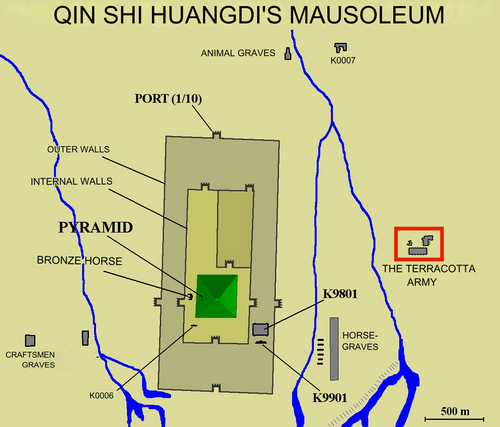
The Terracotta Army was never meant to be found. It was funerary art, buried alongside Qin Shi Huang to protect him in the afterlife, part of a necropolis that modern surveys estimate covers roughly 98 square kilometers around his tomb mound8. The mound itself, a truncated pyramid about 76 meters tall, sits in what is now Lintong District outside Xi'an, in Shaanxi Province10.
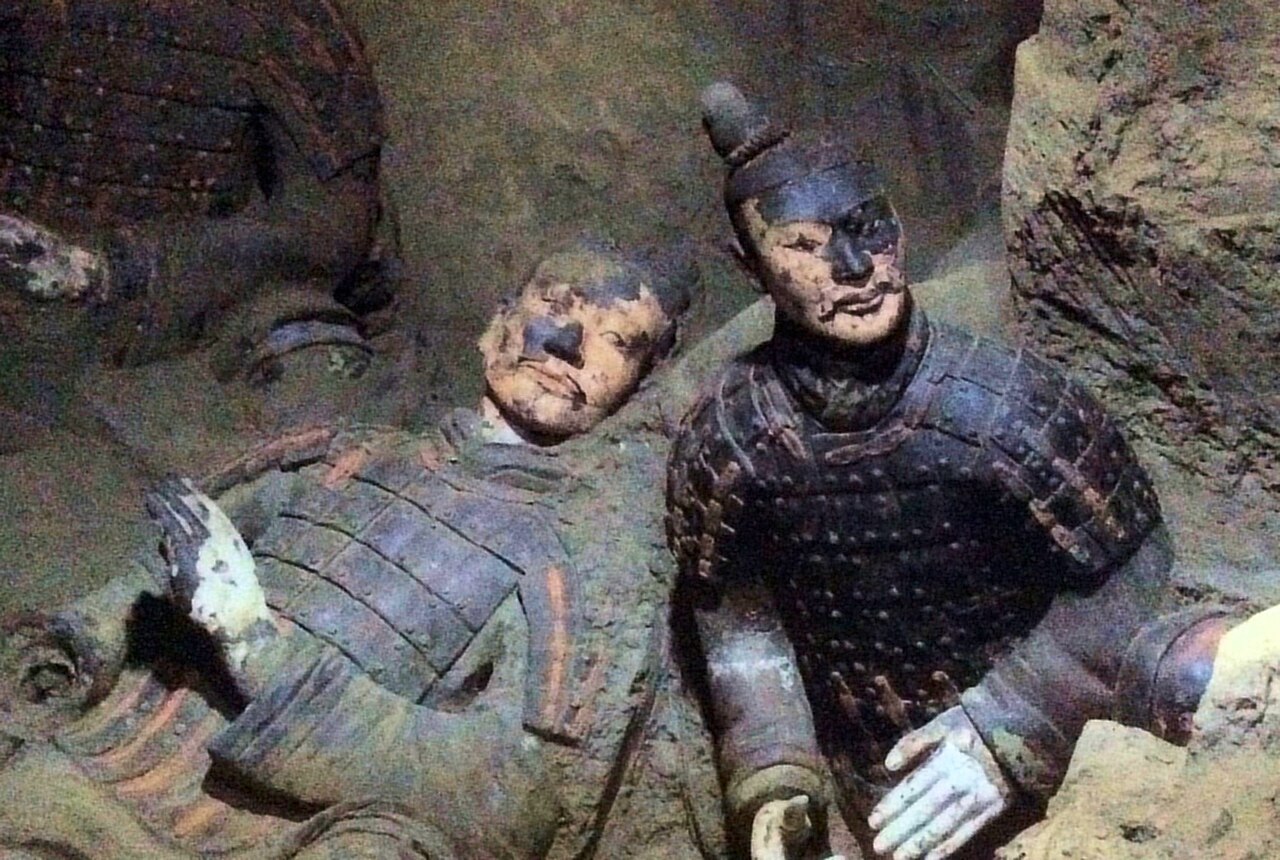
The tomb proper has never been opened, partly over fears of what exposure would do to anything inside; terracotta paint has been seen to flake within minutes once uncovered to Xi'an's dry air8. Archaeologists have instead worked the surrounding pits, which besides thousands of soldiers, chariots, and horses have also produced figures of acrobats, civil servants, and waterfowl, a reflection, one former excavation director said, of an entire state bureaucracy the emperor wanted buried with him8,2.
Separate evidence, including inscriptions on Qin dynasty lacquerware using titles like "adult woman," "young girl," and "young boy," already showed that women and children took part in other state-run craft production of the period13. Whether that extended to the army guarding the emperor's tomb was, until the fingerprint study, an open question13.
The Fingerprint Count
- 79: well-preserved fingerprints analyzed, pulled from 36 terracotta warriors2,6.
- 36: figures sampled, all from Unit T23 in Pit 1 of the mausoleum complex2,3.
- 45.0%: estimated share of the sampled prints left by adult men2,5,6.
- 32.7%: estimated share left by adult women2,5,6.
- 22.3%: estimated share left by juveniles under 15, an age line drawn from Qin legal texts9,12.
- 73 vs. 6: prints tied to shaping/molding/assembly versus prints tied to pressing on pre-made decorations like armor rivets3.
- ~8,000: estimated total warriors across the mausoleum's pits, the scale against which this one small sample sits8,1.
What the Study Does Not Prove
The headline version, that women and children built the Terracotta Army, overstates what one sample can show. The 45/33/22 split describes an estimated mix of fingerprints in 36 figures from a single excavation unit, not a census of everyone who ever worked on the project6,7.
The researchers themselves flagged the limits: fingerprints cannot be matched to named individuals, one person could have left prints on several figures, and the sample may reflect a specific production phase or workshop crew rather than the whole labor force6,12. They have called for analyzing fingerprints from other pits and excavation areas to see whether the pattern holds6.
There's also a subtler bias worth noting. The study's authors suggest less experienced workers, who may disproportionately have been women and children functioning as helpers or apprentices, were more likely to leave visible prints at all, since skilled artisans often smoothed clay surfaces clean after finishing5. That does not undercut the finding that a mixed workforce existed, but it complicates any claim about exact proportions among all workers, skilled or not5.
Timeline
- 246 BCEConstruction begins on Qin Shi Huang's mausoleum complex near Mount Li10.
- 221 BCEQin Shi Huang unifies China and full-scale construction of the mausoleum accelerates10.
- 210 BCEQin Shi Huang dies and is buried in the mausoleum1.
- 1974Farmers digging a well near Xi'an strike pottery fragments and bronze arrows, leading to the Terracotta Army's discovery8,1.
- 2026-10-13A study in the Journal of Cultural Heritage reports fingerprint evidence of adult women and juveniles among the army's makers4.
Pictures


Sources
- Terracotta Army: Legacy of the First Emperor of China on ...cincinnatiartmuseum.org
- Who really made China's Terracotta Army? Fingerprints reveal ...phys.org
- Fingerprints on China's 2,200-year-old clay army point to women and children among its makers - VnExpress Internationale.vnexpress.net
- China’s Terracotta Army may have been mainly built by women and children: studyscmp.com · 2026
- Did Women and Children Collaborate With Male Artisans to Create China's Terra-Cotta Army? Fingerprints Left on the 2,000-Year-Old Clay Warriors May Hold the AnswerSmithsonian Magazine · 2026
- The Terracotta Army Holds a Hidden Clue About Who Built It, New Study Findscolombiaone.com · 2026
- Study reveals women and teenagers helped build Terracotta Army | China Labour Bulletin Boardclb.org.hk
- Terracotta ArmyWikipedia
- Fingerprint analysis reveals something remarkable about makers of ...yahoo.com
- Mausoleum of Qin Shi HuangWikipedia
- Fingerprints Pressed Into China’s Terracotta Army Reveal a Secret Buried for More Than 2,200 Yearsyahoo.com
- 2,200-Year-Old Fingerprints Reveal Who Really Built China's Mysterious Terracotta Armysciencealert.com · 2026
- Fingerprint analysis reveals something remarkable about makers of Terracotta Armyindependent.co.uk · 2026
Researched and written by Lorelet from the sources above. It cites as it goes, but it can still get things wrong, so check the sources for anything that matters.
Report a problem
More featured lorelets
See all
Today · Food
The Turkey Surplus That Became the TV Dinner
A company drowning in frozen birds found an answer on an airline food cart, or so the story goes for fifty years.

Today · Space
Why Is Jupiter's Great Red Spot Actually Red?
Jupiter is built almost entirely of colorless gas, yet its most famous storm glows orange-red. Scientists have spent decades in the lab trying to fig…

Today · Art & Design
The Aztec Labret Whose Golden Tongue Still Moves
A small gold serpent made for a pierced lip somehow ended up with a tongue that flicks side to side. No one alive has ever seen it worn.