Featured · TodayHistory
The Real Jolly Roger: Rare Surviving Pirate Flags
Pop culture gives every pirate a crisp skull-and-crossbones banner. Reality left behind maybe two or three faded, bullet-scarred scraps of cloth, and none of them belonged to Blackbeard.
Listen
Read by Finch · 10 min
A Flag With Gunpowder Still in It
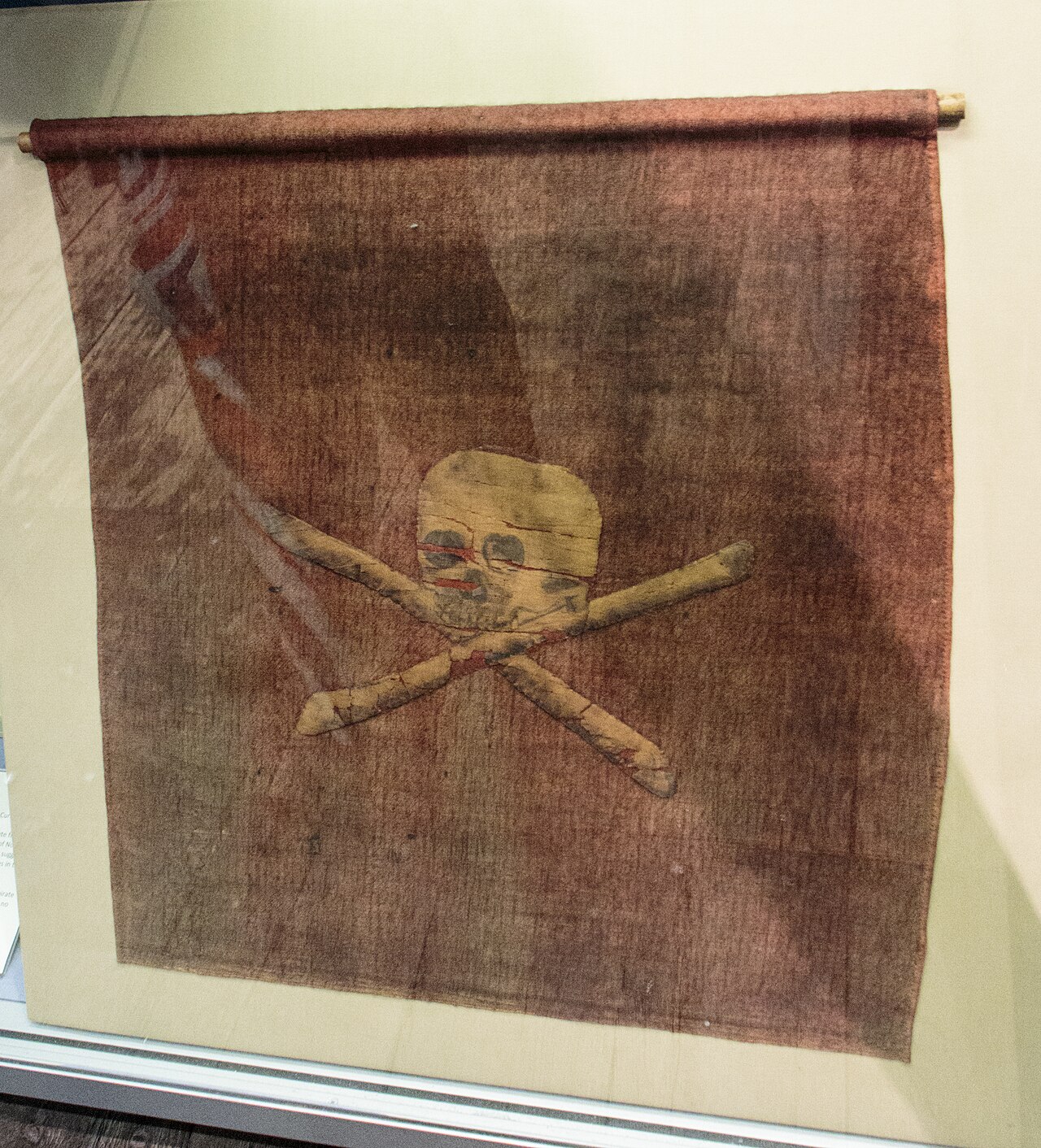
In December 2011, a faded red cloth went on display at the National Museum of the Royal Navy in Portsmouth, billed as one of the only genuine pirate flags left on earth2. It did not look like the Jolly Roger of the movies. The background was red, not black, and the skull and crossbones on it had dulled with age.
The flag's story, as told by the museum, starts in 1780, when Lieutenant Richard Curry captured it in battle off the North African coast2. Curry went on to become an admiral, and the flag stayed in his family for generations, eventually loaned to the museum by his descendant Pamela Curry2. When conservators at the Winchester School of Art examined it in 2007, they found gunpowder residue and small holes with charred edges, the kind of damage you'd expect from a flag that was actually flying during a fight, not one sewn for a costume shop2.
That red color is not an accident of fading alone, or at least not entirely. Red pirate flags carried a specific threat: no quarter, meaning no mercy if the crew resisted6. A black flag, by contrast, usually meant surrender your cargo and you'll live. Curry's flag, in other words, was the pirates' way of saying there would be no negotiating.

What the museum can't tell you, because nobody can, is which specific vessel or captain the flag came from, the exact tactical details of the 1780 engagement, or lab-confirmed dating of the textile and pigments. It's a well-provenanced flag with a named officer and a documented family chain of custody, which puts it well ahead of almost everything else claiming to be an authentic pirate flag. It does not, however, come with a complete paper trail from capture to display case.
What "Jolly Roger" Actually Meant
The skull-and-crossbones-on-black image that everyone pictures was only one version among many. Pirate flags in the early 1700s came in red or black, decorated with skulls, full skeletons, weapons, hearts, hourglasses, or combinations of all of it1. The name "Jolly Roger" itself shows up in Captain Charles Johnson's 18th century pirate history, attached to Bartholomew Roberts in 1721 and Francis Spriggs in 1723, two pirates whose flags looked nothing alike1. The term was generic long before it was standardized.
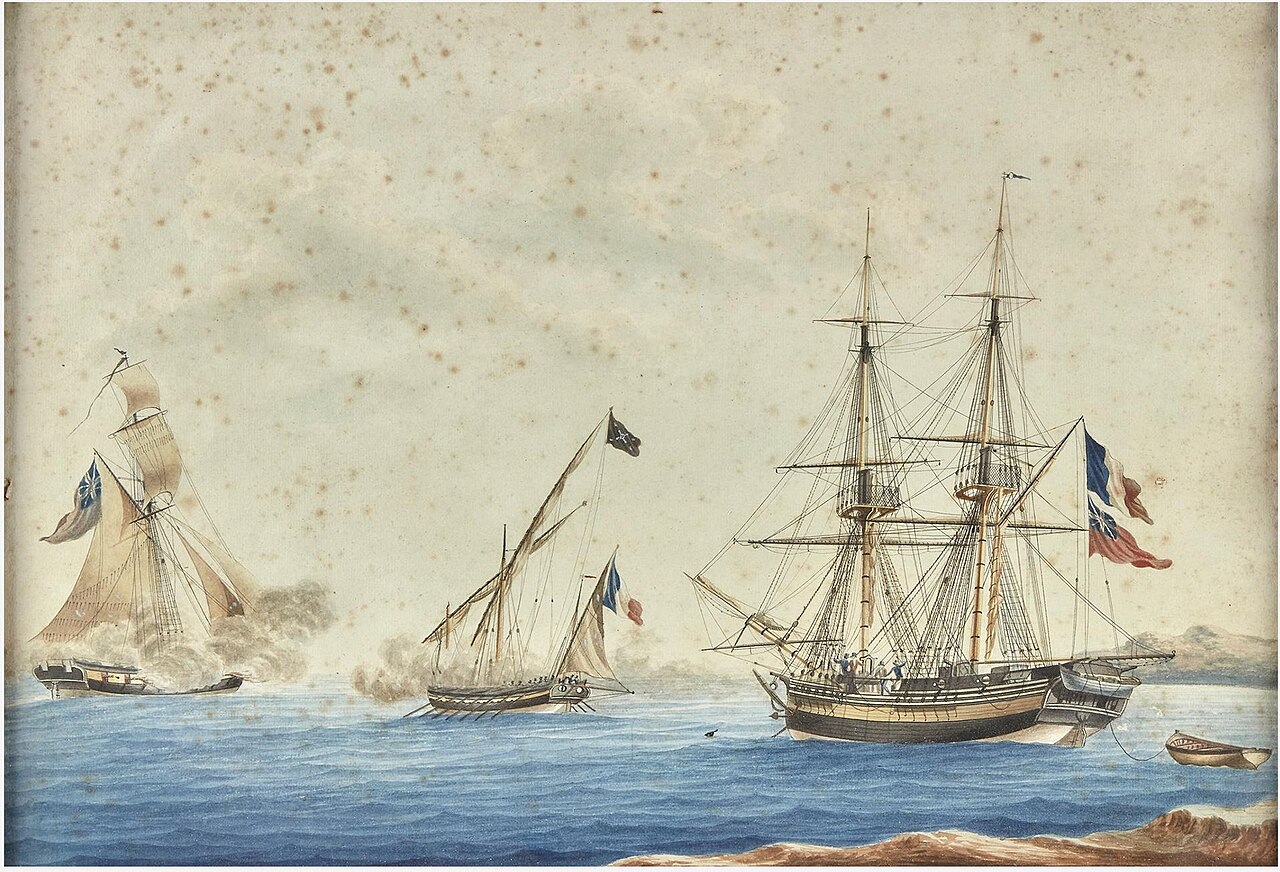
An early black flag with a skull, crossbones, and hourglass is attributed to the French pirate Emanuel Wynn, reported by a Royal Navy captain in 17007. Henry Avery is credited with an even earlier personalized flag in 1695, a red field with silver chevrons flown alongside the Cross of St George8. Both are documented in writing. Neither survives as an object.
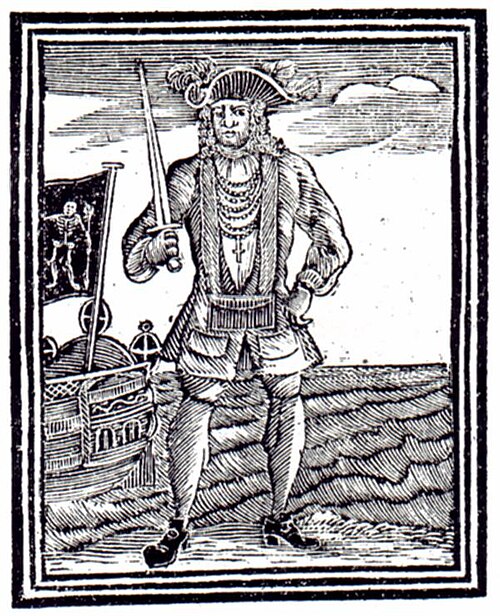
The reason almost nothing survives is mundane: these were working textiles, battered by salt water, sun, and handling, with no particular reason for anyone to preserve them once a ship was captured1. Historians reconstruct what pirate flags looked like mainly from eyewitness accounts, naval logs, trial records, and printed histories like Johnson's, not from cloth in a drawer somewhere.
Who's Who
- Richard Curry: Royal Navy lieutenant who reportedly captured the red Jolly Roger off North Africa in 1780 and later became an admiral2.
- Pamela Curry: Descendant of Richard Curry who loaned the flag to Portsmouth's museum in 20112.
- National Museum of the Royal Navy: Institution at Portsmouth Historic Dockyard that displays the Curry flag and researches Jolly Roger history2,6.
- Åland Maritime Museum: Finnish museum holding a flag associated with a captured Barbary vessel, one of the two strongest surviving candidates3.
- St. Augustine Pirate & Treasure Museum: Florida museum whose flag is often cited as authentic but carries disputed, possibly 1850s, provenance4,5.
- Barbary corsairs: North African raiders, often conflated with "pirates" in popular retellings, linked to most of the surviving flag candidates3.
The Count
- 2: flags most consistently described by researchers as credible surviving pirate flags, the Portsmouth red flag and the Åland flag9.
- 3: the count if you include the disputed St. Augustine flag, which is why online sources disagree on "two" versus "three"5,10.
- 1780: year the Portsmouth flag was reportedly captured by Lieutenant Richard Curry2.
- 1700: year a Royal Navy report describes pirate Emanuel Wynn's black skull-and-hourglass flag, the earliest widely cited description of the design7.
- 1721 and 1723: years Captain Charles Johnson's history ties the name "Jolly Roger" to pirates Bartholomew Roberts and Francis Spriggs, respectively1.
- 0: number of flags securely identified as having belonged to Blackbeard, Calico Jack, or Bartholomew Roberts.
What's Disputed
The St. Augustine flag is the clearest fault line. It's sometimes dated to around 1850, which would place it decades after the Golden Age of Piracy that gave us the Jolly Roger legend in the first place, and its ownership history is not backed by documentation comparable to Portsmouth's or Åland's4,5. Calling it a genuine pirate flag rather than an old flag displayed in a pirate museum requires a leap the evidence doesn't fully support.
Even the stronger candidates have gaps. Nothing in the public record for the Portsmouth flag nails down the specific corsair vessel it was taken from, and the Åland flag's capture date, capturing ship, and chain of custody are described in less detail than Curry's story3. Neither has been confirmed through published scientific dating of the textile itself, as far as the available accounts show.
There's also a labeling problem running through all of this. The North African raiders whose flags these likely were are usually called Barbary corsairs, state-connected or politically motivated raiders, not freelance pirates in the Caribbean sense. Museums and popular write-ups use "pirate" anyway, because it's the word people recognize, but it blurs a real legal and political distinction3.
Timeline
- 1695Henry Avery reportedly flies one of the earliest documented personalized pirate flags, red with silver chevrons8.
- 1700A Royal Navy report describes Emanuel Wynn's black flag with skull, crossbones, and hourglass7.
- 1721Bartholomew Roberts names his flag the "Jolly Roger," per Captain Charles Johnson's history1.
- 1723Francis Spriggs also names his flag "Jolly Roger," with a different design than Roberts's1.
- 1780Lieutenant Richard Curry reportedly captures a red Jolly Roger off the North African coast2.
- 2007Conservators at the Winchester School of Art find gunpowder residue and burn holes on the Curry flag2.
- 2011-12-14The Curry flag goes on public display at Portsmouth's National Museum of the Royal Navy, loaned by Pamela Curry2.
Pictures


Sources
- Pirate flags decoded | National Maritime Museum Greenwichrmg.co.uk
- Rare Jolly Roger goes on display at Portsmouth's navy museumBBC · 2011
- The flags in this image have nothing to do with Blackbeard, Calico ...x.com
- St. Augustine Pirate & Treasure Museum (2025) - Airial Travelairial.travel
- The only 3 authentic pirate flags known to be in existenceReddit
- Portsmouth's Royal Navy Submarine Museum waves new Jolly RogerBBC · 2024
- Every Pirate Had a Brand: The Fascinating Flags That Terrorized the ...owlcation.com
- Signaling Pirate Identityacademic.oup.com
- The only two authentic pirate flags known to existReddit
- There are only three preserved pirate flags in existence. (The first is pretty dubious)Reddit
Researched and written by Lorelet from the sources above. It cites as it goes, but it can still get things wrong, so check the sources for anything that matters.
Report a problem
More featured lorelets
See all
Today · Culture
Live Forever: The Carnival Sword That Made a Writer
In 1932, a traveling sideshow magician tapped a 12-year-old boy with an electrified sword and shouted two words that Ray Bradbury spent the rest of h…
Today · History
The Little Cannon That Started a Revolution
A loaned Mexican cannon, a buried gun in a peach orchard, and a hand-painted flag daring soldiers to come and take it: how a small-town squabble in G…

Oct 1 · Film & TV
Why Nick Jr. Aired the Same Blue's Clues Episode All Week
A preschool show about a cartoon dog and her pawprints became a quiet experiment in how children actually learn from television, and the data said: r…