Featured · TodayGaming
Pulling Mario's Nose: Giles Goddard and the Mario 64 Face Demo
A British programmer stuck ping-pong balls to his face to test a webcam at Nintendo. Somehow it became the first thing anyone touched in 3D Mario.

Listen
Read by Wren · 7 min
Ping-Pong Balls and a Webcam
Giles Goddard sat at an SGI Indy workstation at Nintendo with fluorescent ping-pong balls stuck to his face, watching the machine's camera try to follow them around1,2. The Indy was new, a blue, pizza-box-shaped machine Nintendo's programmers had been handed to get used to ahead of the Nintendo 64, and its built-in camera was still a novelty worth poking at1,2. Goddard wasn't trying to make anything for a game. He was trying to find out whether the camera could track motion at all, and the balls were just the easiest thing for it to pick out against his face1,6,7.
It wasn't supposed to end up in Super Mario 64. Nobody had asked for a face players could grab and stretch, and nothing in the plan for the game called for one1.
Goddard had arrived at Nintendo the long way. He left school at sixteen and took a job at Argonaut Games in London, which built an early 3D wireframe demo for the Game Boy that caught Nintendo's eye and led to the Super FX chip behind Star Fox8,9. He moved to Japan at nineteen to work alongside Nintendo's team, eventually becoming the first Western employee inside Nintendo's EAD development division, where engineers were free to experiment with Nintendo 64 hardware and software that wasn't finished yet1,8,7.
That freedom is how he ended up with the Indy and its camera in the first place. Nintendo's deal with Silicon Graphics put SGI workstations, including the Indy, in front of its own programmers so they could get a feel for the coming hardware, while some early Mario 64 work ran instead on SGI Onyx machines using a software emulator of the console's programming interface1,2,10. Years earlier, at the January 1993 Consumer Electronics Show, Nintendo had already shown off a talking, polygonal 3D Mario head as a demo for Star Fox's debut, a separate but related idea that predates Goddard's version11,5.
The turn came when Shigeru Miyamoto walked past Goddard's desk while the ping-pong-ball test was running. Goddard remembers it plainly: "When I was doing it Miyamoto-san walked past and said 'ooh that's cool, why don't we put it in Mario 64?' It was really a thing that just happened"1. In another retelling, Goddard recalls Miyamoto enjoying the way the tracked points could be pulled into funny expressions and asking whether the face could be made more rubbery7.

From there it became a real production task. Koizumi, an animator on the Mario team, built a Mario head with bones and other rigging, and Goddard took it from there. "Then I just skinned all the polygons together, skinning was a new thing as well, and I got it all spongy, and then we just iterated on that to see what was fun," Goddard said4,3. He later described the underlying system as inverse kinematics, so that pulling one part of the face dragged the rest of the model along with it, instead of leaving two separate pieces6.
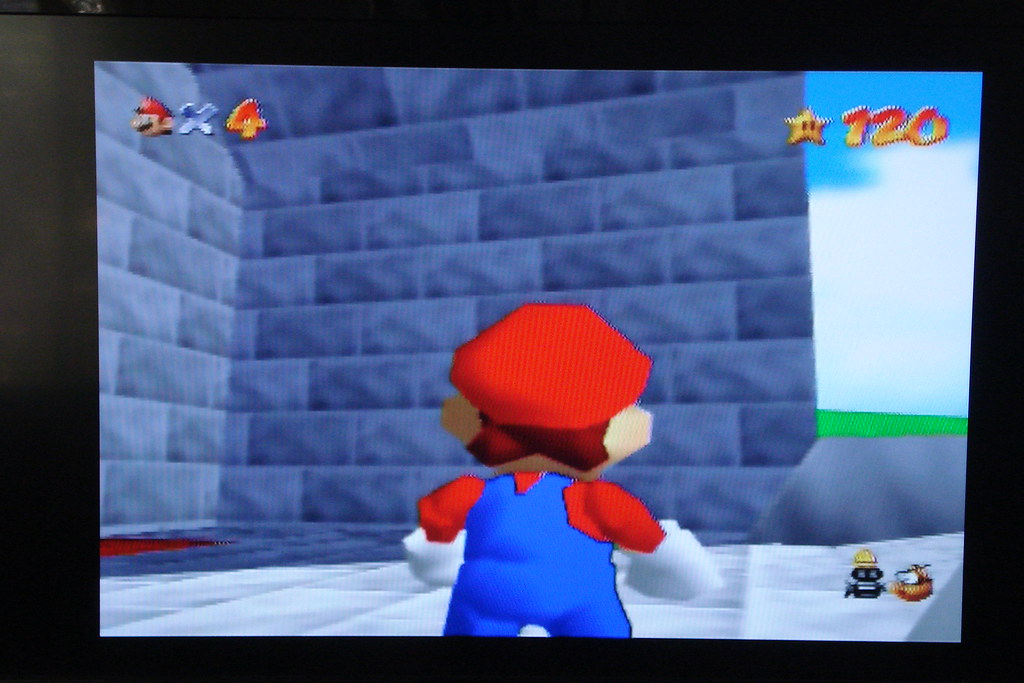
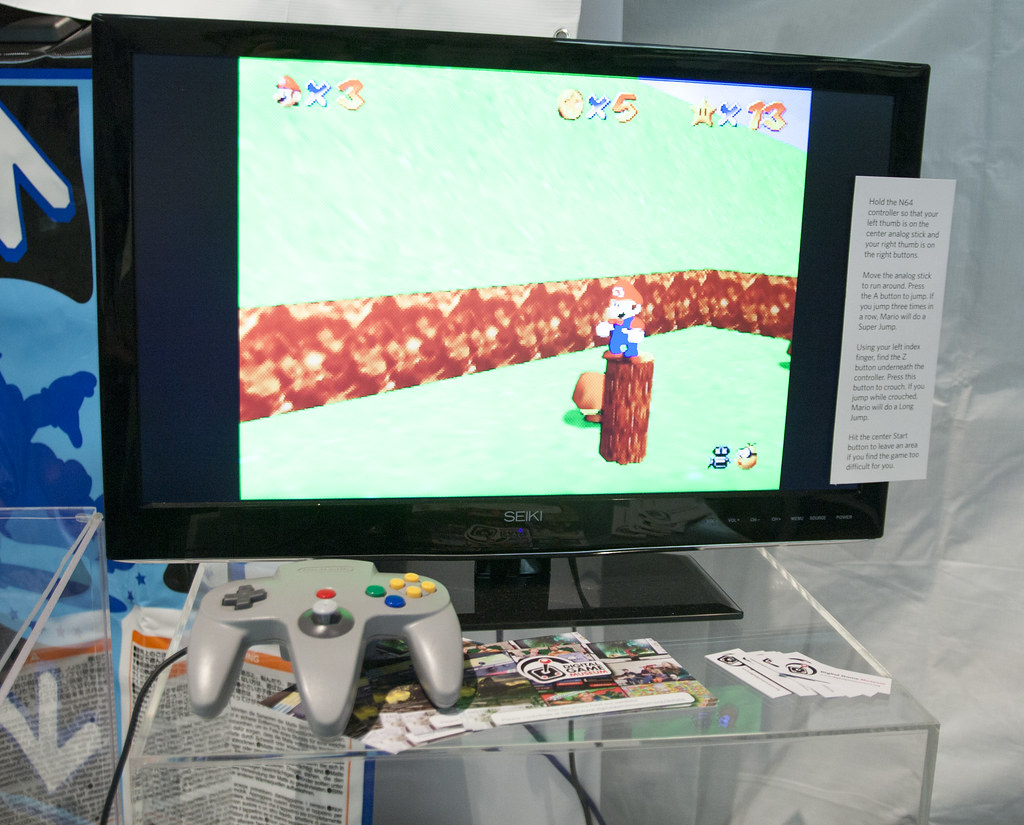
What players eventually got, when Super Mario 64 launched in Japan on June 23, 1996, was a Mario head sitting on the title screen that they could grab by the nose, ears, cheeks, chin, or cap and stretch into whatever shape they liked before the game had even started4,5. It worked because the elastic, continuous surface Goddard built held together no matter how far you pulled it, the same quality he and Koizumi had been chasing since the first ping-pong-ball test4,3,6.
Goddard has described the whole arc, from camera test to global curtain-raiser, with a kind of shrug: nobody designed it, Miyamoto just happened to be walking by1.
SGI, Nintendo, and the Argonaut Pipeline
Nintendo's partnership with Silicon Graphics shaped much of the technical culture around Super Mario 64's development, including the hand-me-down workstations that gave Goddard his camera in the first place1,2. Programmers got Indys, designers got Indigos, and the far larger Onyx machines ran the software emulator that stood in for the unfinished Nintendo 64 hardware during early development3,10.
Goddard's path into that world ran through Argonaut Games, the London studio founded by Jez San, where a handful of British teenagers built early 3D demos that convinced Nintendo to commission the Super FX chip used in Star Fox2,8,10. That chip, and the relationship it built, is why Goddard and fellow Argonaut programmer Dylan Cuthbert ended up moving to Nintendo's Kyoto headquarters as teenagers themselves2,10.
Super Mario 64 itself was in active production between September 1994 and May 1996, directed by Miyamoto, who had been imagining a 3D Mario since the Star Fox era11.
Who's Who
- Giles Goddard: British programmer who built the camera-tracking prototype and later programmed the interactive face1,6,9.
- Shigeru Miyamoto: Nintendo designer who saw Goddard's experiment and proposed putting it in Super Mario 641.
- Yoshiaki Koizumi: Animator who built the bones and rigging for the Mario head that Goddard then skinned and deformed4,3.
- Dylan Cuthbert: Fellow Argonaut programmer who moved to Nintendo alongside Goddard and worked on Star Fox2,10.
- Jez San: Founder of Argonaut Games, which first pitched 3D chip technology to Nintendo2,8.
The Figures That Matter
- June 23, 1996: Japanese release date of Super Mario 644,5.
- Nearly 12 million: copies of Super Mario 64 sold by 2015, making it the best-selling Nintendo 64 game11.
- Five: the facial features players can pull on the title screen (nose, ears, cheeks, chin, cap)4.
- January 1993: when Nintendo first showed a talking 3D Mario head at CES, a separate predecessor demo11,5.
Pictures



Sources
- How Super Mario 64 changed the face of the games industry - 25th Anniversaryvg247.com · 2021
- Inside Nintendo in the 1990s: Star Fox, late nights and making the N64eurogamer.net · 2023
- Tales from inside 90s Nintendo - from the man who made Mario's faceeurogamer.net · 2018
- Giles Goddard On How Nintendo Influenced The Way He ...timeextension.com
- COLLECTED WORKS GILES GODDARDpocketmags.com
- Super Mario 64 - WikipediaWikipedia
- Giles Goddard (video game programmer)Wikipedia
- Lads of the Rising Sun | Nintendo Lifenintendolife.com
- The Making Of Super Mario 64 – full Giles Goddard interview ...pixelatron.com
- The British teens who taught Nintendo how to make Star Foxeurogamer.net · 2018
- Super Mario 64Wikipedia
- Giles GoddardWikipedia
Researched and written by Lorelet from the sources above. It cites as it goes, but it can still get things wrong, so check the sources for anything that matters.
Report a problem
More featured lorelets
See all
Today · History
The Night Parliament Had to Remove Its Own Ironwork
A suffragette chained herself to a barrier built to keep women silent, and the men running the House of Commons found they had no way to make her let…
Today · History
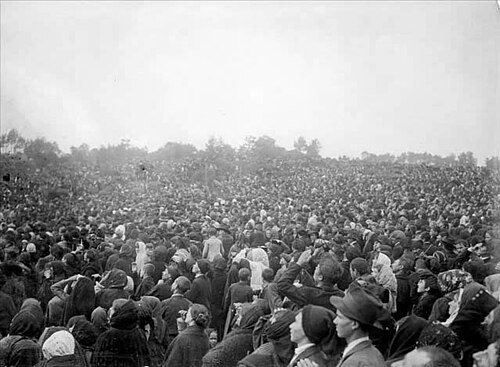
The Miracle of the Sun at Fatima
Tens of thousands gathered in a muddy Portuguese field in October 1917 to see a promised sign in the sky. What they say they saw became one of the mo…

Oct 12 · History
The Accidental Rise of the Pointy Witch Hat
Nobody on trial for witchcraft was ever recorded wearing one. So how did a plain medieval hat become the uniform of evil?