Featured · TodayHistory
The Accidental Rise of the Pointy Witch Hat
Nobody on trial for witchcraft was ever recorded wearing one. So how did a plain medieval hat become the uniform of evil?
Listen
Read by Finch · 9 min
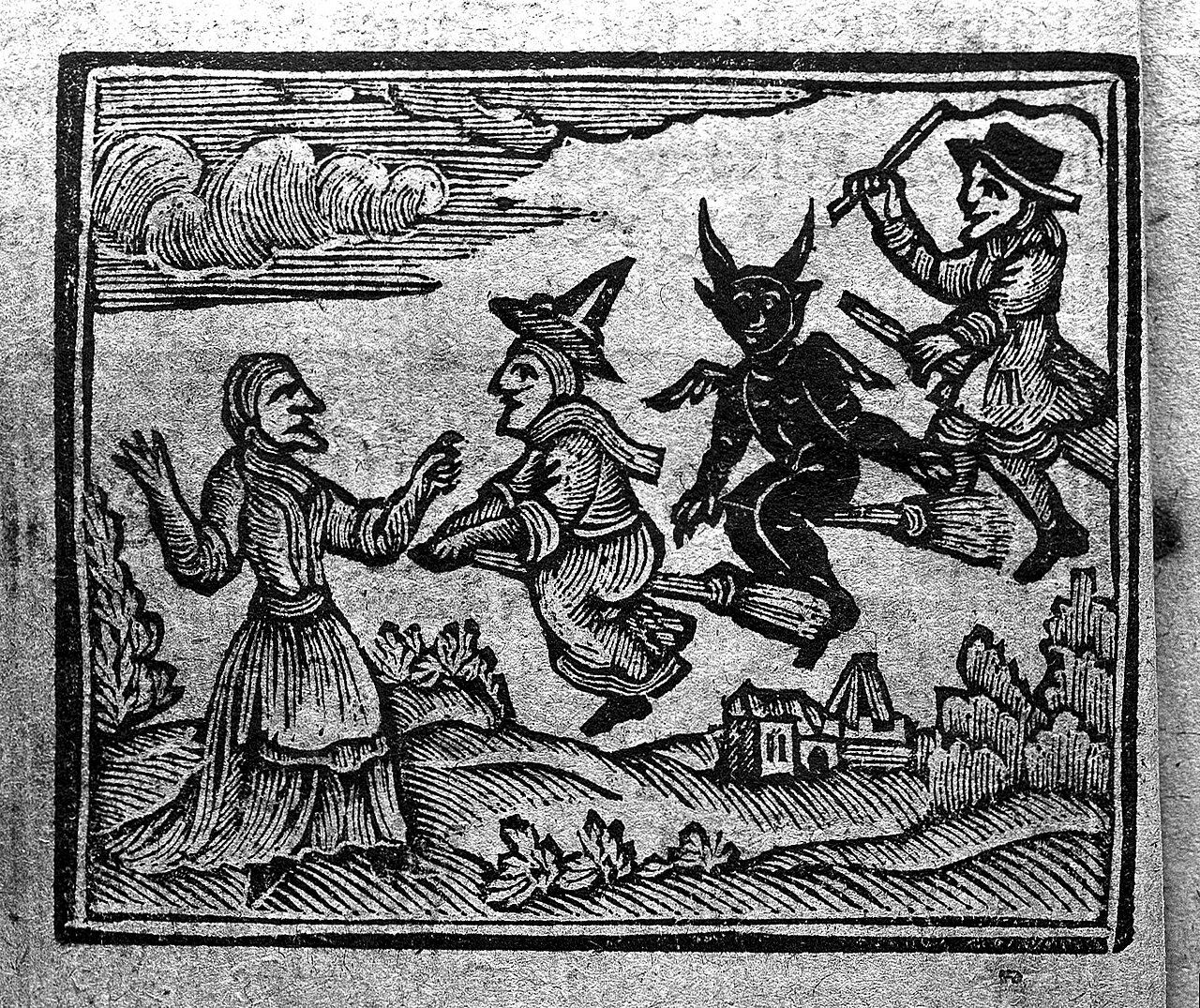
A Woodcut, Around 1720
The image is simple enough to describe in one breath: figures airborne on broomsticks, each topped with a tall, tapering hat, printed in a woodcut included in a book called The History of Witches and Wizards3,4. It is, as far as the record shows, the first clear picture of a witch wearing the hat we would recognize today3.
That date is the strange part. By 1720, England's major witch panics were long over. The last confirmed execution for witchcraft in England happened in Exeter in 16858. The woodcut's hat shows up roughly thirty five years after the hangings stopped, not during them, which runs against the assumption that the hat was something accusers pointed to in court.
It wasn't. Surviving English assize records from Essex, Hertfordshire, Kent, Surrey, and Sussex between 1559 and 1625 (extending to 1688 in Kent) show witchcraft was a rare charge, well under 2 percent of roughly 19,000 indictments, and the case files focus on alleged acts, familiars, and confessions, not costume8. Historian Laura Kounine, who studies early modern England at the University of Sussex, says flatly that in the 16th century 'everyone wore a hat, not necessarily a pointy hat, just any hat,' varying by social and marital status rather than occupation or suspicion1. Striking period depictions of accused witches, such as Albrecht Durer's Witch Riding Backwards on a Goat (1501-02) and Hans Baldung Grien's The Witches' Sabbath (1510), show women bare-headed with loose hair, itself a marker of supposed moral disorder, not hatted at all1.
So if the hat wasn't evidence at the trials, it had to come from somewhere else, and pointed hats had already been doing other cultural work in Europe for centuries.
Conical and pointed headwear is old. Bronze Age graves have produced gold conical hats decorated with astronomical symbols, likely tied to priestly or ritual authority1,2. In classical antiquity, the Phrygian cap marked out 'Asians' or 'barbarians' in Greek eyes, and in Rome a related cap, the pileus, became a symbol of a freed slave's liberty2. None of that is witch imagery. It is simply proof that a pointed hat was already a loaded visual object long before anyone used it to mean sorcery.
The meaning that mattered most for the witch hat's later history came out of medieval anti-Jewish law. Beginning in the twelfth century, European Christian art increasingly showed Jewish men in a pointed cap, the Judenhut6. The Fourth Lateran Council of 1215 ordered that Jews be made visually distinguishable from Christians, though it left the exact form to local rulers: German-speaking regions adopted the pointed hat, while England generally used a badge instead5,9,2. From there the hat metastasized as a mark of suspicion. A late-fourteenth-century law in the German town of Seligenstadt forced the pointed hat onto usurers and onto Christian women involved with Jewish men, and the practice spread to men convicted of sorcery, heathenism, and theft across German-speaking Europe2. A Hungarian law in 1431 even required first-time sorcery offenders to wear 'peaked Jews' caps' in public10. By the time pointed hats start showing up on devils, ogres, and folkloric dwarfs in early modern German imagery, the association between the shape and imputed evil was already well worn2.
England complicates a tidy Judenhut-to-witch-hat story, though. Clothing historian Abby Cox points out that England marked its Jewish population mainly with badges, not hats, which weakens a direct line from Judenhut to the specifically English, specifically black witch hat that later became global shorthand9,3. Cox instead points to a homegrown English quarrel: the Quakers. George Fox's Society of Friends, founded after the English Civil War, preached women's equality and direct experience of God, and was treated as heretical and socially alarming in the mid-1600s, the same years English witch panics peaked9,3. Quaker headgear became a flashpoint of ridicule, even though Quakers did not actually wear pointed hats themselves5,11. The theory holds that as Quaker fashion aged out of style, it got folded into the broader visual vocabulary of religious deviance that painters and engravers drew on when they pictured witches. It is a plausible contributor, though thinner on direct evidence than the Judenhut strand5,3.
Then there is the explanation most people reach for first: the alewife. Alewives were women who brewed and sold ale commercially, a trade that was dominated by women in England before the Black Death and persisted into the 17th century12. The popular version says alewives wore tall hats to stand out in crowded marketplaces, kept cats to guard grain from mice, and used broomsticks and cauldrons in their trade, and that male brewers taking over the industry smeared them as witches to push them out13.

Kounine calls the direct alewife-to-witch connection 'a bit of a myth,' created in hindsight rather than documented at the time1. Smithsonian's own editor's note on a widely shared 2021 piece making this claim says multiple scholars disagreed with its framing and conclusions, and that the magazine corrected several factual errors after publication13. Women certainly brewed ale, and the hat and cauldron were ordinary kitchen and market gear of the period, as Kounine notes, 'everyone had a cauldron, that's what people were using to cook'1. What is missing is any documented chain showing that a standardized tall alewife hat specifically became the witch's costume.
What finally locked the image in place was print and illustration, well after any of these medieval disputes. English prints through the eighteenth century kept giving witches tall, sometimes broad-brimmed hats, building toward a recognizable silhouette3,14. Victorian and Edwardian children's illustrators standardized it further, pairing the pointed hat with dark clothing, a broom, a cauldron, and exaggerated features1,7. An 1899 illustration in Gems from Mother Goose shows a hatted witch flying on a broomstick, part of that wave7.

L. Frank Baum's The Wonderful Wizard of Oz, published in 1900, gave the Wicked Witch of the West a tall conical hat in its illustrations, and when MGM filmed The Wizard of Oz in 1939, costume designer Adrian put Margaret Hamilton in the same shape, rendered in black5,3. From there, Halloween costuming, theater, and advertising did the rest, carrying the hat around the world as instantly legible shorthand for 'witch,' detached from the Judenhut regulations, the Quaker controversies, and the alewife's brewing stool that had all fed into it along the way5,1.

The woodcut from around 1720 turns out to be less a record of what accused witches actually wore and more an early snapshot of an image already being assembled from other people's hats.
Timeline
- Bronze AgeGold conical hats with astronomical symbols are made in central Europe, likely tied to priestly authority1
- 12th-13th centuriesEuropean Christian art increasingly depicts Jewish men wearing the pointed Judenhut6
- 1215The Fourth Lateran Council orders Jews to be visually distinguishable from Christians; local regions decide the form, hat or badge5,2
- Late 14th centuryA law in Seligenstadt extends the pointed hat requirement to usurers and others, and the practice spreads to men convicted of sorcery2
- 1431Hungarian law requires first-time sorcery offenders to wear 'peaked Jews' caps'10
- 1689/1693Cotton Mather's Wonders of the Invisible World circulates witchcraft imagery around the Salem trials8,4
- Around 1720A woodcut shows figures on broomsticks in conical hats, the earliest clear witch-hat image3,4
- 1685The last confirmed execution for witchcraft in England takes place in Exeter8
- 1899An illustration in Gems from Mother Goose depicts a hatted witch flying on a broomstick7
- 1900L. Frank Baum's The Wonderful Wizard of Oz is illustrated with a conical-hatted Wicked Witch5,3
- 1939MGM's film gives Margaret Hamilton's Wicked Witch the now-iconic black pointed hat5,3
Pictures


Sources
- Bronze Age to Elphaba: The centuries-old origins of the witch's hatBBC · 2025
- The Complicated History of Pointy Hats - JSTOR Dailydaily.jstor.org · 2023
- The Weird, Winding History of the Witch Hat | The Mary Suethemarysue.com · 2020
- Pointing to Witchcraft: The Possible Origin of the Conical Witch's Hatancient-origins.net
- Witch hatWikipedia
- la prolifération d'un signe juif / Judenhut and Zauberhut - ISIDOREisidore.science
- Witch's Hatnightbringer.se
- January 2026 – millerpsychmillerpsych.wordpress.com
- The Witch Hat - by Jeffrey Rubel - The Curiosity Cabinetjeffreyrubel.substack.com
- How broomsticks, cauldrons, and pointy hats became essential witch gearNational Geographic · 2024
- Why Do Witches Wear Pointy Hats?Slate Magazine · 2013
- Alewife (trade)Wikipedia
- Why Did Women Stop Dominating the Beer Industry?Smithsonian Magazine · 2021
- Why do ‘wicked’ witches wear pointed hats? The real history explainedtollbit.historyextra.com
Researched and written by Lorelet from the sources above. It cites as it goes, but it can still get things wrong, so check the sources for anything that matters.
Report a problem
More featured lorelets
See all
Today · History
Did Khrushchev Really Bang His Shoe at the UN?
A Soviet premier, a furious Filipino senator, and sixty years of eyewitnesses who can't agree on what actually hit the desk.

Today · History
Breathing Under Pressure: How Philip Drinker Built the Iron Lung
A metal box, two vacuum cleaners, and an ill child became the start of mechanical ventilation as we know it.

Oct 11 · Technology
The Holy Grail of Bug Bounties: Knuth's Reward Checks
For more than fifty years, finding a mistake in a Donald Knuth book has earned you a strange little check that almost nobody wants to cash.