Featured · TodayHistory
Breathing Under Pressure: How Philip Drinker Built the Iron Lung
A metal box, two vacuum cleaners, and an ill child became the start of mechanical ventilation as we know it.

Listen
Read by Finch · 8 min
The Girl in the Tank
In October 1928, at Boston Children's Hospital, an eight-year-old girl named Bertha Richards was placed into a long galvanized-iron cylinder until only her head stuck out through a rubber collar at one end1,4. She had paralytic polio, and the muscles between her ribs had stopped working4. A pair of adapted vacuum-cleaner pumps attached to the tank were switched on, and her chest began to rise and fall again, moved by changes in air pressure around her body rather than by her own muscles1,2.
The machine was doing what it was designed to do5. That did not mean the girl was out of danger.
Polio could damage the nerves controlling the diaphragm and chest wall, leaving patients fully conscious while they lost the ability to breathe on their own6. Before this device existed, there was not much to offer such a patient beyond nursing care, oxygen, and watching them struggle. A person could die of suffocation while perfectly aware of what was happening to them.
The idea behind the tank came out of a Harvard laboratory, not a hospital ward. Philip Drinker, an industrial hygienist, and Louis Agassiz Shaw, a physiologist and engineer, had been studying how pressure changes affected breathing, partly in connection with industrial gas poisoning9,10. Their early experiments used anesthetized animals sealed inside a metal chamber with the head left outside through a collar. Lowering the pressure inside the chamber made the chest expand on its own; raising it made the chest fall. It was, in effect, breathing done from the outside in10,11.

Turning that lab setup into something usable on a child took almost nothing exotic: an airtight iron box, a sliding bed, a rubber neck seal, and two household vacuum cleaners wired to alternately pull air out of the chamber and let it back in1,2,3. Drinker and Shaw got outside money to build a human-sized version, reportedly a $500 grant from the Consolidated Gas Company of New York, the kind of unglamorous industrial sponsor that would later help place more machines in hospitals12,5.
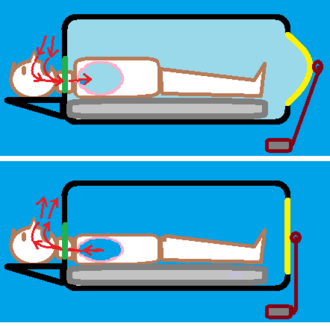
Back in the Boston ward, the respirator kept Bertha Richards breathing for roughly 122 hours, just over five days5. For that stretch, a mechanical box did the job her own body could no longer do. It was the first time anyone had managed that for a human patient.
She died anyway. The reported cause was cardiac failure linked to extensive bronchopneumonia, not injury from the machine; an autopsy reportedly found no sign that the respirator had damaged her lungs through overinflation or otherwise5. The tank had done precisely what Drinker and Shaw built it to do. It just could not touch the infection and paralysis underneath, and that gap, between keeping someone breathing and actually curing them, would define the iron lung for the next three decades.
Why a Breathing Machine, and Why Then
Polio epidemics were already a recurring American and European terror by the late 1920s, striking children in particular and sometimes leaving them unable to breathe without help6,13. The disease's worst form attacked the nerves controlling respiratory muscles, which meant a child could be fully alert while suffocating in a hospital bed.
Drinker and Shaw's chamber was not originally conceived as a polio treatment at all. It grew out of research into industrial hazards, including coal gas poisoning, where victims also lost the ability to breathe on their own6,9. The leap from gas-poisoning victims to polio patients happened because the underlying problem, a body that could not move air in and out of its own lungs, was the same.
Scale of the Crisis
- 57,628: polio cases recorded in the United States during the 1952 epidemic, the country's worst2,13.
- 1,200: people using iron lungs in the United States by 195913.
- $1,500: reported cost of a 1930s iron lung, roughly the price of an average American home at the time.
- 90% to 20%: reported drop in mortality among severe bulbar polio patients after positive-pressure ventilation replaced negative-pressure machines in parts of Europe.
- 39: people still using tank respirators in the United States by 2004, falling to about 10 by 20146.
Who Was Involved
- Philip Drinker: Harvard industrial hygienist who co-built the respirator; later known for a disputed wartime asbestos-safety study9.
- Louis Agassiz Shaw Jr.: physiologist and engineer at Harvard who worked with Drinker on the chamber's design10,11.
- Bertha Richards: eight-year-old patient from Waltham, Massachusetts, the device's first human subject in October 19284,5.
- John Haven Emerson: inventor who introduced a cheaper, sturdier iron lung in 1931 and later defeated Drinker in a patent lawsuit6,5,7.
- Boston Children's Hospital: site of the first clinical use of the respirator4,3.
What Sources Disagree On
Historical accounts split over whether to date the invention to 1927, when Drinker and Shaw built the first prototype, or 1928, when it was first used on a human patient; both appear in reputable summaries10,13.
The exact date of that first clinical use is also inconsistent. Most modern sources give October 12, 1928, but one detailed account gives October 13, which may simply reflect different starting points, preparation versus the machine actually running1,4,11.
After the Tank
John Haven Emerson's 1931 version replaced the original's blowers with a flexible elk-hide diaphragm, making it quieter, lighter, and reportedly half the price of Drinker's design5. Drinker and Harvard sued him for patent infringement; Emerson argued that lifesaving devices should not be locked behind a patent, and won by showing the underlying technology already existed before Drinker's claim6,7.

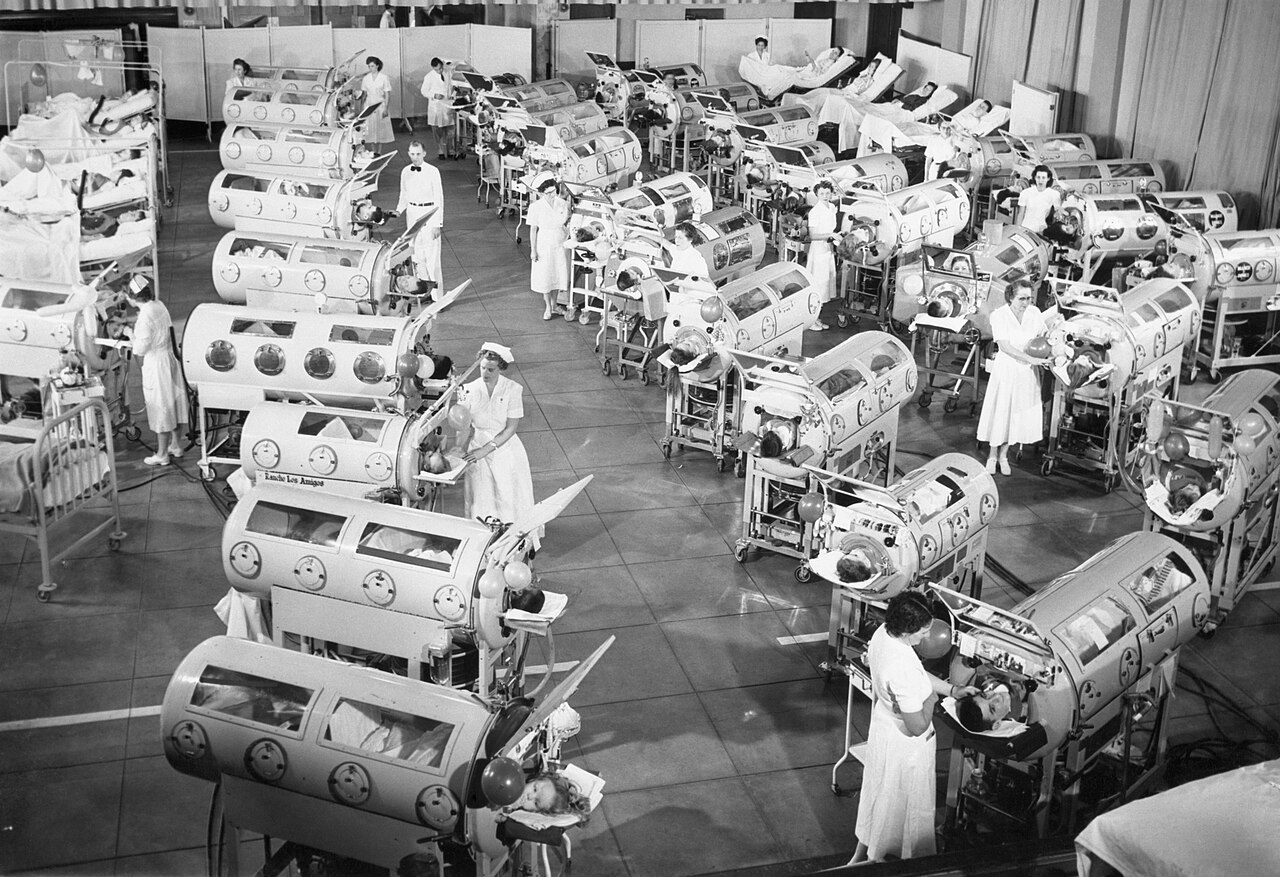
By the 1940s and 1950s, rows of iron lungs filled polio wards, keeping paralyzed patients alive for the weeks it took their own breathing to recover, if it ever did6. The machines were heavy, loud, and hard to move, which pushed European clinicians during the 1952 Copenhagen epidemic toward positive-pressure ventilation delivered through a tube in the airway, a method that cut mortality sharply among the sickest patients and, within a year, had displaced the iron lung across much of Europe6,8.
Timeline
- 1927Drinker and Shaw develop a pressure chamber at Harvard, testing it on anesthetized animals10,11.
- October 1928First clinical use of the respirator on Bertha Richards at Boston Children's Hospital; she is ventilated for about 122 hours before dying of cardiac failure linked to pneumonia4,5.
- 1929A Drinker machine is installed at Bellevue Hospital in New York; Consolidated Gas Company donates 14 machines to New York hospitals12.
- 1931Drinker and Shaw receive the John Scott Medal; John Haven Emerson introduces an improved, cheaper respirator12,14.
- 1935-1940Emerson successfully challenges Drinker's patents in court, arguing lifesaving devices should be widely available6,7.
- 1952US polio cases peak at 57,628; Copenhagen epidemic drives adoption of positive-pressure ventilation2,8.
- 1959About 1,200 people in the United States are using iron lungs13.
Pictures


Sources
- The iron lung: How a hulking metal tube became the first ...acs.org
- The Iron Lung | Science Museumsciencemuseum.org.uk
- History of polio - WikipediaWikipedia
- Book Excerpt: How the Iron Lung Transformed Polio Caregavi.org
- The Emerson Iron Lung · "Breathe" · OnViewcollections.countway.harvard.edu
- Iron lungWikipedia
- Philip Drinker versus John Haven Emerson: Battle of the iron lung machines, 1928-1940.Scholarly work · 2018
- Assisted ventilation. 5. Non-invasive and domiciliary ventilation: negative pressure techniquesPubMed Central (PMC) · 1991
- Philip DrinkerWikipedia
- Lifesaving Breath | Harvard Medical Schoolhms.harvard.edu
- Philip Drinkerlitfl.com
- Prof. Philip Drinker Dies at 77; A Co‐Inventor of the Iron LungThe New York Times
- Flashback: Iron Lungpfizer.com
- Boston Doctors Use First Iron Lung - Mass Momentsmassmoments.org
Researched and written by Lorelet from the sources above. It cites as it goes, but it can still get things wrong, so check the sources for anything that matters.
Report a problem
More featured lorelets
See all
Today · History
The Accidental Rise of the Pointy Witch Hat
Nobody on trial for witchcraft was ever recorded wearing one. So how did a plain medieval hat become the uniform of evil?

Today · History
Did Khrushchev Really Bang His Shoe at the UN?
A Soviet premier, a furious Filipino senator, and sixty years of eyewitnesses who can't agree on what actually hit the desk.

Oct 11 · Technology
The Holy Grail of Bug Bounties: Knuth's Reward Checks
For more than fifty years, finding a mistake in a Donald Knuth book has earned you a strange little check that almost nobody wants to cash.