
Featured · Nov 9History
The Slip of Paper That Opened the Berlin Wall
A tired spokesman, an unchecked memo, and a border guard with no one left to call on the phone: how East Germany lost control of its own border in a single evening.

Listen
Read by Wren · 9 min
A Phone Call to Nowhere
Harald Jäger watched the press conference from the canteen at the Bornholmer Straße checkpoint, the border crossing he commanded that evening as a lieutenant colonel of the East German border police5,8. On the television, Günter Schabowski was reading from papers he seemed to be seeing for the first time, fumbling toward an answer about when East Germans could leave the country5. Jäger's first reaction was bafflement. "I thought, what's he going on about," he said later. "He doesn't have any idea what the impact's going to be"5.
Jäger picked up the phone to his superior at the operations command center in Treptow, who had also just watched the broadcast and was just as startled5. The order that came back was simple: turn people away5. It was the only instruction anyone at Bornholmer Straße would get that night, and it would not survive contact with what was already gathering outside5.
A regime running out of road
By the autumn of 1989, East Germany was hemorrhaging people. Citizens had been slipping west for months through Hungary, which had opened its border with Austria, and through Czechoslovakia, where crowds occupied the West German embassy in Prague7,6. Inside the country, mass demonstrations in Leipzig and elsewhere demanded travel freedom and political reform. Erich Honecker, the longtime party leader, resigned on October 18, 1989, replaced by Egon Krenz9.
Krenz's new leadership wanted to relieve the pressure without losing its grip, and settled on a cautious travel reform: East Germans would be able to apply for permission to travel privately without the old restrictive requirements, and permanent emigration would be allowed through all crossings, including those in Berlin3,10. This was meant to be a managed bureaucratic procedure, with applications and paperwork, not an open gate. The border police, the agencies that would actually have to implement it, had not been fully briefed3.
The memo and the microphone
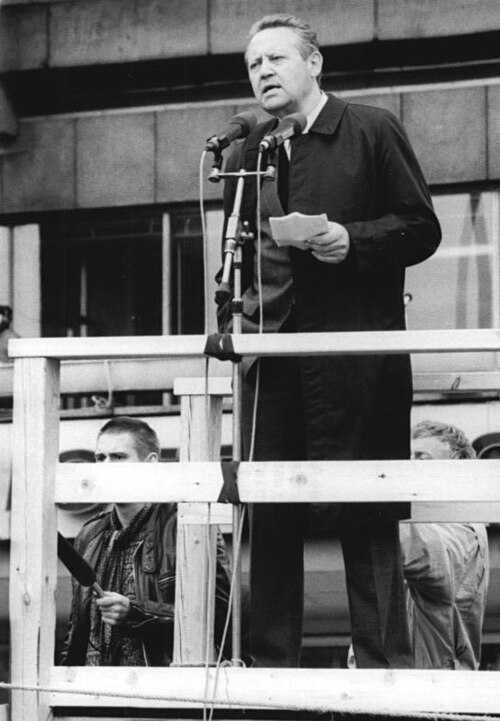
On November 9, Krenz handed Schabowski, the party's unofficial spokesman, a document describing the new rules shortly before Schabowski's scheduled press conference9. Schabowski had not been present for the internal discussions that shaped the text and did not fully grasp its intended limits3. He had spent his career in a press culture where journalists were told what to write after events had already happened, and by his own account later felt that conducting a press conference required little more than reading a text aloud without mistakes9.
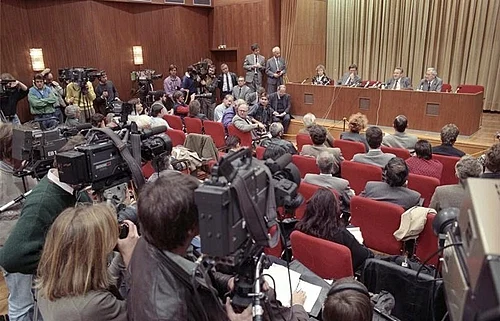
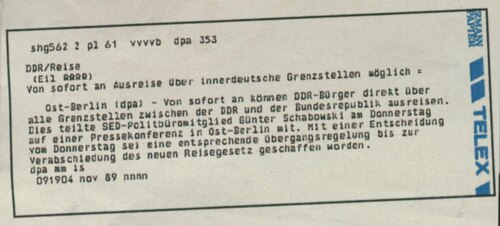
The conference ran from roughly 6:53 to 7:01 p.m. and was carried live on East German television10. Near its end, Schabowski read: "We have therefore decided today to put in place a regulation that allows every citizen of the German Democratic Republic to leave through any of its border crossings"11. When a reporter, generally identified as either Riccardo Ehrman of the Italian agency ANSA or Peter Brinkmann of the tabloid Bild, asked when the rule would take effect, Schabowski paused, searched his papers, and answered: "As far as I know... effective immediately, without delay"1,2.
Within minutes, Reuters and West German broadcasters were reporting that the border was open. The evening news programs heute and Tagesschau carried the story into East German living rooms as well as West German ones, since West German television reached across the border9,4. What had been a hedged, incomplete administrative measure now sounded, on live television, like an immediate and total opening.
Back at Bornholmer Straße, people who had heard the broadcasts began arriving, first in dozens, then hundreds, then thousands5. Some guards tried a partial fix: they stamped the passports of the most insistent travelers, letting them leave but not return, a stopgap that could not survive a crowd that kept growing and watching others get through5. Jäger kept calling his command center. He was told, again, that there was nothing new, that he should send people away5. He could not. "I can only block off the border," he told his colonel5. At one point the colonel, apparently trying to demonstrate the chaos at the top rather than hand down an answer, let Jäger listen in on a call to the ministry, where someone asked whether Jäger could be trusted to judge the situation or was simply afraid. Jäger, by his own account, had had enough. He held the phone out of his office window so the ministry official could hear the crowd for himself5.
His own officers gathered in his office and told him it was his decision. "Should I let the GDR citizens leave?" he asked them. "Or should I give the order to open fire?"5 No one wanted that outcome, and Jäger later said he feared people could be crushed or trampled even without a shot fired, given the size of the crowd pressing against the barrier5,12. Shortly after 11:30 p.m., with no authorization from above and after roughly three and a half hours of holding the line, Jäger told his men to raise the barrier5,6.
East Berliners streamed into West Berlin, met by cheers, embraces, and champagne from West Berliners who had gathered at the crossing5. Other checkpoints across the city, including Invalidenstraße, Chausseestraße, Checkpoint Charlie, and Heinrich-Heine-Straße, faced the same swelling crowds and the same absence of clear orders, and opened in turn over the following hours7. None of it had been commanded from above. The regime that had built and defended the Wall for twenty-eight years lost control of it not through an order, but through the absence of one.
Timeline
- 1989-10-18Erich Honecker resigns as leader of the SED; Egon Krenz takes over9.
- 1989-11-09, ~18:53-19:01Günter Schabowski holds the press conference announcing new travel rules and says they take effect 'immediately, without delay'10,1,2.
- 1989-11-09, eveningWest German television news (heute, Tagesschau) broadcasts the announcement into East Germany; crowds begin gathering at checkpoints9,4.
- 1989-11-09, ~23:30Harald Jäger orders the barrier opened at Bornholmer Straße without authorization from superiors5,6.
- 1989-11-09 to 11-10Other Berlin checkpoints open as crowds overwhelm guards7.
Pictures




Sources
- 9 November - a historically signficant date - Bundesregierungbundesregierung.de
- On 9 November 1989 Günter Schabowski announced to the press ...bundesregierung.de
- The Fall of the Berlin Wall, 25th Anniversarynsarchive2.gwu.edu
- Guenter Schabowski's Press Conference in the GDR International ...1989.rrchnm.org
- The Guard Who Opened the Berlin Wall: 'I Gave my People the Order -- Raise the Barrier'spiegel.de · 2009
- Berlin Wall opening remains fresh on minds - National | Globalnews.caglobalnews.ca · 2014
- Fall of the Berlin WallWikipedia
- The man who opened the Berlin Wallthelocal.de
- Günter SchabowskiWikipedia
- [PDF] Temporary Transition Rules for Travel and Permanent Exitnsarchive2.gwu.edu
- The Berlin Wall opens - History of the Berlin Wall and its fallthe-berlin-wall.com
- Photo Gallery: The Man Who Opened the Wallspiegel.de
- Schabowskis legendärer Auftritt: Das folgenreichste Versehen der DDR-GeschichteDER SPIEGEL · 2009
Researched and written by Lorelet from the sources above. It cites as it goes, but it can still get things wrong, so check the sources for anything that matters.
Report a problem
More featured lorelets
See all
Today · Food
The Turkey Surplus That Became the TV Dinner
A company drowning in frozen birds found an answer on an airline food cart, or so the story goes for fifty years.

Today · Space
Why Is Jupiter's Great Red Spot Actually Red?
Jupiter is built almost entirely of colorless gas, yet its most famous storm glows orange-red. Scientists have spent decades in the lab trying to fig…

Today · Art & Design
The Aztec Labret Whose Golden Tongue Still Moves
A small gold serpent made for a pierced lip somehow ended up with a tongue that flicks side to side. No one alive has ever seen it worn.