
Featured · Nov 1History
The Disposable Timber Ship
Two Quebec shipbuilders found a clever way around British tariffs: build a giant wooden ship, sail it once, then sell it for scrap lumber. It worked beautifully, until someone decided to do it twice.

Listen
Read by Finch · 8 min
Filling With Water, 650 Miles From Land
On October 21, 1825, the Baron of Renfrew was taking on water fast, far out in open sea, 650 miles from the nearest coast5. She drew 33 feet and already had 31 feet of water in her hold, waterlogged and barely answering her helm5. Her captain, officers, and the remaining 22 of her crew abandoned her off Gravelines that day5. She had, by then, already crossed the Atlantic.
That was the strange part. The ocean, the part everyone worried about, she had survived. Whatever was wrong with the Baron of Renfrew had been wrong with her from the start, and it had nothing to do with weather on the open sea.
The whole venture began with a tax problem. In the early 1820s Britain taxed imported Canadian timber heavily, but a ship's own structural timber, once it was broken up and sold as lumber, was not assessed the same way1,3. Charles Wood, a Scottish shipbuilder working out of Port Glasgow, found backers for a scheme built on that gap: construct an enormous, cheaply made wooden hull, load it with timber cargo, sail it to Britain once, then take the whole ship apart and sell the hull as lumber too3,2. It also solved a real problem, since the biggest Canadian pine masts and squared timbers were too long for ordinary cargo ships to carry2.
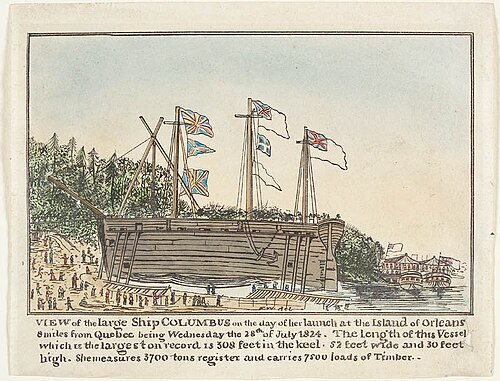
Wood's first attempt, the Columbus, was launched at Anse-du-Fort on Île d'Orléans near Quebec in 1824, flat-bottomed, straight-sided, built of square timber to maximize cargo space rather than speed or durability4. She measured about 301 feet long and ran roughly 3,690 gross register tons, around ten times the size of an ordinary timber trader4. She carried a cargo of loose timber far beyond what thirty normal cargo ships combined could manage4.

The maiden voyage worked. Columbus left Quebec on September 5, 1824, grounded briefly at Bersimis but was refloated, and crossed the Atlantic to become, for a time, the largest vessel ever to have made the crossing4. She arrived leaking at Blackwall under tow, where her sheer size drew sightseers to the dock rather than demolition crews4. The scheme, on paper, had worked exactly as designed: cross once, dismantle, sell the wood, done.

Instead, her owners sent her back. Against Captain Wood's own advice, Columbus was loaded with ballast and dispatched from the Downs on April 26, 1825, bound for Saint John, New Brunswick, under Captain Daniel Nesbitt Munro and a 73-man crew, for a second load of timber4. A ship built for one crossing was being asked for two. On May 17, in a mid-Atlantic storm, her timbers opened and she began taking water at two feet an hour, faster than her steam pumps and crew could bail4. The merchant ship Dolphin eventually took the crew aboard, stood by for eight hours, then, short on water and food, carried them to Cork, landing on May 24 with provisions down to a pint of water and a third of a pound of pork per man per day4.
The Baron of Renfrew, meanwhile, had already been laid down before Columbus even sailed for the first time, an even bigger version of the same idea, roughly 5,294 gross register tons and rigged as a four-masted barque, with Wood himself aboard for this one2,5. She left Quebec on August 23, 1825, carrying some 9,000 tons of timber as cargo and hull combined5. She crossed the Atlantic without disaster. Then, approaching the English Channel under tow by two tugs with a pilot aboard, she grounded on the Goodwin Sands, filled with water, and went ashore in three pieces near Calais on October 24, 18255,2.
No source here records what Wood said as his second ship came apart off the French coast, or whether he thought of the advice he'd given about sending Columbus back out. What the record does show is the aftermath: falling freight rates, cheaper timber, and an eventual cut to the import duty made disposable ships pointless, and nobody built another one for the Atlantic trade4.
Who Was Involved
- Charles Wood: Scottish shipbuilder from Port Glasgow who designed and built both ships at Anse-du-Fort on Île d'Orléans, near Quebec, and sailed aboard the Baron of Renfrew3,2.
- William McKellar: captain of Columbus on her successful maiden voyage from Quebec to London in 18244.
- Daniel Nesbitt Munro: captain of Columbus on her fatal second voyage in 1825, ordered the crew to abandon ship after the pumps failed4.
- Matthew Walker: captain of the Baron of Renfrew on her 1825 voyage from Quebec5,3.
- Dolphin: the merchant vessel that rescued Columbus's 73-man crew in the mid-Atlantic and carried them, short on supplies, to Cork4.
The Ships By The Numbers
- Columbus: about 301 feet long, 50 feet 6 inches in beam, 22 feet 5 inches deep, roughly 3,690 gross register tons4.
- Columbus's maiden cargo: between 6,300 and 7,875 long tons of timber, versus the roughly 15,000 tons once hoped for4.
- Baron of Renfrew: roughly 5,294 gross register tons, about 92.65 metres long (110.8 metres with bowsprit and jibboom), 18.59 metres wide, 10.36 metres deep5.
- Baron of Renfrew's cargo: reported around 9,000 tons of timber, likely counting ship and cargo timber together5.
- Crew sizes: 73 men aboard Columbus on her second, fatal voyage4; 25 men aboard Baron of Renfrew on her only voyage5.
Where The Record Gets Fuzzy
Sources disagree on when Columbus launched: one gives July 28, 1824, at Anse-du-Fort1, another gives September 5, 18246, which may actually mark her departure rather than her launch, since the Wikipedia account separately dates her launch to July 28 and her departure to September 54.
Accounts also differ on exactly where the Baron of Renfrew finally came apart, with some placing the wreck near Calais in three pieces and others describing debris found further along the coast near Dunkirk and Gravelines5. The surviving sources do not record a verbatim exchange between the pilot, Captain Walker, and Charles Wood as the ship grounded, so any dramatic account of that moment beyond the bare facts of the stranding is reconstruction, not documentation.
Timeline
- August 1823Charles Wood leases a shipbuilding site at Île d'Orléans, near Quebec, to begin construction7.
- July 28, 1824Columbus is launched at Anse-du-Fort, Île d'Orléans4,1.
- September 5, 1824Columbus departs Quebec for London under Captain William McKellar4.
- November 1, 1824Columbus arrives at The Downs, becoming the largest vessel to have crossed the Atlantic up to that point4.
- April 26, 1825Columbus departs The Downs for a second, fatal voyage, against Charles Wood's advice4.
- May 17, 1825Columbus takes on water faster than her pumps can clear in a mid-Atlantic storm4.
- May 24, 1825Columbus's crew, rescued by the Dolphin, land at Cork, Ireland4.
- August 23, 1825Baron of Renfrew departs Quebec under Captain Matthew Walker, with Charles Wood aboard5,3.
- October 21-24, 1825Baron of Renfrew fills with water, is grounded near the English Channel, and breaks up in three pieces near Calais5,2.
Pictures

Sources
- Disposable ship - WikipediaWikipedia
- WOOD, CHARLES – Dictionary of Canadian Biographybiographi.ca
- The Distributed Proofreaders Canada eBook of Wooden ...fadedpage.com
- Columbus (1824 ship)Wikipedia
- Baron of Renfrew (ship)Wikipedia
- Guide de création - Document Word 2013 accessiblecdn-contenu.quebec.ca
- Great Republicdoriccolumns.wordpress.com · 2016
- 12 Famous Sail Shipsmarineinsight.com
Researched and written by Lorelet from the sources above. It cites as it goes, but it can still get things wrong, so check the sources for anything that matters.
Report a problem
More featured lorelets
See all
Today · Food
The Turkey Surplus That Became the TV Dinner
A company drowning in frozen birds found an answer on an airline food cart, or so the story goes for fifty years.

Today · Space
Why Is Jupiter's Great Red Spot Actually Red?
Jupiter is built almost entirely of colorless gas, yet its most famous storm glows orange-red. Scientists have spent decades in the lab trying to fig…

Today · Art & Design
The Aztec Labret Whose Golden Tongue Still Moves
A small gold serpent made for a pierced lip somehow ended up with a tongue that flicks side to side. No one alive has ever seen it worn.