
Featured · Nov 18Art & Design
Jan van Eyck Was Here: Who Is in the Mirror?
A 1434 wedding portrait has baffled art historians for nearly 600 years, and a new reading of its most famous clue has reopened the question of who, exactly, is standing in that room.

Listen
Read by Wren · 5 min
The Writing Above the Mirror
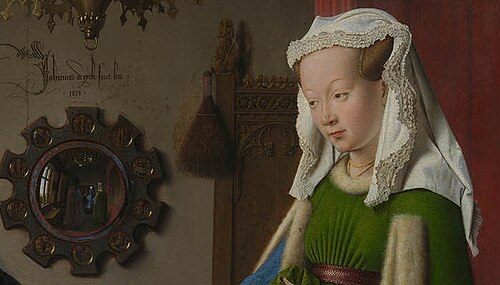
Above a small convex mirror, on the back wall of a Bruges interior, Jan van Eyck wrote a sentence in looping Latin script: "Johannes de eyck fuit hic 1434." Jan van Eyck was here, 14341,3,4. In the mirror itself, barely visible, two more figures stand near the doorway, one of them in blue with an arm raised in what looks like a greeting4.
It is a strange thing for a painter to write on a portrait. Most artists who signed their work said they made it. Van Eyck said he was there, as if testifying to something rather than simply painting it1,4,2. Nearly six hundred years later, nobody agrees on what that difference means, or even who the man and woman in front of him actually were.

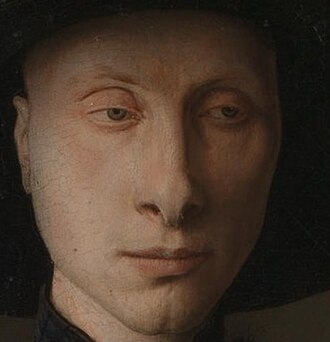
What the panel shows is not in dispute. A man in a wide, dark hat and a fur-lined coat stands with his right hand raised, holding the hand of a woman in a voluminous green dress and a high, folded headdress1,7. Between them stands a small dog. The room holds a bed with red hangings, a brass chandelier, oranges on a chest, wooden shoes on the floor, and a carved figure of Saint Margaret on the bedpost1. The woman's dress is gathered in a way that has long suggested pregnancy to viewers, though scholars note this may simply be a fashion of the period rather than evidence of an actual pregnancy1.
For most of its modern life, the painting has been read as a portrait of the Arnolfini family, Italian merchants who had settled in Bruges. That identification rests on an inventory of the possessions of Margaret of Austria, compiled at Mechelen between 9 July 1523 and 17 April 1524, which describes "a man and a woman, standing, touching hands, done by the hand of Johannes," naming the man "Arnoult Fin"1. In 1857, the art historians Gustave Waagen and Joseph Archer Crowe connected that inventory entry to the painting and proposed it showed Giovanni Arnolfini and his wife2. Four years later, James Weale named the wife as Jeanne, or Giovanna, Cenami, and for roughly a century that was the accepted story2.
In 1934, Erwin Panofsky pushed the reading further. Writing in The Burlington Magazine, he argued that the painting was effectively a legal record of a wedding ceremony, with van Eyck's inscription functioning like a witness's signature on a marriage document, and the two figures in the mirror standing in as the witnesses2,1. The raised hand, the joined hands, the inscription itself: all of it, in Panofsky's reading, pointed to a notarized moment rather than a simple likeness.
Then, in 1997, a document surfaced that broke the chronology. It showed that Giovanni di Arrigo Arnolfini married Giovanna Cenami in 1447, thirteen years after the date on the painting and six years after van Eyck's own death2. The marriage the panel supposedly recorded could not have happened yet when the panel was painted. Scholars shifted toward a different candidate: Giovanni di Nicolao Arnolfini, a cousin, whose first wife, Costanza Trenta, had died by early 1433, leaving room for him to have remarried by 14342,1,5. The National Gallery's current catalogue names him, known as Giannino or Jehannin, as the most likely sitter, paired with an unknown second wife1.
That is where the identification sat, unsettled but stable, until November 2026, when the National Gallery opened an exhibition bringing together all ten surviving van Eyck portraits for the first time8. In the catalogue, curator Stephan Kemperdick argued for something else entirely: that the man in the hat is Jan van Eyck himself, and the woman is his wife, Margaret5,6. His case leans on the inscription as a literal self-reference, a reinterpretation of the old inventory name as something closer to "a deceived cheat," and the carved figure of Saint Margaret on the bedpost, which shares a name with van Eyck's own wife6. The man's apparent age, in his thirties or forties, also fits what little is known of van Eyck's own life in 14348.

No document says so outright. The National Gallery's own catalogue still favors Giovanni di Nicolao and his unnamed wife1, and co-curator Nicholas Flory has said the point of the new exhibition is less to settle the question than to show how deliberately strange the painting is compared with van Eyck's other, more conventional portraits8. The inscription above the mirror still says only that he was there. It does not say as what.
Timeline
- 1433Costanza Trenta, first wife of Giovanni di Nicolao Arnolfini, dies, by some accounts in childbirth2,1.
- 1434Jan van Eyck paints the panel now known as the Arnolfini Portrait and inscribes it 'Jan van Eyck was here, 1434'1,3.
- 1523-1524An inventory of Margaret of Austria's possessions at Mechelen describes the painting and names the man 'Arnoult Fin'1.
- 1857Gustave Waagen and Joseph Archer Crowe link the painting to the Arnolfini family2.
- 1861James Weale identifies the wife as Giovanna Cenami2.
- 1934Erwin Panofsky publishes his marriage-contract theory in The Burlington Magazine2,1.
- 1997A document shows Giovanni di Arrigo Arnolfini married Giovanna Cenami in 1447, undercutting the long-held identification2.
- 2026-11-21The National Gallery opens 'Van Eyck: The Portraits,' whose catalogue proposes the self-portrait theory8,5,6.
Pictures

Sources
- Jan van Eyck | The Arnolfini Portrait | NG186 | National Gallery, Londonnationalgallery.org.uk
- Arnolfini PortraitWikipedia
- Van Eyck The Arnolfini Portrait - Iconic Poster Collectionshop.nationalgallery.org.uk
- Generosity | Fruits of the Spirit: Art from the Heartnationalgallery.org.uk
- Who Sat for Jan van Eyck’s Arnolfini Portrait?artnews.com
- For Almost 600 Years, This Enigmatic Jan van Eyck Painting Has Entranced Viewers. Could It Actually Be a Self-Portrait in Disguise?Smithsonian Magazine · 2026
- List of works by Jan van Eyck - WikipediaWikipedia
- The mystery of the most controversial portrait in the National Galleryinews.co.uk · 2026
- Has the pair in Jan van Eyck’s ‘Arnolfini Portrait’ been ...theartnewspaper.com
Researched and written by Lorelet from the sources above. It cites as it goes, but it can still get things wrong, so check the sources for anything that matters.
Report a problem
More featured lorelets
See all
Today · Food
The Turkey Surplus That Became the TV Dinner
A company drowning in frozen birds found an answer on an airline food cart, or so the story goes for fifty years.

Today · Space
Why Is Jupiter's Great Red Spot Actually Red?
Jupiter is built almost entirely of colorless gas, yet its most famous storm glows orange-red. Scientists have spent decades in the lab trying to fig…

Today · Art & Design
The Aztec Labret Whose Golden Tongue Still Moves
A small gold serpent made for a pierced lip somehow ended up with a tongue that flicks side to side. No one alive has ever seen it worn.