Featured · Oct 5History
Eugene Hasenfus: The Crash That Exposed Iran-Contra
A cargo kicker from Wisconsin parachuted into the Nicaraguan jungle with a weapons flight behind him and, in trying to explain his job, blew open one of the biggest scandals of the Reagan years.

Listen
Read by Finch · 7 min
A Parachute, a Jungle, and a Confession
The plane went down just after noon on October 5, 1986, cartwheeling into the Nicaraguan jungle in a spin and a ball of flame8,1. It had been flying low, around 2,500 feet, preparing to drop supplies to Contra forces near San Carlos when a Sandinista soldier shouldered a Soviet-made SA-7 missile and fired2,1. The C-123, tail number N4410F, had started its life decades earlier as a U.S. Air Force transport before ending up in the hands of a private outfit called Corporate Air Services2,4.
Three men died in the crash: pilot William J. Cooper, co-pilot Wallace Blaine Sawyer, and an unidentified Nicaraguan radio operator3. The fourth man aboard, Eugene Hasenfus, got out alive for one simple reason: he was wearing a parachute, which was unusual for people doing this kind of work1. He dove through the plane's open cargo hatch as it spun toward the ground.
Hasenfus spent more than a day alone in the jungle, rigging his parachute into a hammock and a makeshift tent against the rain9,8. He knew roughly where he was, he said later, but he walked straight into a Sandinista patrol anyway8. On October 6, Nicaraguan government forces took him into custody, the first American captured in the conflict10,5.
Two days later, on October 8, Nicaragua put him in front of international reporters in Managua4,11. He gave his name, said he was from Marinette, Wisconsin, and said little else at first5. But in the days that followed he talked more, telling journalists he had made about ten resupply flights out of El Salvador and Honduras, and that he believed the operation was run by men connected to the CIA, including two Cuban Americans he knew as Max Gomez and Ramon Medina1,4. The Reagan administration flatly denied any government link to the flight; Secretary of State George Shultz said the plane had been paid for by private operators with no U.S. government connection1.
At his trial before Nicaragua's People's Tribunal, Hasenfus softened some of his earlier claims, saying under cross-examination that he did not actually know who his bosses worked for, only that he had heard rumors3. He said he took the job, which paid $3,000 a month plus a $750 bonus for every flight over Nicaraguan territory, because he was unemployed and his benefits had run out3. On November 15, 1986, the tribunal convicted him of terrorism, violating public order, and criminal association, and sentenced him to 30 years1,5. A little over a month later, on December 17, Nicaraguan President Daniel Ortega pardoned him at the request of U.S. Senator Christopher Dodd, and Hasenfus flew home after roughly ten weeks in custody1,5.
Why a Downed Cargo Plane Mattered
None of this happened in a vacuum. The Sandinista National Liberation Front had run Nicaragua since toppling the Somoza dictatorship in 1979, and the Reagan administration had spent years backing the Contras who were fighting to overthrow them4,11. In October 1984, Congress passed the Boland Amendment, barring U.S. government money from being used to support military action against the Sandinista government7.
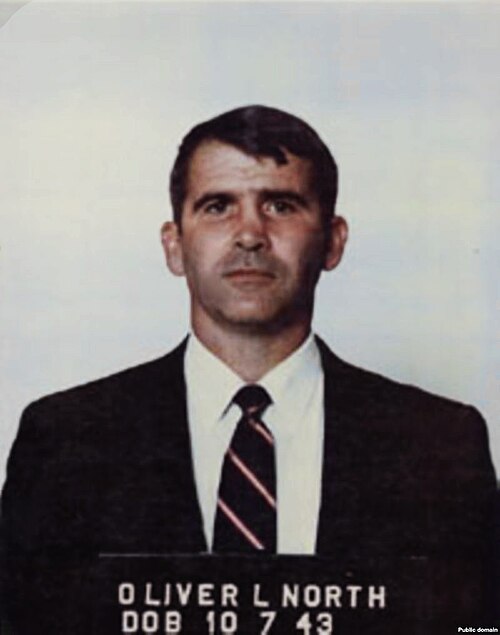
That left a legal problem for an administration committed to keeping the Contras armed. The workaround was a private supply network, with men like retired Army Major General John K. Singlaub heading companies such as Corporate Air Services that could fly weapons to the Contras while the government kept its hands technically clean4. Documents recovered from the wreckage, and papers found on the dead crewmen, later tied the operation to Lieutenant Colonel Oliver North, a National Security Council staffer coordinating Contra aid from inside the White House1,7.
The cargo itself left little room for ambiguity about the mission's purpose. Accounts put it at roughly 50,000 rounds of AK-47 ammunition, dozens of collapsible AK-47 rifles, nearly as many RPG-7 grenade launchers, and 150 pairs of jungle boots, somewhere around 10,000 pounds of munitions in all1,7. This was not a humanitarian airlift.
Who's Who
- Eugene Hasenfus: Former Marine and Wisconsin construction worker who worked as the C-123's loadmaster; the lone survivor of the shootdown and the public face of the scandal1,3.
- William J. Cooper: American pilot killed in the crash, previously tied to earlier covert aviation work3,2.
- Wallace Blaine Sawyer: American co-pilot killed alongside Cooper3.
- Oliver North: Marine lieutenant colonel on the National Security Council who helped run the secret Contra-supply pipeline and later became the central figure in the Iran-Contra investigations7,6.
- John K. Singlaub: Retired Army major general associated with Corporate Air Services, the private firm used to keep the resupply operation at arm's length from the U.S. government4.
- Daniel Ortega: Sandinista president whose government tried, convicted, and ultimately pardoned Hasenfus1,5.
- Ronald Reagan administration officials: Denied CIA ownership of the flight while maintaining that private citizens were free to aid the Contras4,1.
What's Disputed
Hasenfus himself gave conflicting accounts of how official the operation really was. Early on, in interviews with journalists, he said he believed he was working for CIA operatives and named two men, Max Gomez and Ramon Medina, as his contacts in El Salvador1. Later, under cross-examination at trial, he backed away from that, saying he only knew rumors and had no direct evidence of CIA control3,12.
The Reagan administration's position shifted in emphasis rather than substance: officials never denied that the flight was carrying weapons to the Contras, only that the CIA or the U.S. government owned or ran it7,4. Scholar Scott Armstrong later argued that the press's skepticism toward that denial carried over into how reporters covered the Reagan administration's subsequent denials about the Iran arms-for-hostages deal, once that story broke the following month1.
The identity of the Nicaraguan radio operator who died in the crash was never consistently reported, and some contemporary sources name him inconsistently or not at all3,13.
Timeline
- 1979-07Sandinistas overthrow the Somoza dictatorship in Nicaragua.
- 1984-10Congress passes the Boland Amendment restricting U.S. aid to anti-Sandinista military action.
- 1986-10-05A covertly operated C-123 is shot down over southern Nicaragua; three crew die, Hasenfus survives by parachute.
- 1986-10-06Hasenfus is captured by Sandinista troops.
- 1986-10-08Nicaragua presents Hasenfus to international journalists in Managua.
- 1986-11-05Hasenfus testifies at trial that he helped fly arms to the Contras for the money.
- 1986-11-15Nicaraguan tribunal convicts Hasenfus and sentences him to 30 years.
- 1986-12-17Ortega pardons Hasenfus, who is released and flown out of Nicaragua.
Pictures
Sources
- Eugene HasenfusWikipedia
- Fairchild C-123 Provider - WikipediaWikipedia
- Needed the Job, Hasenfus Tells Court : Admits Helping to Fly Arms to U.S.-Backed Contras for the Moneylatimes.com · 1986
- AMERICAN IS CAPTURED AFTER PLANE IS DOWNED IN NICARAGUA TERRITORYThe New York Times
- How Hasenfus Case Unfolded: From His Capture to Pardonlatimes.com · 1986
- Iran–Contra affairWikipedia
- From the Archives: Iran-Contra scandal launched by capture of U.S. flier in Nicaragua 35 years agosandiegouniontribune.com
- PBS Wisconsin Documentaries | The Eugene Hasenfus Storypbs.org · 2014
- Eugene Hasenfus, key figure in the 1980s Iran-Contra affair, dies at 84pbswisconsin.org
- The Confession Of Eugene Hasenfus - Ann Arbor District Libraryaadl.org
- NICARAGUA SHOWS REPORTERS MAN IT SAYS IS FLIERThe New York Times
- Hasenfus says cargo was for Contras - UPI Archivesupi.com
- Nicaragua: Shot Out of the Skytime.com
Researched and written by Lorelet from the sources above. It cites as it goes, but it can still get things wrong, so check the sources for anything that matters.
Report a problem
More featured lorelets
See all
Today · Technology
ChatGPT Started Forging New Yorker Cartoonists' Signatures
When an AI model began signing fake New Yorker cartoons with real cartoonists' names, it turned a style-imitation problem into something that felt, t…

Today · Music
The Monkees' Missing Tapes: Theft, Rescue, or Both?
Somewhere between corporate indifference and collector obsession, the Monkees' original session tapes went missing for decades. The story of how they…
Today · Science
Optogenetics: Controlling Brain Cells With Light
How a light-sensitive protein from pond algae gave neuroscientists a switch for turning specific brain cells on and off with pulses of blue light.