
Featured · TodayHistory
The RAF Fauld Explosion: Britain's Largest Blast Crater
On a quiet Monday morning in wartime Staffordshire, the ground opened up. It took thirty years for anyone outside the military to find out why.

Listen
Read by Finch · 10 min
Two Columns of Black Smoke
Just after eleven on the morning of Monday, 27 November 1944, people across a stretch of rural Staffordshire looked up and saw two distinct columns of black smoke climbing thousands of feet into the sky, mushrooming at the top, with fire visible at the base of each1,2. Near Fauld, a farmer walking up his own drive turned around at the sound of the blast and watched the cloud darken the sky over his land, not yet realizing that every window in his house had just blown in6. Something had gone wrong deep underground, in tunnels that most people nearby knew existed but had never been allowed to see, and for a long time afterward nobody outside a very small circle would be told what1,2.
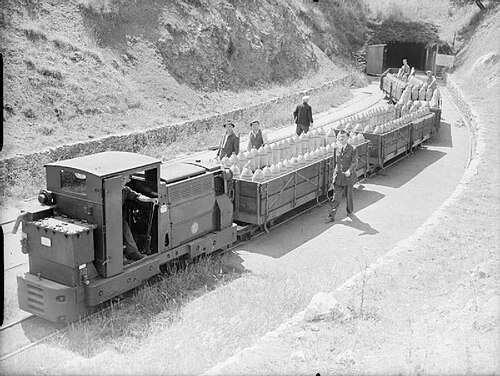
The site beneath that smoke had started out as something far less dramatic. In the nineteenth century, gypsum mining companies, including Peter Ford & Sons, had tunnelled into the hills near the hamlet of Fauld and the village of Hanbury to extract plaster rock, and by the 1930s much of that network sat disused5. In 1937, with war approaching, the Air Ministry bought a stretch of those old workings and turned them into an ammunition depot, eventually known as RAF Fauld, run by No. 21 Maintenance Unit7,5,2. By 1944 the underground chambers held an enormous stockpile, with published figures suggesting roughly 24,000 tons of bombs, incendiaries, and detonators moved through the site over time5,2, and somewhere between 3,500 and 4,000 tons on hand at the moment of the explosion1,3.

More than a thousand people worked there, RAF personnel and civilians together, alongside nearly 200 Italian prisoners of war doing much of the manual labor5,2. The depot ran under severe wartime strain: a management post had sat empty for a year, training was thin, multiple agencies worked the tunnels without one clear chain of command, and the push to keep munitions moving for the war effort meant safety rules were often treated as optional1,3. One RAF man who worked there later put it bluntly: you never saw a damned officer8.
The inquiry into what happened that morning could not rely on a clean eyewitness account, because the people closest to the first detonation were killed and the physical evidence destroyed1,5. What investigators reconstructed, in a report kept secret until 1974 under wartime security rules, was that a worker, or according to some accounts two airmen, had been trying to remove a detonator or exploder pocket from a damaged bomb using a brass chisel rather than the prescribed wooden or copper tool1,3,5,6. A witness later testified that workers had routinely used brass chisels on live ordnance, against regulations1,5. The contact probably threw a spark, and the spark set off that one bomb3,6.
From there it was not really one explosion but a chain reaction. The first detonation ignited the surrounding stores, consuming an estimated 3,800 tons of bombs in the chain that followed3,5,2. Above ground, the blast obliterated Upper Castle Hayes Farm along with its horses and cattle, tore apart Peter Ford & Sons' plaster works, and burst a reservoir that sent roughly six million gallons of water, mud, and debris pouring down into the mined areas below, drowning many of the workers there1,5,2. It left a crater, now called the Hanbury Crater, with estimates ranging from about 250 to over 1,000 feet across and roughly 80 to 100 feet deep1,2,4,9. Buildings as far as ten miles away sustained damage, and the sound reportedly carried to Birmingham and Coventry2,4.

Casualty counts have never fully settled. The most commonly cited figure is at least 70 dead or missing, a mix of RAF personnel, civilian workers, Italian prisoners of war, and farm workers, with 18 of them never recovered1,4. Other sources, including Historic England, put the toll closer to 80 or 90 once the injured and missing are folded in10,9. No one in a position of authority was disciplined afterward; the officer commanding the unit kept his post and later received an OBE8.
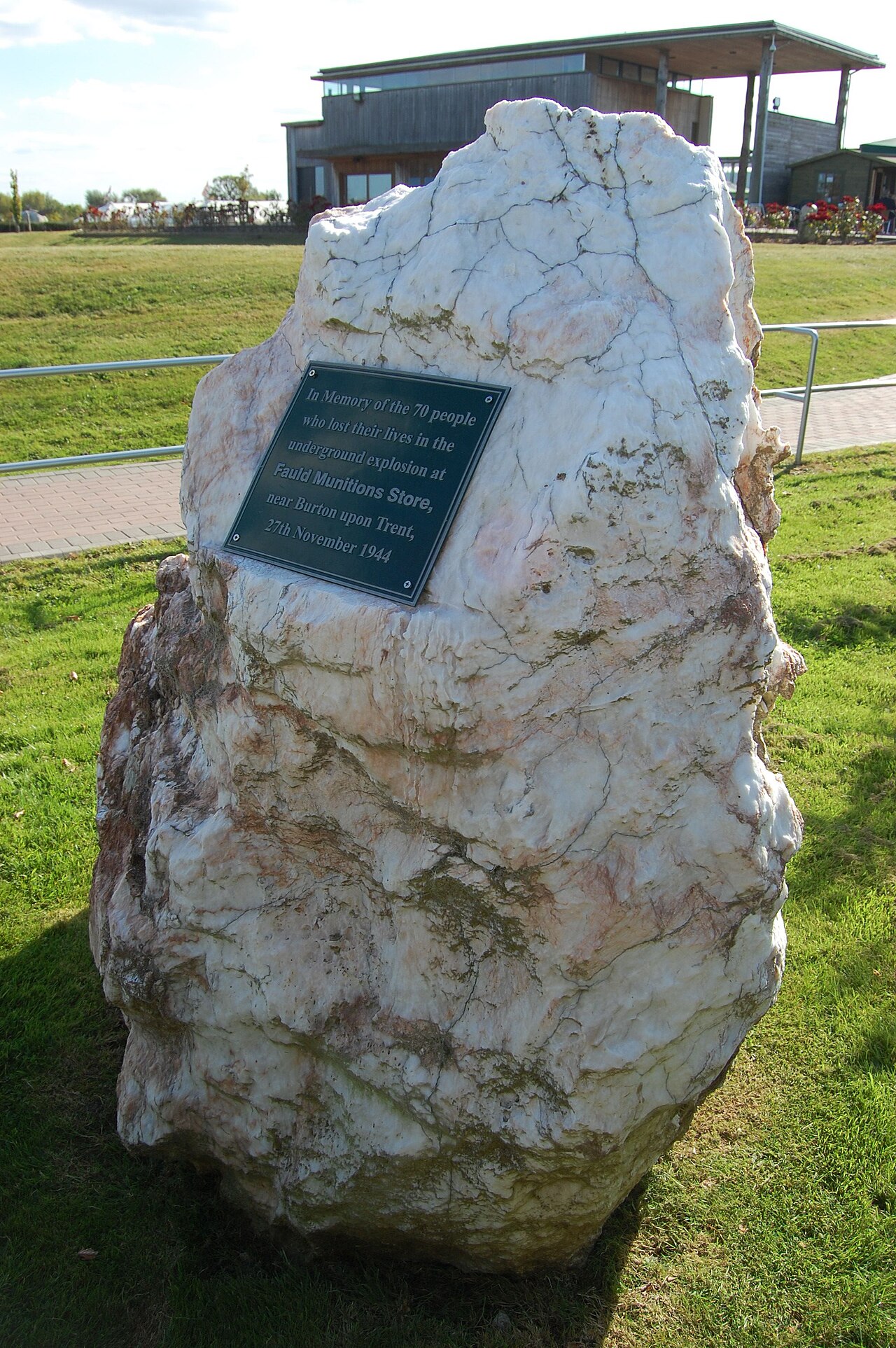
The government's reasons for secrecy were practical as much as embarrassing: revealing the scale of the depot and the disaster risked telling Germany exactly how badly Britain's munitions supply had been hit1,2. It was not until the thirty-year rule released the Court of Inquiry's findings in 1974 that the public learned what had actually happened underground, rather than the rumors of a V2 rocket or sabotage that had circulated locally for decades5. A memorial, its stone a gift from the Italian government in recognition of the prisoners of war killed, was unveiled at the crater's edge in 1990, and a second marker went up for the 70th anniversary in 20141,6. The crater itself is still there, fenced off by the Ministry of Defence because unexploded ordnance remains buried in the ground, now partly reclaimed by trees and wildlife1. Those two columns of smoke that people saw rising over the fields that Monday morning turned out to mark not an attack from abroad, but a mistake made with a chisel, inside a mine nobody outside the fence was supposed to know about.
The Scale of It
- Time and date: approximately 11:11 to 11:15am, Monday, 27 November 19441,7,2
- Explosive material involved: roughly 3,500 to 4,000 tons of stored ordnance, with about 3,800 tons consumed in the chain reaction1,3,2
- Crater size: estimates range from about 250 to over 1,000 feet across and 80 to 100 feet deep, covering around 12 acres1,5,2,9
- Death toll: at least 70 confirmed dead or missing; some official and heritage sources cite totals nearer 80 to 90 when injuries are included1,4,10,9
- Damage radius: buildings damaged within roughly 10 miles; the blast reportedly heard in Birmingham and Coventry2,4
- Workforce: over 1,000 RAF and civilian employees plus nearly 200 Italian prisoners of war at the time5,2
- Secrecy: the Court of Inquiry's findings were not released until 1974, thirty years after the explosion1,3,5
What Still Doesn't Add Up
The exact death toll has never been fixed. Wikipedia and the RAF Memorial Flight Club cite at least 70 dead or missing1,2, while Historic England records 81 service personnel and local residents killed, and an Institution of Chemical Engineers account lists 68 killed and 22 injured10,9. The differences likely come down to whether missing people, later deaths, and all categories of worker get counted the same way; no single tally has become the settled figure.
Accounts also differ on the tool involved. The Tutbury Museum and some other sources describe the correct implement as a wooden batten or a regulation copper chisel, contrasted against the brass chisel allegedly used1,5; other versions simplify this to just wood versus metal. Since no direct eyewitness to the actual moment of ignition survived, all of this rests on the inquiry's reconstruction rather than observed fact1,5.
Local rumor at the time pointed to a V2 rocket strike or sabotage by Italian prisoners of war as the cause, reflecting wartime anxieties rather than evidence5. The official inquiry found no support for either theory, attributing the disaster instead to unsafe handling of explosives within a poorly supervised depot1,3,5.
Timeline
- 1937The Air Ministry buys disused gypsum mine workings near Fauld and Hanbury to create an underground RAF munitions depot7,5.
- 27 November 1944, c. 11:11-11:15amAn underground detonation triggers a chain reaction through thousands of tons of stored bombs, killing at least 70 people and creating the Hanbury Crater1,2.
- Late 1944The RAF holds a secret Court of Inquiry into the cause; findings are withheld for wartime security reasons3,5.
- 1974The inquiry's findings are released under the thirty-year rule, pointing to unsafe removal of a detonator as the probable cause5,11.
- 1990A memorial stone, donated by the Italian government, is unveiled at the crater site1,6.
- 27 November 2014A second memorial is unveiled for the 70th anniversary of the explosion6.
Pictures



Sources
- RAF Fauld explosionWikipedia
- The RAF Fauld explosion on 27th November 1944 | RAF Memorial Flight Clubmemorialflightclub.com
- RAF Fauld explosion, 1944 — 27 November 1944 | MineArchiveminearchive.co.uk · 2026
- The Fauld explosion | CWGCcwgc.org
- The Fauld Explosion – Tutbury Museumtutburymuseum.org
- Fauld explosion 70th anniversary: New memorial unveiledBBC · 2014
- RAF FauldWikipedia
- BBC - Stoke & Staffordshire - Discover Staffordshire - World's largest-ever explosion (almost)BBC
- THE LARGEST EXPLOSION IN THE UK FAULD, 1944icheme.org
- Fauld Crater, Hanbury - Heritage Gateway Recordhistoricengland.org.uk
- The day Staffordshire was hit by UK's biggest ever explosionstokesentinel.co.uk
- Thousands of tons of bombs explode at the RAF Fauld underground depot in England - Today's Flashbacktodaysflashback.com
Researched and written by Lorelet from the sources above. It cites as it goes, but it can still get things wrong, so check the sources for anything that matters.
Report a problem
More featured lorelets
See all
Today · History
When Alfred Nobel's Will Shocked His Family
A handwritten testament gave away a fortune to strangers and left a young assistant to make it real, against the wishes of furious relatives and a ki…
Today · Space
First Breath: How Astronomers Sniffed an Exoplanet's Air
A star 150 light-years away, a planet crossing its face, and a sliver of color in the spectrum that changed what astronomers thought was measurable.

Nov 26 · Mystery
The Night Vrillon Spoke Through Southern Television
On a quiet November evening in 1977, a British newsreader's voice vanished from the air and something else took its place, addressing viewers in thei…