
Featured · TodaySpace
First Breath: How Astronomers Sniffed an Exoplanet's Air
A star 150 light-years away, a planet crossing its face, and a sliver of color in the spectrum that changed what astronomers thought was measurable.
Listen
Read by Finch · 6 min
A Quarter of a Percent of Nothing
Between April and May of 2000, the Hubble Space Telescope's Space Telescope Imaging Spectrograph collected 684 spectra of the star HD 209458, timed to catch four separate transits of the planet crossing its face3. The first of those transits, observed on April 25, was partly ruined: a database error had misplaced the spectrum on the detector, so part of it fell outside the subarray, and the team discarded it along with some noisy early-orbit data from the other visits3. That left 417 usable spectra, sorted into narrow wavelength bands centered on one particular pair of lines3.
The team was not hunting for the planet itself. They were hunting for a few hundred parts per million of extra dimness, concentrated at one narrow stripe of color, hidden inside a transit signal already dominated by the planet's own opaque bulk3,5.
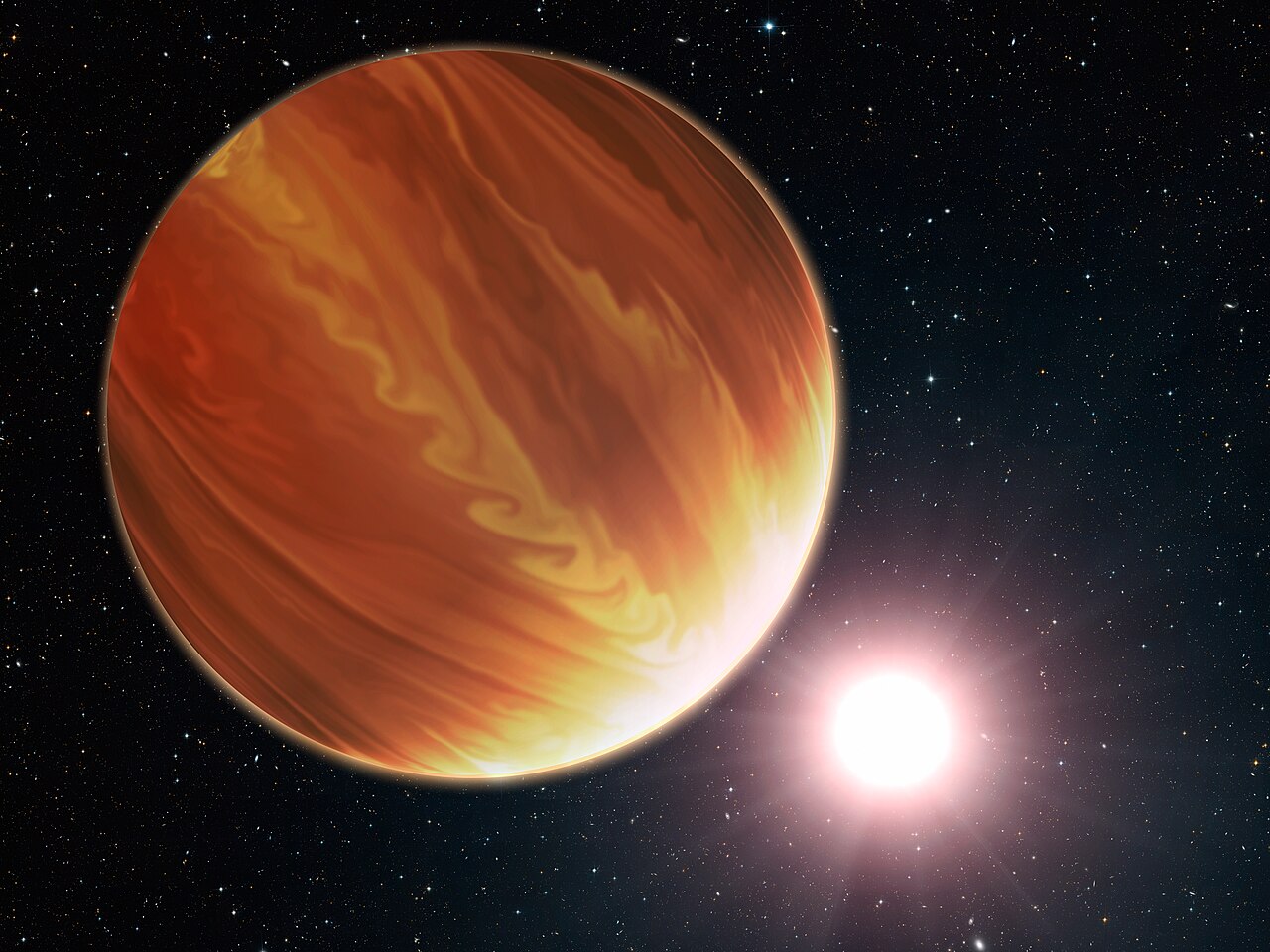
HD 209458 b had been known for barely two years by then. In 1999, two teams had picked up a wobble in the star's motion using the radial-velocity method, evidence of an unseen companion tugging on HD 209458 but no proof it ever crossed the star's disk6,7,8. Weeks later, two separate groups, one led by David Charbonneau with Timothy Brown, the other by Gregory Henry, caught the star's light actually dipping on schedule: the companion transited4,9,8. That made HD 209458 b the first planet confirmed to cross the face of a Sun-like star as seen from Earth, and the first whose radius could be pinned down directly, combining the transit depth with the radial-velocity data6,7.
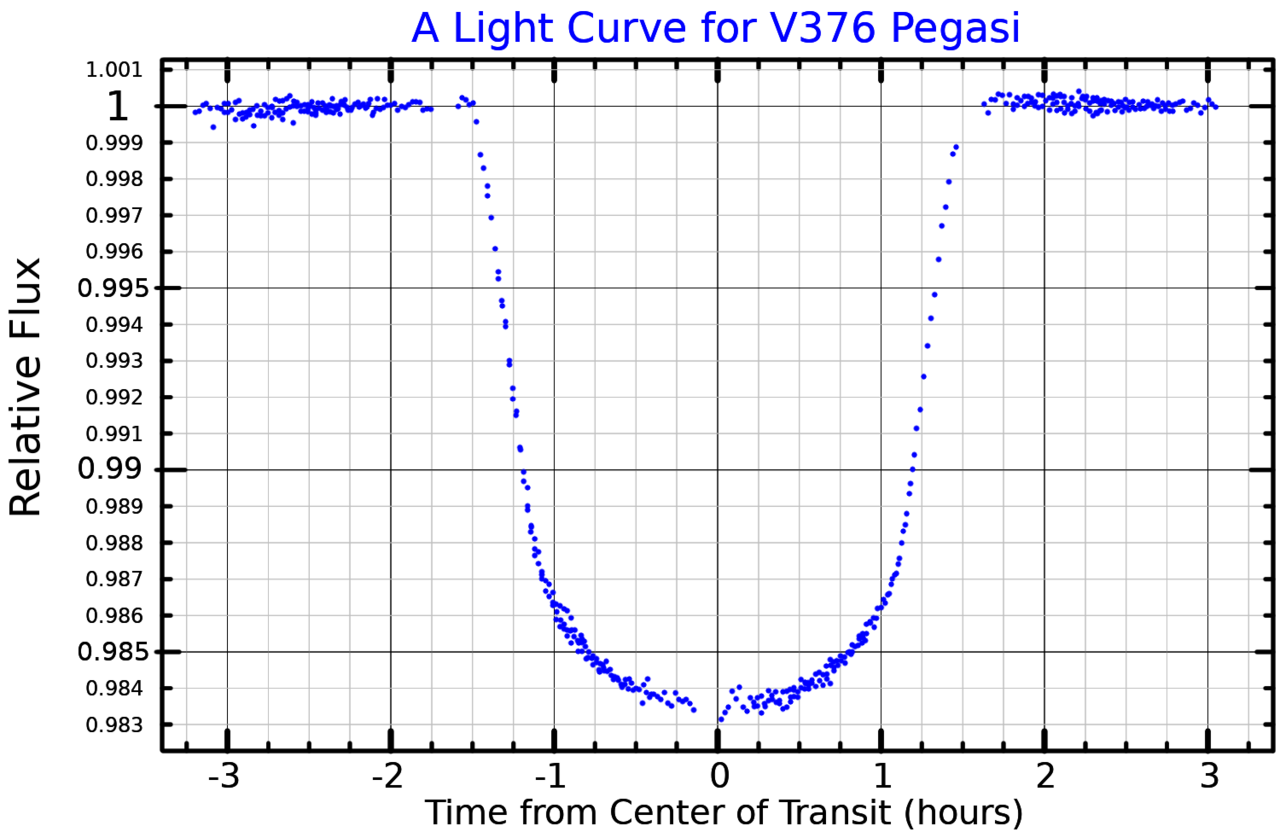
The transit was the opening that made everything else possible. During it, the star's total brightness fell by about 1.7 percent as the planet's disk blocked direct light1. But a thin ring of starlight grazed the planet's limb on its way to Earth, passing through whatever gas surrounded it before reaching the telescope1,10. If that gas absorbed light more strongly at certain wavelengths, the planet would look very slightly bigger at those colors, and the transit would look very slightly deeper there than elsewhere3,5. Transmission spectroscopy, as this approach came to be called, needed a transiting planet, a bright enough star, and an atmospheric signal big enough to clear the instrumental noise1,6. HD 209458 b had all three1,6.
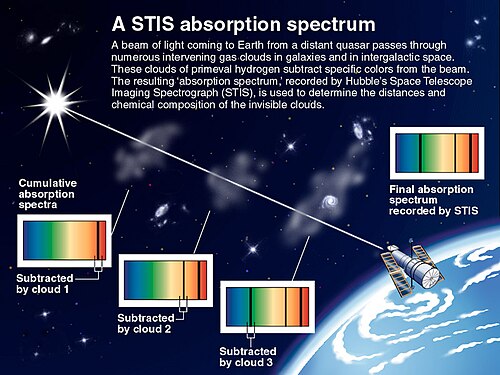
Charbonneau, then affiliated with Caltech, led the atmospheric search with Brown, of the National Center for Atmospheric Research, and collaborators, aiming Hubble's STIS spectrograph at the narrow resonance doublet of sodium near 589.3 nanometers, a feature theorists had already predicted would show up if the planet had an atmosphere at all3,1,11. Rather than trying to image the planet, invisible beside its much brighter star, they compared the star's own spectrum in transit against its spectrum out of transit, band by band1,5.

What came back, after sorting the 417 good spectra into nine photometric bands, was a transit that ran measurably deeper in the sodium band than in the bands beside it3. The excess came to about 0.023 percent, plus or minus 0.006 percent, inside a band just 12 angstroms wide: roughly 230 parts per million, with an uncertainty equal to about a quarter of the signal itself2. It was small enough that it rode entirely inside the noise floor of the two prior searches for the same thing, which had only been sensitive down to signals of 1 to 2 percent3. The team wrote plainly: "We interpret this additional dimming as absorption from sodium in the planetary atmosphere"3,5.
The paper, titled "Detection of an Extrasolar Planet Atmosphere," was accepted by The Astrophysical Journal on November 19, 20013. NASA announced it publicly on November 27, calling it the first direct measurement of an atmosphere on a planet orbiting another star, and the agency's Astronomy Picture of the Day followed the next day with the same claim12,1. It became, by the consensus of later papers revisiting the planet, the first detection of an exoplanetary atmosphere, full stop2,13.
The measurement held up for years as a landmark, even as later studies pushed further, finding an enormous evaporating envelope of hydrogen, carbon, and oxygen around the planet and a long escaping tail4. Some more recent high-resolution reanalyses of ground-based data have questioned whether the original sodium signal survives scrutiny once stellar effects are modeled more carefully14,15, a dispute that belongs to the record of what came after. In 2000 and 2001, what mattered was simpler: three usable transits, one discarded to a database error, and a sliver of starlight that had passed through the air of another world before anyone on Earth saw it3.
Timeline
- 1999 (reported Dec. 16, 1999)Radial-velocity measurements reveal a planetary-mass companion orbiting HD 2094587,8.
- 1999Two teams detect the planet transiting its star, confirming it as the first known transiting exoplanet around a Sun-like star6,9,8.
- April-May 2000Hubble's STIS spectrograph observes four transits of HD 209458 b; one is later discarded due to a database error3.
- November 19, 2001The Astrophysical Journal accepts "Detection of an Extrasolar Planet Atmosphere" by Charbonneau, Brown, and colleagues3.
- November 27-28, 2001NASA publicly announces the first direct detection of an exoplanet atmosphere12,1.
- 2002The formal paper reports an excess sodium absorption of about 0.023 ± 0.006 percent2.
- 2003-2004Follow-up Hubble STIS observations reveal a vast evaporating hydrogen, carbon, and oxygen envelope around the planet4.
Pictures


Sources
- Hubble Makes First Direct Measurements of Atmosphere on World ...NASA
- Ground-based detection of sodium in the transmission spectrum of exoplanet HD 209458baanda.org
- Detection of an Extrasolar Planet AtmosphereBased on observations with the NASA/ESA Hubble Space Telescope, obtained at the Space Telescope Science Institute, which is operated by the Association of Universities for Research in Astronomy, Inc. under NASA contract No. NAS5-26555.arXiv
- HD 209458 bWikipedia
- Charbonneau et al., Detection of an Extrasolar Planet Atmosphereiopscience.iop.org
- Exoplanet Atmospheres at High Spectral ResolutionarXiv
- Detection of Planetary Transits Across a Sun-like Stariopscience.iop.org · 1999
- A Transiting “51 Peg-like” Planetiopscience.iop.org · 1999
- Detection of Planetary Transits Across a Sun-like StararXiv.org
- Atmosphere of an Extrasolar Planet Detected for the First ...NASA
- Astronomy Picture of the DayNASA
- APOD: 2001 November 28 - Extra Solar Planetary Atmosphere ...NASA
- The Significance of the Sodium Detection in the Extrasolar Planet HD 209458 b AtmospherearXiv
- Is there Na i in the atmosphere of HD 209458b?arXiv
- Revisiting the atmosphere of HD 209458b with HARPS-N, CARMENES and ESPRESSOScholarly work (preprint) · 2024
Researched and written by Lorelet from the sources above. It cites as it goes, but it can still get things wrong, so check the sources for anything that matters.
Report a problem
More featured lorelets
See all
Today · History
The RAF Fauld Explosion: Britain's Largest Blast Crater
On a quiet Monday morning in wartime Staffordshire, the ground opened up. It took thirty years for anyone outside the military to find out why.

Today · History
When Alfred Nobel's Will Shocked His Family
A handwritten testament gave away a fortune to strangers and left a young assistant to make it real, against the wishes of furious relatives and a ki…

Nov 26 · Mystery
The Night Vrillon Spoke Through Southern Television
On a quiet November evening in 1977, a British newsreader's voice vanished from the air and something else took its place, addressing viewers in thei…