
Featured · TodayFilm & TV
Errol Morris and the Machine He Built to Steal Eye Contact
For years a documentary filmmaker pressed his own head against the camera lens trying to fake intimacy. Then he built a machine that made four strange men stare straight into the audience's eyes.

Listen
Read by Finch · 6 min
A Machine Built From Mirrors and Terror
On Gates of Heaven, his first film, Errol Morris wanted his subjects looking at the camera while they spoke to him, so he did the only thing he could think of: he pressed his head up against the lens itself, trying to fake a face-to-face conversation while staying close enough to the glass that his subject's eyes would land somewhere near it1.
It worked, in a strained sort of way, but it wasn't a method so much as a contortion, and Morris knew it couldn't last1,2.
By the time he got there, Morris had already spent two decades failing his way into documentary filmmaking. He dropped out of a history of science program at Princeton after clashing with his advisor, Thomas Kuhn, left a philosophy doctorate at Berkeley feeling surrounded by what he called pedants, worked briefly as a private detective, and spent long stretches in Plainfield, Wisconsin researching Ed Gein for a project he never finished3,4. His first two features, Gates of Heaven (1978) and Vernon, Florida (1981), were already built on the kind of eccentric, digressive talkers he would keep returning to3,5.
The problem he kept running into was structural. A documentary interview is a conversation, and conversations happen face to face, but a camera lens sits off to the side of wherever the interviewer is sitting. A subject can talk to the person, or look at the audience, but ordinarily not both at once6,2. Every standard talking-head shot inherits that compromise: the subject's eyes drift slightly off center, toward a person just out of frame7.
Morris's fix was mechanical. He rigged a camera behind a two-way mirror, fed a live video image of his own face onto a teleprompter-style screen positioned directly over the lens, and built a matching rig so he could see his subject the same way1,8,9. The subject, looking into what appeared to be a small television showing Morris's face, was in fact staring straight down the barrel of the lens the entire time10,6.
His wife, Julia Sheehan, named the contraption: Interrotron, a combination of "interview" and "terror"10,1. The name described the feeling, not the function. Before he ever tried it on a subject, Morris worried people might bolt from the studio1,7.
He didn't test it on a stranger. He tested it in 1997, while making Fast, Cheap & Out of Control, on four men whose jobs sounded like a dinner-party riddle: a lion tamer turned robotics hand named Dave Hoover, a topiary gardener named George Mendonça who sculpted animals out of hedges in Rhode Island, an MIT robotics researcher named Rodney Brooks, and a naked mole-rat specialist, Ray Mendez5,1,7. Morris later said it worked like a charm, that people loved it1.
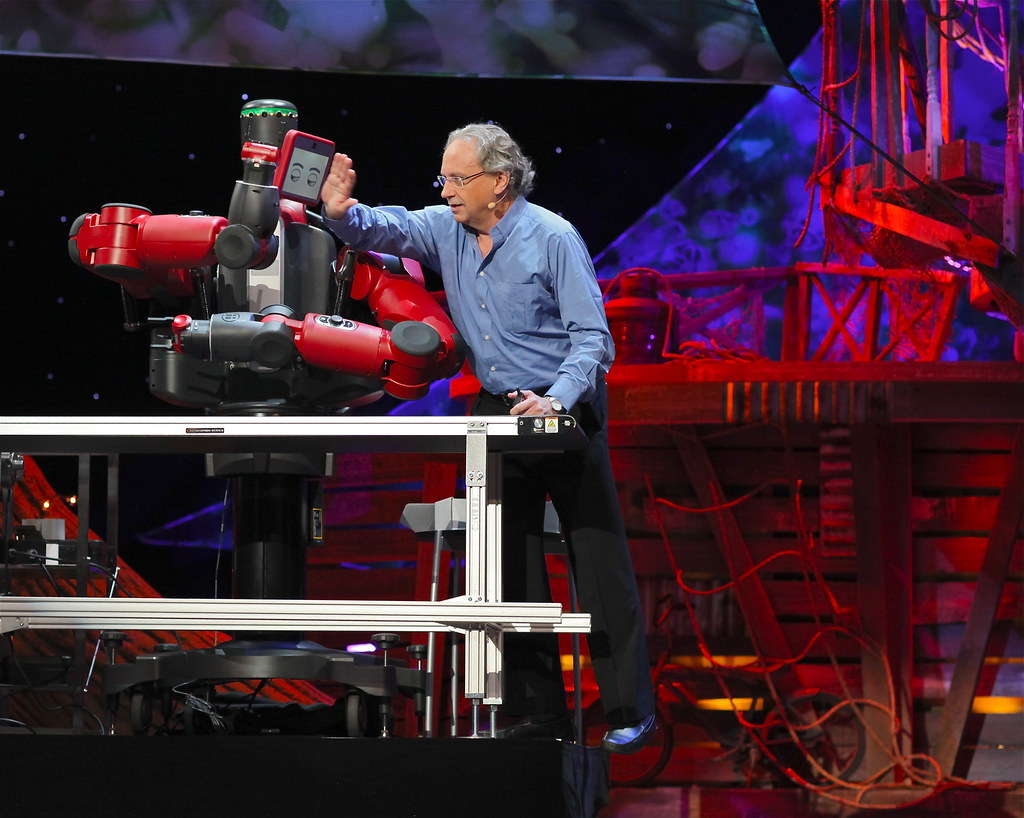
The reason it worked was not really about optics. A subject looking into the Interrotron wasn't confronting a machine at all; they were watching what felt like live television, Morris's own face, responding in real time1. His production designer, Ted Bafaloukos, put it plainly: the device let people do what they do best, which is watch television1. The camera had disappeared. What was left was a conversation that happened to be recorded on the same axis the audience would later look down.
Not everyone took to it immediately. When Robert McNamara, the former U.S. secretary of defense, arrived for what became The Fog of War, he looked at the rig and asked what it was. Told it was the Interrotron, he said, "Well, whatever it is, I don't like it"1. He sat down anyway, and the two of them recorded more than twenty hours of interviews1. Morris used the same rig later on Donald Rumsfeld for The Unknown Known, and on a parade of public figures including Mikhail Gorbachev, Laura Bush, Iggy Pop, Al Sharpton, and Walter Cronkite1,11,12.
In Fast, Cheap & Out of Control, the effect showed up less as a trick than as a tone. Hoover, Mendonça, Brooks, and Mendez each appear to be speaking not to Morris but outward, past him, at whoever is watching5,13. Roger Ebert described the film as being about people trying to take on, in his words, the mantle of God, each of them wrestling in some private and slightly melancholy way with control, work, and mortality3. None of that came from new footage techniques or a clever script. It came from four men looking dead into a lens that, for the first time, was wearing Morris's face.
Timeline
- 1978Morris releases Gates of Heaven, interviewing subjects by pressing his head against the camera lens1.
- 1997Morris uses the Interrotron for the first time while filming Fast, Cheap & Out of Control1,7.
- 1997-11-14Fast, Cheap & Out of Control is released13,14.
- 2003-2004Morris uses an updated Interrotron on The Fog of War, interviewing Robert McNamara; the film wins the Academy Award for Best Documentary Feature1,15.
- 2013Morris uses the Interrotron on Donald Rumsfeld for The Unknown Known11.
Pictures


Sources
- Errol Morris: Eye Contacterrolmorris.com
- Errol Morris Fans, There's a Surprise for You on YouTubegizmodo.com
- Errol MorrisWikipedia
- Errol Morris: InterviewInternet Archive
- Fast, Cheap & Out of ControlWikipedia
- Errol Morris : Bullseye with Jesse ThornNPR · 2021
- The Interrotron: How Errol Morris Changed The Way Documentaries Watch UsInternet Archive · 2017
- Post navigationblogs.uoregon.edu
- Cinema as Prosthesis: Errol Morris's Use of the Interrotron in ...journal.media-culture.org.au
- Documentarian Errol Morris on the Complicated Relationship Between Truth and Deception - Nieman Reportsniemanreports.org · 2026
- How Making THE UNKNOWN KNOWN Was Satisfying for Errol Morrisdocumentary.org
- Shot Craft: The Talking Head — Shooting Interviewstheasc.com
- Fast, Cheap & Out of Controlaustinchronicle.com
- Fast, Cheap & Out of Controlaustinchronicle.com
- 'Fog of War' lifts Morris to his first Oscar victoryLos Angeles Times · 2004
- [PDF] It Could All Be Wrong - An unfinished interview with Errol Morristhestickingplace.com
Researched and written by Lorelet from the sources above. It cites as it goes, but it can still get things wrong, so check the sources for anything that matters.
Report a problem
More featured lorelets
See all
Today · History
Indianola: The Boomtown Erased by the Gulf
Texas's second-busiest port once rivaled Galveston. Twice the Gulf tried to take it, and the second time, almost no one was left to argue.

Today · Sports
The Night Canton and Massillon Nearly Killed Pro Football
A two-game series between Ohio's best teams ended with a brawl in a hotel bar and accusations that would hang over professional football for a decade.

Nov 23 · History
Boss Tweed's Downfall: Caught by His Own Caricature
A New York political boss fled across an ocean under a false name. Something about him was impossible to hide.