
Featured · TodayHistory
Boss Tweed's Downfall: Caught by His Own Caricature
A New York political boss fled across an ocean under a false name. Something about him was impossible to hide.

Listen
Read by Wren · 8 min
The Man Who Could Not Change His Face
He had a new name by the time he reached Spain. He had crossed from Cuba, spent some 42 days at sea, and by November 1876 had been a fugitive for roughly eleven months4. At the Atlantic port of Vigo, in Galicia, Spanish officials looked at the traveler in front of them and recognized William M. Tweed4,2.
A changed name does not change a face, at least not one that newspaper readers on two continents had seen hundreds of times. Something had already made this particular face impossible to lose.
That something started in New York more than a decade earlier. Tweed had risen through Tammany Hall, the Democratic Party machine that dominated New York City politics, becoming its "Grand Sachem" and widely known as "Boss" by 18631. By 1870 he and allies including Peter B. Sweeny, Richard B. Connolly, and Mayor A. Oakey Hall controlled the city's government, a group that came to be called the Tweed Ring1,5.
The Ring's method was simple and brazen: contractors favored by Tammany were told to inflate their bills, sometimes by five or ten times the real cost, and the padded money was split among Tweed and his partners1. The construction of the New York County Courthouse, begun in 1861, eventually cost nearly $13 million, almost twice the price of the Alaska Purchase six years later1. A committee later estimated the Ring's total theft at $25 million to $45 million, though some estimates ran as high as $200 million1.
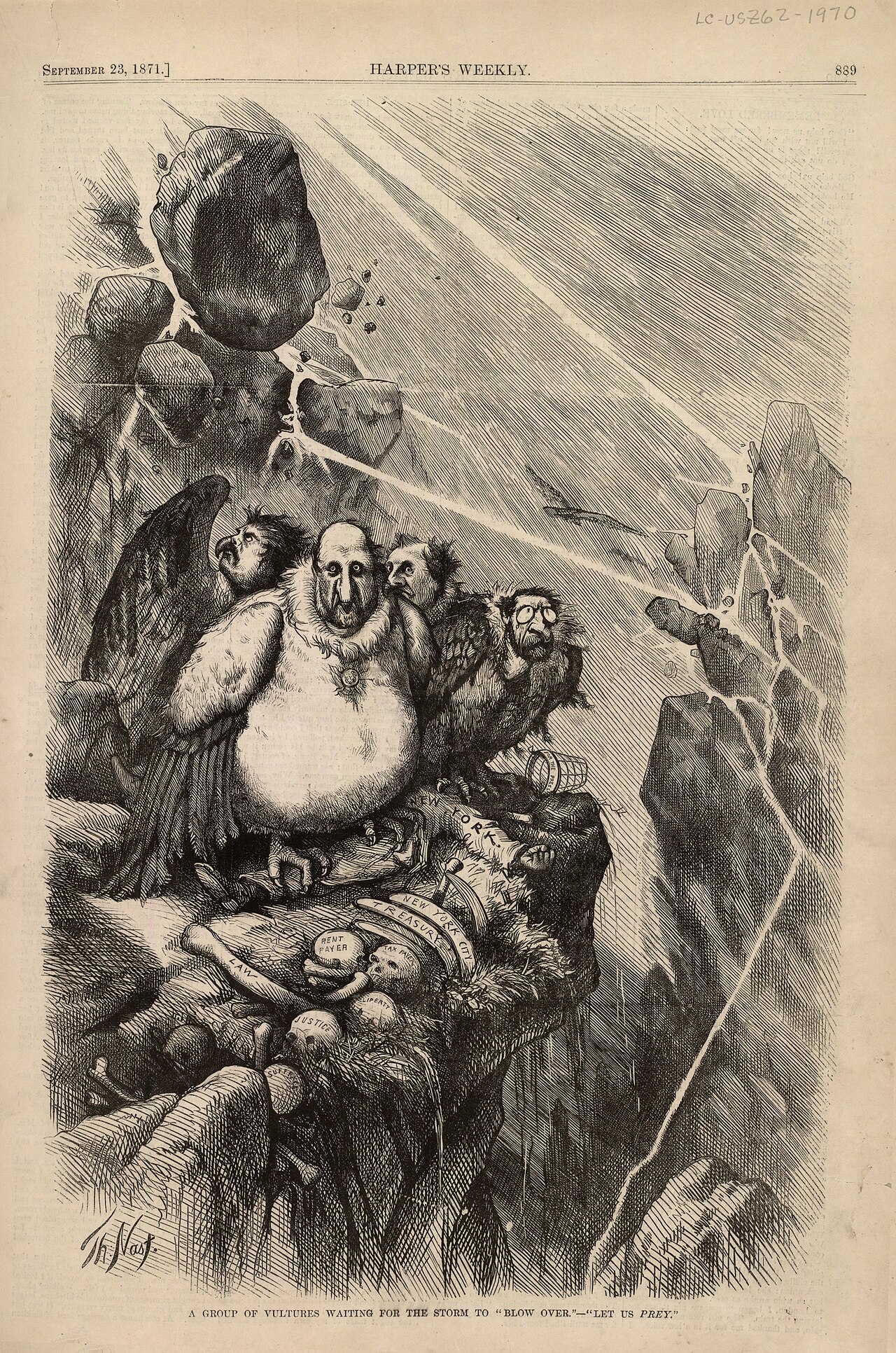
The scandal became public in 1871, when reform newspapers, especially the New York Times, published evidence of the city's distorted finances6,7. Thomas Nast, a German-born illustrator at Harper's Weekly, had been needling Tweed intermittently since 1869, drawing him large and imposing, often with a diamond stickpin he had taken to wearing once his wealth grew1,2. In 1871 Nast sharpened the attack, pairing Tweed's exaggerated bulk with the Tammany tiger, a symbol the organization had used since Tweed's volunteer fire company days1,3.
On August 19, 1871, Harper's Weekly ran a pair of Nast cartoons that reduced the entire accounting scandal to a question and an answer: "Who Stole the People's Money?" and the blunt reply, "'Twas Him"3. By November, Tweed and his allies had been forced from office, though Tammany itself survived5.
Tweed is often quoted as having said of Nast's work: "I don't care a straw for your newspaper articles, my constituents don't know how to read, but they can't help seeing them damned pictures"8,9. The line is repeated everywhere, but the surviving record treats it as apocryphal rather than a documented transcript8. True or not, it describes exactly what happened to him.

Tweed was convicted on corruption charges and imprisoned, then later released under a civil arrangement tied to the city's attempt to recover its money. By late 1875 he was back in legal custody, and he escaped, making his way first to Cuba and then across the Atlantic to Spain under an assumed identity4,1.
It was in Vigo that Nast's years of repetition caught up with him. Officials there reportedly recognized Tweed by comparing him to one of Nast's caricatures, images that had circulated internationally and turned his face into something like a wanted notice4,2. No source gives a verified transcript of the exact exchange, or names the officer involved, or identifies which specific cartoon was used, so those details should stay out of any retelling. What is established is simpler and stranger: a man trying to disappear had spent years being drawn, over and over, as the same large figure with the same diamond and the same tiger at his heel, and that was enough.
Spain returned him to the United States. He was imprisoned again in New York and died in the Ludlow Street Jail in 18781.
Who's Who
- William M. Tweed: New York political boss and head of Tammany Hall, convicted of massive public corruption1.
- Thomas Nast: German-born cartoonist for Harper's Weekly whose caricatures turned Tweed into a visually recognizable villain2.
- Peter B. Sweeny, Richard B. Connolly, A. Oakey Hall: Tweed's partners in the Ring, controlling parks, the comptroller's office, and the mayoralty respectively1.
- Tammany Hall: The Democratic political machine Tweed led, symbolized in Nast's cartoons by a tiger1,3.
- Harper's Weekly: The illustrated magazine that published Nast's attacks on Tweed starting in 1869 and intensifying in 18711,2.
By the Numbers
- $25 million to $45 million: an 1877 aldermen's committee estimate of what the Ring stole; later estimates ran as high as $200 million1.
- $13 million: final cost of the New York County Courthouse, begun in 1861 at a fraction of that price1.
- 42 days: time Tweed reportedly spent at sea during his escape4.
- About 11 months: total time Tweed spent as a fugitive before his capture in Vigo4.
- 1869: year Nast began using Tweed's diamond stickpin as a caricature detail in Harper's Weekly1.
What's Shaky in the Story
The famous line attributing to Tweed a fear of "damned pictures" over newspaper articles is widely repeated but treated by researchers as apocryphal rather than a secured quotation8,9.
The popular version of the Vigo capture, in which a single cartoon is held up and a man is instantly arrested from a drawing, oversimplifies what happened. The more defensible account is that Nast's repeated, widely circulated caricatures made Tweed's face recognizable abroad, working alongside whatever formal notice Spanish authorities had of his escape4,2.
No source in the record gives a verified transcript of the exchange at Vigo, names the specific officer involved, or identifies the exact cartoon used for identification. Those specifics should be treated as missing rather than filled in for effect.
Timeline
- 1863Tweed becomes "Grand Sachem" of Tammany Hall and is known as "Boss"1.
- 1869Thomas Nast begins caricaturing Tweed in Harper's Weekly, using his diamond stickpin as a visual marker1.
- 1870Tweed and allies gain control of major parts of New York City government1,5.
- August 19, 1871Harper's Weekly publishes Nast's "Who Stole the People's Money?" cartoons3.
- November 1871Tweed and Ring members are removed from office5.
- Late 1875Tweed escapes custody in New York and flees, eventually reaching Cuba4,1.
- November 1876Tweed is identified and captured in Vigo, Spain, after about 11 months on the run4.
- 1878Tweed dies in the Ludlow Street Jail in New York1.
Pictures


Sources
- William M. TweedWikipedia
- Thomas NastWikipedia
- On This Day: August 19, 1871The New York Times
- How a series of political cartoons by artist Thomas Nast helped send ...nydailynews.com
- September 27: Thomas Nast | FCITfcit.usf.edu
- Stop Thief! - The Object of Historyobjectofhistory.org
- Stop Thief! – Tour – The Voting Machineobjectofhistory.org
- Controversies | Illustrating Chinese Exclusionthomasnastcartoons.com
- Thomas Nast's Campaign Against Boss Tweedthoughtco.com
Researched and written by Lorelet from the sources above. It cites as it goes, but it can still get things wrong, so check the sources for anything that matters.
Report a problem
More featured lorelets
See all
Today · Film & TV
An Unearthly Child's Narrow Escape from the News
A new BBC science fiction serial went out the day after the Kennedy assassination, to an audience distracted and half the country watching something…

Today · History
The Night the Explorer Went Down in Antarctica
A tourist ship built for polar ice spent decades proving it could handle Antarctica, until one night in the Bransfield Strait it couldn't.

Nov 22 · Food
The Turkey Surplus That Became the TV Dinner
A company drowning in frozen birds found an answer on an airline food cart, or so the story goes for fifty years.