Featured · TodayBusiness
The Terminal: How a Firing Built Wall Street's Addiction
Michael Bloomberg got pushed out of Salomon Brothers with a check for about $10 million. He turned it into a locked-box machine that trading floors still cannot live without.

Listen
Read by Finch · 6 min
Fired on a Saturday, in business by Monday
Michael Bloomberg's version of the story starts with a specific date: Saturday, August 1, 1981, the day he says he was let go from Salomon Brothers6. He had been there fifteen years, rising from an entry-level clerk earning $9,000 a year to general partner, and had spent the late 1970s running the firm's information-technology division1,7. When Salomon was acquired by Phibro Corporation in 1981, Bloomberg was among the partners who left in the transaction8,2.
What he walked away with was roughly $10 million, tied to his partnership stake rather than a standard severance check, though accounts differ on exactly how to characterize the payment9,2,10,6. One version holds that he actually voted in favor of the Phibro deal once he understood it would cash him out10. Whatever the mechanics, the money was real, and so was the itch to build something of his own.
He did not wait long. Bloomberg founded Innovative Market Systems in 1981, bringing in three former Salomon colleagues: Thomas Secunda, who wrote the early analytics code, Duncan MacMillan, and Charles Zegar1,7. One account says Bloomberg sank about $4 million of his payout directly into building the company, though that figure is not independently confirmed11.

The idea was simple to state and hard to execute: traders did not just need prices, they needed prices, history, calculations, news, and a way to talk to each other, all in one box. IMS called its first machine the Market Master. It paired a monochrome CRT monitor with a custom keyboard, a controller unit, and a link into IMS's own private data network3.
In 1982, in the middle of a global recession, the first 22 Market Master terminals went to Merrill Lynch3. That was not a small customer taking a flyer on a startup. Merrill also took an equity stake, reportedly 30 percent for $30 million, in exchange for a five-year exclusivity window that kept IMS from selling the machine to Merrill's competitors4,5. Merrill released IMS from that restriction in 1984, and the terminal spread across the rest of Wall Street from there4.
Around 1986, IMS renamed itself Bloomberg L.P., and the Market Master became the Bloomberg Terminal3,5. By then the company was already layering on more than data: messaging, research tools, and eventually its own newsroom. The terminal's internal chat system, Instant Bloomberg, let subscribers message each other directly over Bloomberg's private network, turning the box on every desk into a communications system that traders could not easily quit even if they wanted to3.
Why one box beat everybody else's parts
Before Bloomberg, financial-data vendors mostly did one thing: distribute prices, or news, or historical records, and left customers to stitch the pieces together themselves, often with help from in-house programmers3. Quotron had introduced electronic quote screens back in 1960, and Reuters and Dow Jones ran subscription news services, but none of them fused data, analytics, and communication into a single interface built for traders3.
IMS's bet was that Wall Street would pay a premium to skip the stitching. The terminal did its own calculations on the spot, so a trader did not have to route a request through a separate research desk and wait3. And because the whole experience lived inside one proprietary system, the company that made it controlled far more than data accuracy. It controlled the hardware, the keyboard, the command language, the network, and the training that came with learning it all3.
That combination is why the product proved so sticky. A rival could copy the data. Matching the interface, the muscle-memory keyboard shortcuts, the private messaging network, and years of institutional habit was another matter entirely.
The Chiclet and the closed box
The keyboard became the terminal's signature as much as the data did. IMS built a custom keyboard from scratch rather than adapting an off-the-shelf design, hand-assembling the earliest versions into something that became known as the "Chiclet"3. In 1990, Bloomberg added a trackball and built-in voice-chat capability to the keyboard, and the first color version of the terminal arrived the following year12.
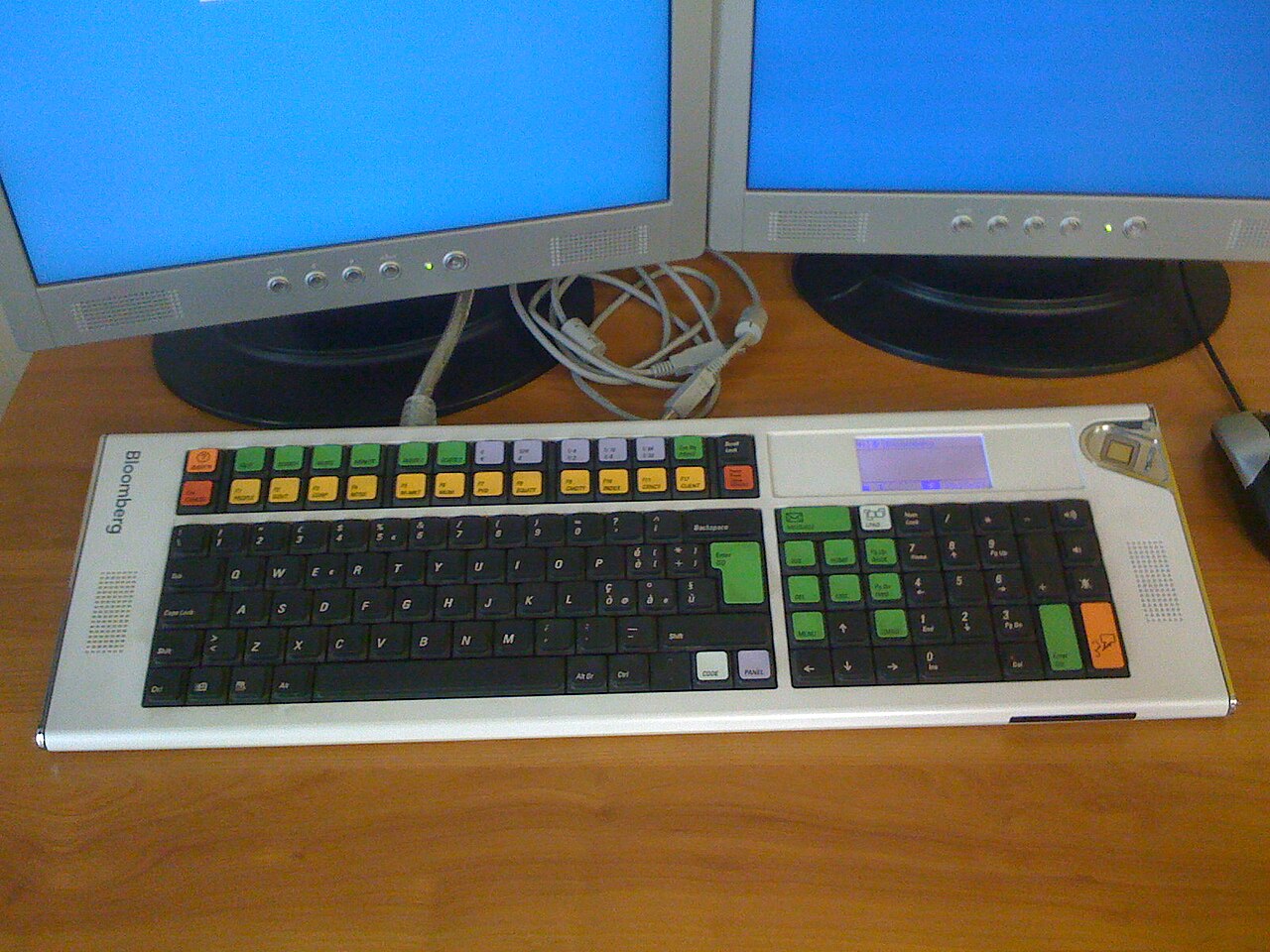
Every piece of that hardware, plus the software running behind it, stayed inside Bloomberg's walls. Subscribers leased terminals in two-year cycles rather than buying software outright, which meant the business ran on recurring revenue instead of one-time sales12. By 2022, roughly 325,000 terminals were subscribed worldwide, and the terminal business alone accounted for more than 85 percent of Bloomberg L.P.'s revenue12.
Who built it
- Michael Bloomberg: Supplied the capital from his Salomon payout, the commercial instinct, and firsthand knowledge of how fragmented Wall Street's information systems were1,7.
- Thomas Secunda: Former Salomon colleague who wrote much of the early analytics software that turned the concept into a working product7.
- Duncan MacMillan: Co-founder who helped build the company in its earliest, scrappiest stage1.
- Charles Zegar: Co-founder and former Salomon colleague who rounded out the founding team1.
- Merrill Lynch: Took the first 22 terminals and an equity stake in 1982, giving the fledgling company both capital and credibility on Wall Street4,3,5.
Fired, or just cashed out?
The popular version of this story, that Bloomberg was fired with a severance check and built an empire out of spite, is simplified. Sources agree he left Salomon in 1981 with about $10 million, but they disagree on what to call it. Some describe it as a straightforward severance package; others say it was the cash value of his partnership stake after Phibro's acquisition, and one account even suggests Bloomberg voted for the deal because he saw the payout coming9,2,10,6.
The exact amount he poured into founding the company is also unsettled. One source puts it at about $4 million of the $10 million total, but that figure does not appear corroborated elsewhere in the record11.
Timeline
- 1966Michael Bloomberg joins Salomon Brothers.
- 1978Salomon moves Bloomberg to run its information-technology division.
- 1981Salomon is acquired by Phibro Corporation; Bloomberg leaves with roughly $10 million and founds Innovative Market Systems with Thomas Secunda, Duncan MacMillan, and Charles Zegar.
- 1982IMS delivers the first 22 Market Master terminals to Merrill Lynch, which also takes an equity stake.
- 1984Merrill Lynch releases IMS from its exclusivity restriction.
- 1986IMS renames itself Bloomberg L.P.; the Market Master becomes the Bloomberg Terminal.
- 1990The Bloomberg keyboard gains a trackball and built-in voice-chat features.
- 1991The first color version of the terminal is released.
Pictures



Sources
- Billionaire Mike Bloomberg was fired after dedicating 15 years of his career to Salomon Brothers—the next morning, he founded his media empire | Fortunefortune.com · 2026
- Michael Bloomberg was fired from a Wall Street bank after 15 years. He used his $10 million payout to build a $109 billion fortune and has given away $25.4 billiontimesofindia.indiatimes.com
- A Brief History of the Bloomberg Terminalspectrum.ieee.org · 2026
- Bloomberg L.P.Wikipedia
- The history of 'Bloomberg Terminal,' designed for traders and analysts.gigazine.net
- Bloomberg by BloombergThe New York Times
- How Michael Bloomberg Achieved Massive Successbusinessinsider.com
- How Michael Bloomberg made his $65 billion net worthnypost.com
- How Michael Bloomberg Built His Business Empirethefabulous.co
- 55 Things You Need to Know About Mike Bloombergpolitico.com
- Michael Bloomberg: Getting Fired Fueled His Billion-Dollar Brandentrepreneur.com
- Bloomberg TerminalWikipedia
Researched and written by Lorelet from the sources above. It cites as it goes, but it can still get things wrong, so check the sources for anything that matters.
Report a problem
More featured lorelets
See all
Today · Film & TV
Why Nick Jr. Aired the Same Blue's Clues Episode All Week
A preschool show about a cartoon dog and her pawprints became a quiet experiment in how children actually learn from television — and the data said:…

Today · Crime
Liquid Gold: The Black Market for Used Cooking Oil
Green energy policy turned restaurant fryer grease into a commodity worth stealing, and a quiet corner of American crime grew up around it.

Sep 30 · Film & TV
The Pixar Lunch That Conceived Four Animated Classics
In the summer of 1994, four Pixar staffers went to a diner while Toy Story was still finishing up and, over lunch, sketched the outlines of A Bug's L…