
Featured · TodayHistory
The 1895 Race Run Through a Chicago Blizzard
On Thanksgiving Day 1895, six motor wagons set out from Chicago to prove the automobile could survive American roads. The weather had other plans.

Listen
Read by Finch · 8 min
A Driver Passes Out, and the Race Goes On
Somewhere past the halfway point of a fifty-mile slog through the snow, Oscar Mueller stopped being able to drive his own car. He had gone unconscious from exposure, and the umpire riding beside him, Charles Brady King, took the tiller for the rest of the way1. The Benz kept moving. Mueller, for a stretch, did not really know it.
That was not supposed to be the story. The Chicago Times-Herald had set out to prove these new machines could handle American roads and American weather better than a horse could. By the time King was steering a half-conscious man's car through the snow, the day had already answered a different question than the one it set out to ask.
The event began as a promotional idea from Herman H. Kohlsaat, publisher of the Times-Herald, who put up $5,000 in prize money to encourage the fledgling industry and, not incidentally, to mark his paper's anniversary1,2. The vehicles did not even have a settled name. The paper ran a contest before the race just to find a word for them, and the public landed on "motocycle," a term that never really caught on beyond the later Indian Motocycle company1,3.
Getting the cars onto the street at all required more than engineering. Chicago police told organizers the vehicles had no legal right to use city streets, forcing a postponement until the city passed an ordinance confirming that right1.
A snowstorm the night before made things worse. Accounts vary on how much fell, from a few inches to drifts reported as high as two feet, but the roads the next morning were packed snow, mud, and ruts1,4,5,6,7. The original route toward Milwaukee and then Waukegan had already been scaled back over bad roads in the weeks before; organizers settled instead on a round trip from Jackson Park to Evanston and back, roughly 54 miles1,8,7.
Of more than eighty people who had registered interest, only six vehicles reached the starting line on Thanksgiving morning: four gasoline cars and two electrics1,4. They left Jackson Park around 8:53 to 8:55 a.m., in temperatures reported variously near 30 and 38 degrees Fahrenheit4,2,1. Each car carried a race umpire alongside its driver4.
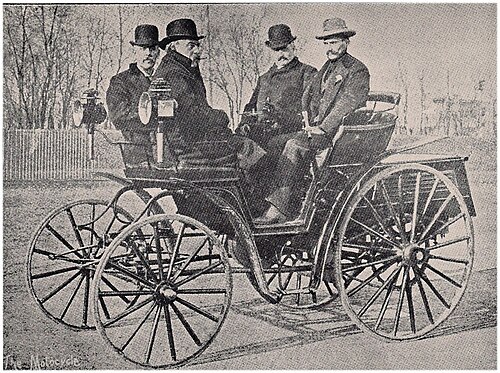
The going was rough from the start. One Benz slid on streetcar tracks it had been following and struck a horse tram, which knocked it out of the race and threw its driver and umpire into a snowbank4. The Duryea lost a tire and had to have attendants tie it back on with rope4. The two electric cars dropped out early as their batteries failed in the cold1,9.
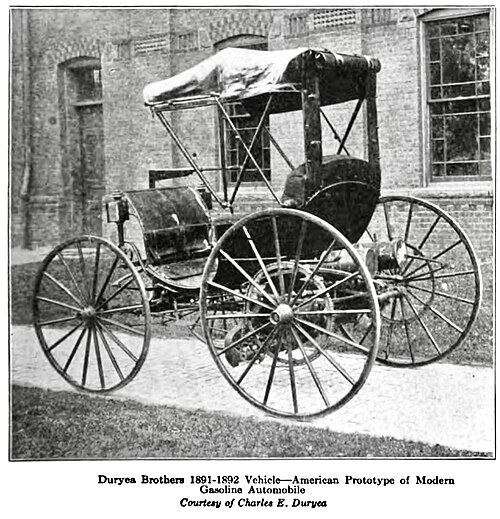
That left the contest, in practice, between Duryea's Motor Wagon and the Mueller Benz. The Duryea took an early lead but lost time to repairs; by one account Duryea spent nearly an hour fixing his machine over the course of the day, using skills he had as its builder that other drivers lacked1,4,2. On the return leg, Duryea passed the slower Benz, and for the last stretch of the course benefited from a horse-drawn sleigh that had already broken a trail through the snow ahead of him1.
It was on that return leg that Mueller's ordeal caught up with him, and King took over the Benz1. Mueller's car had already been slowed through the morning: it had to have its drive belt adjusted before the start, its solid tires wrapped with twine for traction, and at times had to be pushed by hand1. The cold that had been a background condition for everyone became, for Mueller, the thing that ended his race.
Duryea crossed the finish line at 8:53 p.m., more than ten hours after starting, with an elapsed time commonly given as 10 hours 23 minutes and an average speed of roughly 7 miles per hour4,2,10. Mueller's car, now under King's hands, arrived at the line not long after, its passengers described as nearly overwhelmed by the cold11. No other car finished the course1,5.
Kohlsaat later called it a fair test of what these machines could do. "A better test of the utility of road machines could not have been made," he said afterward, pointing to the terrible conditions as proof rather than excuse2. The man whose Benz had gone the last miles under someone else's hands might have put it differently.
Who Was Behind the Wheel, and the Money
- J. Frank Duryea: Drove the winning Duryea Motor Wagon, which he and his brother built; stopped to make his own repairs along the way and finished after dark1,4,3.
- Charles Duryea: Frank's brother and engineering partner in building the winning car; did not drive in the race himself12,3.
- Oscar Mueller: Drove the Benz entered by Hieronymus Mueller & Co. of Decatur, Illinois; lost consciousness from exposure during the return leg1,5.
- Charles Brady King: Served as race umpire in Mueller's car and took over driving it after Mueller collapsed; later became a notable early automotive figure in his own right1.
- Herman H. Kohlsaat: Publisher of the Chicago Times-Herald, who organized the race and put up the $5,000 purse to promote both his paper and the automobile industry1,2.
The Race in Figures
- $5,000: total prize money offered by the Times-Herald, including $2,000 for first place1,2.
- 83 to 89: reported number of entrants who initially registered interest before the field shrank1,2,11.
- 6: vehicles that actually started the race, four gasoline-powered and two electric1,4.
- 54 miles: approximate round-trip distance from Jackson Park to Evanston and back1,2,7.
- 10 hours 23 minutes: Duryea's elapsed winning time, for an average speed of about 7 miles per hour4,2,10.
- 2: number of cars that finished the full course1,5.
Where the Record Disagrees
Sources do not agree on exactly how much snow fell the night before the race, with figures ranging from two or three inches to reported drifts of two feet1,5,6,7. Reported temperatures at the start also vary, between about 30 and 38 degrees Fahrenheit, which may reflect measurements taken at different times or locations1,5.
Accounts differ on fine details of the running order and exact timings during the day, including precisely when Duryea passed the Mueller car and how long his repairs took13. Some sources describe Mueller's second-place car as being driven for part of the course by Charles Brady King after Mueller lost consciousness, while general summaries of the results sometimes simply credit "Mueller" with second place without noting the handoff1,5,10.
Finally, while the race is widely called the first automobile race in the United States, that claim is usually qualified: it is more precisely the first major, publicly organized, newspaper-sponsored automobile contest in the country, distinct from earlier informal or noncompetitive demonstrations4,5,2,8.
Timeline
- 1895-07-10Chicago Times-Herald announces the race and its $5,000 prize purse.
- 1895-11-02A smaller exhibition run between Duryea and Mueller is held after the main race is postponed; Mueller wins it.
- 1895-11-27A snowstorm hits Chicago overnight, leaving roads covered in snow, mud, and drifts.
- 1895-11-28Six cars start from Jackson Park around 8:53 to 8:55 a.m.; Duryea finishes at 8:53 p.m., with Mueller's Benz, driven in part by Charles Brady King, finishing second.
- 1895-12-05Official prize results are announced.
Pictures



Sources
- Chicago Times-Herald raceWikipedia
- Six Cars Raced to the Finish Line of the U.S.'s First Automobile Race—at Speeds of Seven Miles Per HourSmithsonian Magazine · 2024
- The First Auto Race: Thanksgiving 1895saturdayeveningpost.com
- Today in History - November 28Library of Congress
- Chicago Times-Herald Race of 1895encyclopedia.chicagohistory.org
- Frank Duryea Wins First Race In The US 125 Years Ago Today - Jalopnikjalopnik.com
- 1895 Times-Herald Horseless Race - chicagologychicagology.com
- H. H. Kohlsaat and the First Automotive Race in the USchicagohistory.org
- The Forgotten Car That Won America's First Auto RaceSmithsonian Magazine · 2016
- View at the 1895 Chicago Times-Herald Automobile Racethehenryford.org
- Chicago-Times Herald Race, 1895ophelia.sdsu.edu
- Duryea Motor Wagon CompanyWikipedia
- The Great Chicago Race of 1895blackburnwheels.com
- 1895 Chicago Times-Herald - Motor Racing Historymotorracinghistory.com
Researched and written by Lorelet from the sources above. It cites as it goes, but it can still get things wrong, so check the sources for anything that matters.
Report a problem
More featured lorelets
See all
Today · Film & TV
How Blade Runner Got Its Name from Black Market Scalpels
Ridley Scott loved a word buried in his screenwriter's draft. The screenwriter admitted, a little sheepishly, that it wasn't his.

Today · Space
Little Green Men: How Jocelyn Bell Burnell Found Pulsars
A graduate student spotted a stubborn quarter inch of scruff on a chart recorder and spent months chasing down what it was.

Nov 27 · History
The RAF Fauld Explosion: Britain's Largest Blast Crater
On a quiet Monday morning in wartime Staffordshire, the ground opened up. It took thirty years for anyone outside the military to find out why.