Featured · TodayScience
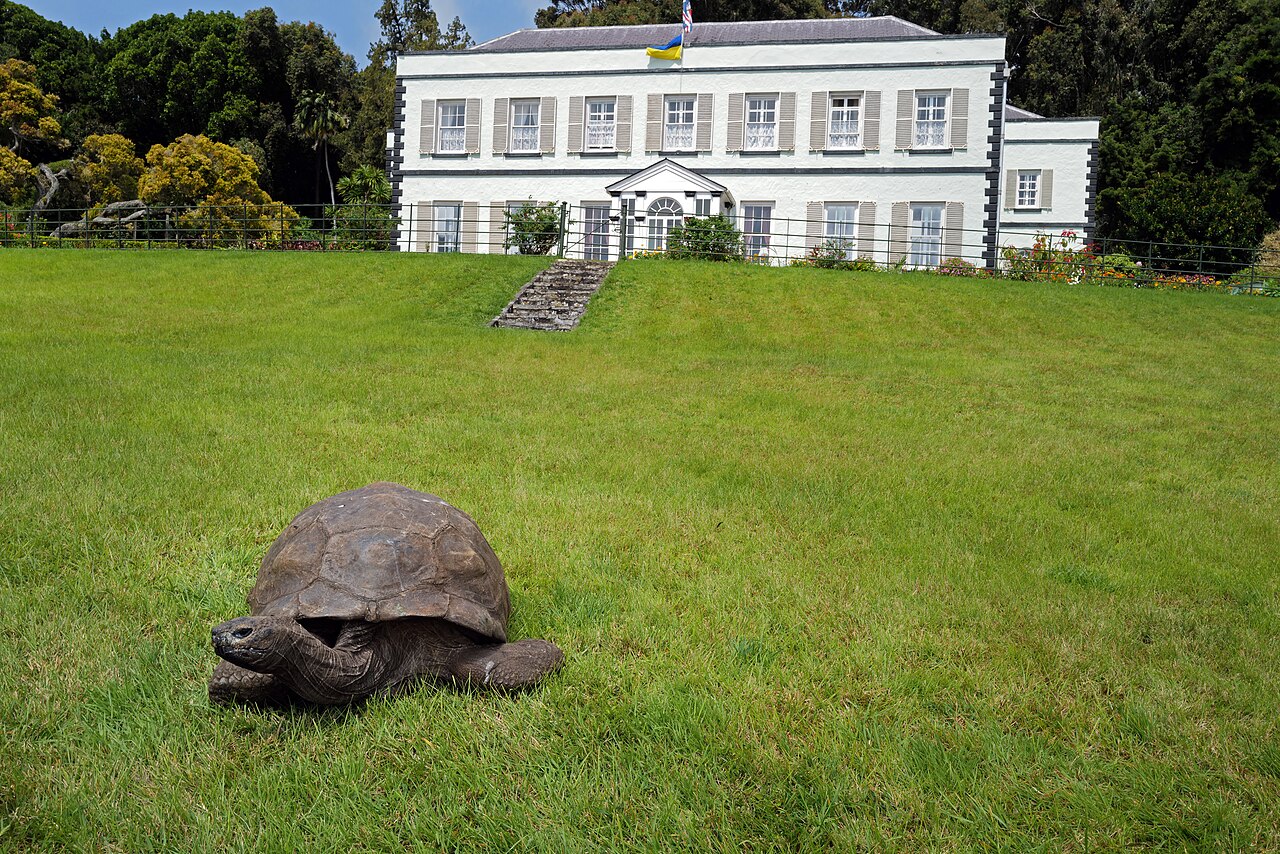
Jonathan the Tortoise and the Secrets in His Shell
A Seychelles giant tortoise who may have hatched before Queen Victoria took the throne is now letting scientists read his DNA for clues about cancer and aging.

Listen
Read by Finch · 8 min
A Tortoise Older Than the Lightbulb
Nobody alive has ever seen Jonathan young. The best anyone can say is that he was already fully grown in 1882, when he and three other tortoises were shipped from the Seychelles to Saint Helena as a gift intended for Sir William Grey-Wilson, who would go on to become the island's governor8,2. A photograph from around that time shows him at full size, and Seychelles giant tortoises typically take about 50 years to get there. Work backward from that, and you land on a hatching date no later than 1832, back when William IV sat on the British throne and Victoria was a 13-year-old princess five years from her coronation1.
That means Jonathan was already an adult tortoise before the telephone, the lightbulb, or the postage stamp existed9. He has outlasted 31 governors of Saint Helena and, according to one count, lived through the terms of 40 US presidents9,10. In 1947 he reportedly met Princess Elizabeth and her father King George VI; Prince Philip visited him in 1957, and Prince Edward saw him again in January 20248.
No birth certificate exists, so in November 2022 Saint Helena's governor, Nigel Phillips, gave him an official birthday: 4 December 18322,4. It is worth being honest about what that date is. It is a commemorative choice, not a documented fact, and Jonathan's own veterinarian, Dr Joe Hollins, has said he suspects the tortoise is even older than the estimate suggests, though there is no way to know for certain1,11.
For decades Jonathan was mostly a local curiosity: a blind, scentless old tortoise with excellent hearing, hand-fed weekly on bananas, cabbage, and carrots, who in March 2016 received the first bath of his recorded life from Hollins12. He lives with companions named David, Emma, and Fred, the last of whom spent years being called Frederika until a 2017 veterinary exam revealed a case of mistaken gender9. Then, in October 2026, Jonathan became something else: a research subject whose DNA might matter to human medicine5,7.
What His DNA Might Explain
In 2021, Hollins swabbed Jonathan for a DNA sample, which Guinness World Records reported was sent for analysis to the Vanderbilt Medical Research Center in Nashville1. That sample eventually fed into a broader project: researchers sequenced his full genome and examined his epigenome, the layer of chemical marks that controls which genes switch on or off without altering the DNA itself5,7.
The headline result, reported in 2026, was the identification of 287 gene variants associated with protection against age-related cellular damage5,6. Cambridge researchers described these variants as reducing the usual effects of aging6. The study looked specifically at systems involved in DNA repair, cellular senescence (where damaged cells stop dividing but linger on), cancer suppression, inflammation and immune regulation, and epigenetic control of gene activity5,7,6.

This fits into a long-running puzzle biologists call Peto's paradox: bigger animals with more cells and longer lifespans should, in theory, accumulate more cancer-causing mutations, yet large, long-lived species do not show correspondingly higher cancer rates. Giant tortoises are a vivid test case. A 2025 review in the journal BioScience noted that cancer appears to be exceptionally rare in turtles despite their size and age, pointing to resistance to oxidative stress and protein damage as possible explanations13. Earlier genomic work on Lonesome George, the last Pinta Island tortoise, and on an Aldabra giant tortoise found lineage-specific variants in DNA repair genes, inflammatory mediators, and cancer-related genes, hinting at evolutionary strategies tied to long life14. Separate research on Galapagos tortoises identified gene duplications linked to longevity and tumor suppression15.
Jonathan adds an unusually dramatic data point to that research: a single, individually documented animal who appears to have gone nearly two centuries without a known fatal cancer. But the people doing this work are careful about what it does and does not show. The reports do not establish that Jonathan carries one single longevity gene, and they do not show his variants can simply be transplanted into human biology to extend a human life5,7,6. What they offer are mechanistic clues: specific pathways worth a closer look, not a finished treatment.
The Numbers That Anchor the Story
- Estimated hatching year: 1832, based on his apparent age on arrival, not a birth record2,1.
- Arrival on Saint Helena: 1882, already fully grown, with three other tortoises8,2.
- Estimated age at arrival: at least 50 years, the typical age at which the species reaches full size2,3.
- Reported age milestones: about 182 in 2014, 190 in 2022, 192 in 2024, and 194 by October 202616,3,2,5.
- Gene variants identified in the 2026 study: 287, linked to resistance against age-related cellular damage5,6.
- Official commemorative birthday: 4 December, assigned in November 20222,4.
What's Solid, What's Guesswork
Jonathan's age is the biggest open question in his own story. There is no hatch record, no birth certificate, nothing contemporaneous from 1832. The entire estimate rests on an inference: he looked fully mature in a photograph from his 1882 arrival, and the species takes roughly 50 years to reach that state2,1. That is a reasonable method, but it is still an estimate with real uncertainty on either side, and Hollins himself has suggested the true number could run higher11.
His taxonomy is also inconsistently reported. Most careful sources identify him as a Seychelles giant tortoise, Aldabrachelys gigantea hololissa, a subspecies of the broader Aldabra giant tortoise, while some general coverage simply calls him an Aldabra giant tortoise without the subspecies distinction8,2,6. Both labels point to the same animal; they just differ in precision.
Finally, a word of caution about the genetics. The 287 variants and the pathways they touch, DNA repair, senescence, cancer suppression, inflammation, are described in the available reporting as associations and leads for further study, not as a proven cause of Jonathan's longevity or a validated treatment for human aging5,7,6. It is tempting to tell this as a story with a tidy ending, a wonder-tortoise who hands science the cure for cancer. The honest version is slower: a very old animal whose body is giving researchers somewhere specific to look next.
Timeline
- c. 1832Jonathan is estimated to have hatched, during the reign of King William IV1.
- 1882Jonathan arrives on Saint Helena from the Seychelles, already fully grown, intended as a gift for Sir William Grey-Wilson8,2.
- March 2016Veterinarian Dr Joe Hollins gives Jonathan what is believed to be the first bath of his life12.
- February 2022Guinness World Records names Jonathan the oldest tortoise ever recorded and the oldest known living land animal4,3.
- November 2022Governor Nigel Phillips assigns Jonathan a commemorative birthday of 4 December 18322,4.
- October 2026Researchers report sequencing Jonathan's genome and epigenome, identifying 287 gene variants linked to resistance against age-related cellular damage5,6.
Pictures




Sources
- Oldest tortoise - Guinness World Recordsguinnessworldrecords.com
- Jonathan (Seychelles giant tortoise)Britannica
- 190-year-old Jonathan is the oldest tortoise everlivescience.com · 2022
- The tortoise, the myth, the legend: Jonathan turns 190popsci.com
- The secret to longer life? Scientists believe a 194-year-old tortoise could unlock clues | CNNcnn.com
- Genetic analysis of the world's oldest land animal reveals secret of living 194 yearscam.ac.uk
- At 194, Jonathan the Giant Tortoise Knows About AgingThe New York Times
- Jonathan (tortoise)Wikipedia
- The World's Oldest Living Land Animal, a Tortoise Named Jonathan, Turns 191Smithsonian Magazine · 2023
- The World's Oldest Living Land Animal Has Lived Through 40 US ...iflscience.com
- At 190, Jonathan the Tortoise Is the World's OldestSmithsonian Magazine · 2022
- JONATHAN TAKES A BATHsainthelena.gov.sh
- Do turtles get cancer?Scholarly work · 2025
- Giant tortoise genomes provide insights into longevity and age-related diseasePubMed Central · 2018
- Concurrent Evolution of Antiaging Gene Duplications and Cellular Phenotypes in Long-Lived Turtles.Scholarly work · 2021
- Meet Jonathan, St Helena's 182-year-old giant tortoiseBBC
- A phylogenetic review of cancer resistance highlights evolutionary solutions to Peto's Paradox.Scholarly work · 2022
Researched and written by Lorelet from the sources above. It cites as it goes, but it can still get things wrong, so check the sources for anything that matters.
Report a problem
More featured lorelets
See all
Today · Technology
Watching the Watchers: A DIY Camera That Hunted Cops
A Canadian YouTuber built a homemade license-plate reader modeled on police surveillance tech, then pointed it at the police themselves. The officers…

Today · Technology
The Maker Who Rebuilt a Cray-1 Out of 30 Mac Minis
A museum in rural Spain spent 18 months building a full-scale Cray-1 replica, then stuffed it with 30 castoff 2012 Mac minis and made the thing actua…

Oct 9 · Film & TV
The Lost Interactive Art of 2000s DVD Menus
For about a decade, before streaming flattened everything into a thumbnail grid, the humble DVD menu was a playground for designers, who turned a sim…