Featured · TodayArt & Design
The Week Garfield Woke Up Alone
For six days before Halloween 1989, a comic strip built on lasagna jokes went somewhere nobody expected, and the silence that followed let readers write their own, much darker ending.

Listen
Read by Finch · 6 min
A Cat Wakes Up Alone
On October 23, 1989, readers opened their newspapers to a Garfield strip that looked wrong before they had even read it1. Jim Davis's usual flat, cheerful art style had been replaced with moody backgrounds and tilted, Dutch-angle panels, as Garfield wakes up to find himself alone in his own house1,4. No Jon Arbuckle. No Odie. Just rooms that looked like home but felt, somehow, abandoned1,5.
There was no punchline. For a strip that had spent eleven years running gags about coffee, naps, and lasagna, that absence was itself the strangest thing on the page1. Something had clearly been taken from Garfield's world, and the newspaper's comics page gave no hint of what, or why.
Garfield was, by 1989, about as far from horror material as a comic strip got. Davis had built him into a sarcastic, gluttonous, lazy orange tabby syndicated in well over a thousand newspapers, a character whose entire comedic engine ran on food, sleep, and mild contempt for effort2. Jon Arbuckle, his hapless owner, and Odie, the dim-witted dog, existed mostly to give Garfield someone to outsmart or ignore2. The strip's one serious predecessor to this mood was years of occasional dark asides, like a 1982 story in which Garfield spots a tombstone with his own name on it during a stormy-night detour, but nothing had gone this far6.
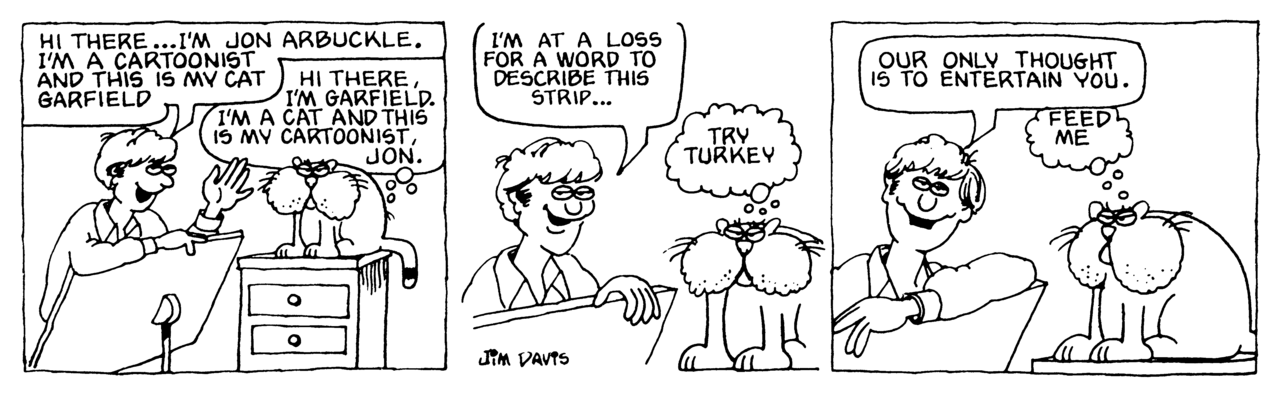
Across the next four strips, October 24 through 27, Garfield searches the house for Jon and Odie and finds only the shell of a home that once held them1,7,5. Commentators have since described the premise as Garfield discovering a future in which the house has been abandoned and he himself no longer exists in the ordinary order of things2. Exactly what he sees along the way is harder to pin down: some retellings mention remnants of his old life, others stress that the strips mostly show an empty house and a cat's mounting distress, and the accounts don't fully agree because so many of them summarize the sequence without naming individual dates7,9,5. What's consistent is the shape of the dread: the problem stops being that Jon and Odie are elsewhere, and becomes the possibility that Garfield has been erased from the world entirely1,2,4.
The strip published October 28, 1989, delivers the line most people remember. Garfield reaches a breaking point and says, "I don't want to be alone!"6. It is an unusually plain sentence for a character defined by sarcasm and self-interest; the appetite and the attitude disappear, and what's left is just a frightened animal1,4. Immediately after, the story resets: Garfield is back in his ordinary house, with Jon and Odie present again, as if the previous five days had been a nightmare he'd woken from rather than a fate he'd suffered7,10,8,6.
Davis said nothing publicly about any of it for nine years. His only on-record explanation came in the 1998 anniversary collection Garfield's Twentieth Anniversary Collection: 20 Years & Still Kicking!, where he wrote: "During a writing session for Halloween, I got the idea for this decidedly different series of strips. I wanted to scare people. And what do people fear most? Why, being alone"2,7,5. He'd apparently gone around asking people what truly scared them, and settled on loneliness over "the old rattling chains" and stock monsters he found boring4,7. The reaction, he said, ranged from "Right on!" to "This isn't a trend, is it?"1
That silence is exactly what let the strip take on an afterlife its creator hadn't planned. Readers who encountered the six strips without Davis's explanation filled the gap themselves, and the theory they landed on was darker than anything he'd intended: that Jon and Odie were actually gone for good, that Garfield really was alone in that house, and that every strip published since October 28, 1989, has been a hallucination of a cat slowly starving to death7,6,11. Davis has called the theory false and is reported to have laughed loudly when fans confronted him with it directly7. The arc, as he's described it, was a deliberate, self-contained Halloween scare with a built-in return to normal, not a secret rewriting of the strip's own continuity2,7,8. But a joke-free comic that vanished from the historical record for nine years had already given readers plenty of room to decide otherwise, and almost forty years later, new fans still rediscover the six strips and ask the same question Garfield himself asked on October 28, 1989: what happens to you when the people who made a place feel like home simply aren't there anymore1,6.
Timeline
- 1989-10-23Garfield wakes alone in an unusually dark, Dutch-angle version of his own house, the first of the six 'Garfield Alone' strips1.
- 1989-10-24Through October 27, Garfield searches the seemingly abandoned house for Jon and Odie1,7,5.
- 1989-10-28Garfield cries 'I don't want to be alone!' and the strip resets to his normal life with Jon and Odie6,7,8.
- 1998Davis publicly explains the arc for the first time, in Garfield's Twentieth Anniversary Collection2,7,5.
Pictures


Sources
- 37 Years Ago, 'Garfield' Suddenly Changed Genres With a Mind-Blowing Comic Strippolygon.com · 2026
- GarfieldWikipedia
- Garfield | Comic Stripsscribd.com
- Jim Davis wanted Garfield’s Halloween Adventure to “at least scare 4-year-olds”avclub.com · 2014
- The Harrowing Horror Of GARFIELD'S HALLOWEEN ...fangoria.com
- Garfield - TV Tropestvtropes.org · 2011
- The Death of Garfield? | Retro Junkretrojunk.com
- Garfieldfantheories.fandom.com
- Starving Garfieldnowiknow.com
- Garfield (Comic Strip)/WMG - Tropedia - Fandomtropedia.fandom.com
- TIL; John/Odie weren't real, Garfield's entire world was made up to cope with him starving to death in an abandoned house.Reddit
Researched and written by Lorelet from the sources above. It cites as it goes, but it can still get things wrong, so check the sources for anything that matters.
Report a problem
More featured lorelets
See all
Today · History
The Welsh Legend of Magnus Maximus and the Lost Roman Fort
A medieval dream-tale placed an emperor's camp on a Welsh mountainside. Two thousand years later, something turned up in a field near Crymych that no…

Today · Food
The Dish That Empties a Texas Smokehouse
A food truck in a county seat of 4,200 people runs out of meat almost every day.

Oct 16 · Science
Hearing a Bell That Has Not Rung Since 1846
Nobody alive has heard the Liberty Bell sound freely, so how did engineers end up playing its voice off a cassette tape.