
Featured · TodaySpace
The Moon Landing That Needs a Fuel Truck Convoy First
Before anyone sets foot near the lunar south pole again, a fleet of unmanned rockets has to pull off something no one has ever done at this scale in orbit.

Listen
Read by Finch · 9 min
A Test That Wasn't the Real Test
At 8:25 a.m. Central time on March 14, 2024, SpaceX launched the third integrated test flight of Super Heavy and Starship from Starbase, Texas3. Partway through the coast phase, the vehicle moved at least 10 metric tons of liquid oxygen from a header tank near the nose to a main tank farther aft, a maneuver NASA had helped fund through a Tipping Point award3,4. Lisa Watson-Morgan, the HLS program manager at NASA's Marshall Space Flight Center, called it one of several ambitious objectives engineers were testing to gather data for future Artemis missions3.
It was not, however, the operation that actually matters for getting to the Moon. Moving propellant between two tanks inside one Starship is a different problem than getting two separate Starships to find each other in orbit, dock, and transfer propellant between them, which is what the Artemis architecture actually requires4,3.
Apollo never had this problem. The Saturn V carried astronauts, their lander, and all the propellant for translunar injection, lunar operations, and the trip home in a single launch8. Starship HLS is built around the opposite assumption: it is too large to launch already full and fly straight to the Moon, so it has to top off its tanks in low Earth orbit first1,2.
NASA's current public plan calls for three versions of the same vehicle. A depot Starship goes up first, built to hold cryogenic propellant and limit boiloff. A series of reusable tankers then fly up, each one rendezvousing with the depot to hand over liquid methane and liquid oxygen. Only after the depot is full does the HLS itself launch, dock with the depot, fill its own tanks, and head for the Moon on a roughly six-day trip to near-rectilinear halo orbit, where it waits for the Artemis crew aboard Orion1,2.
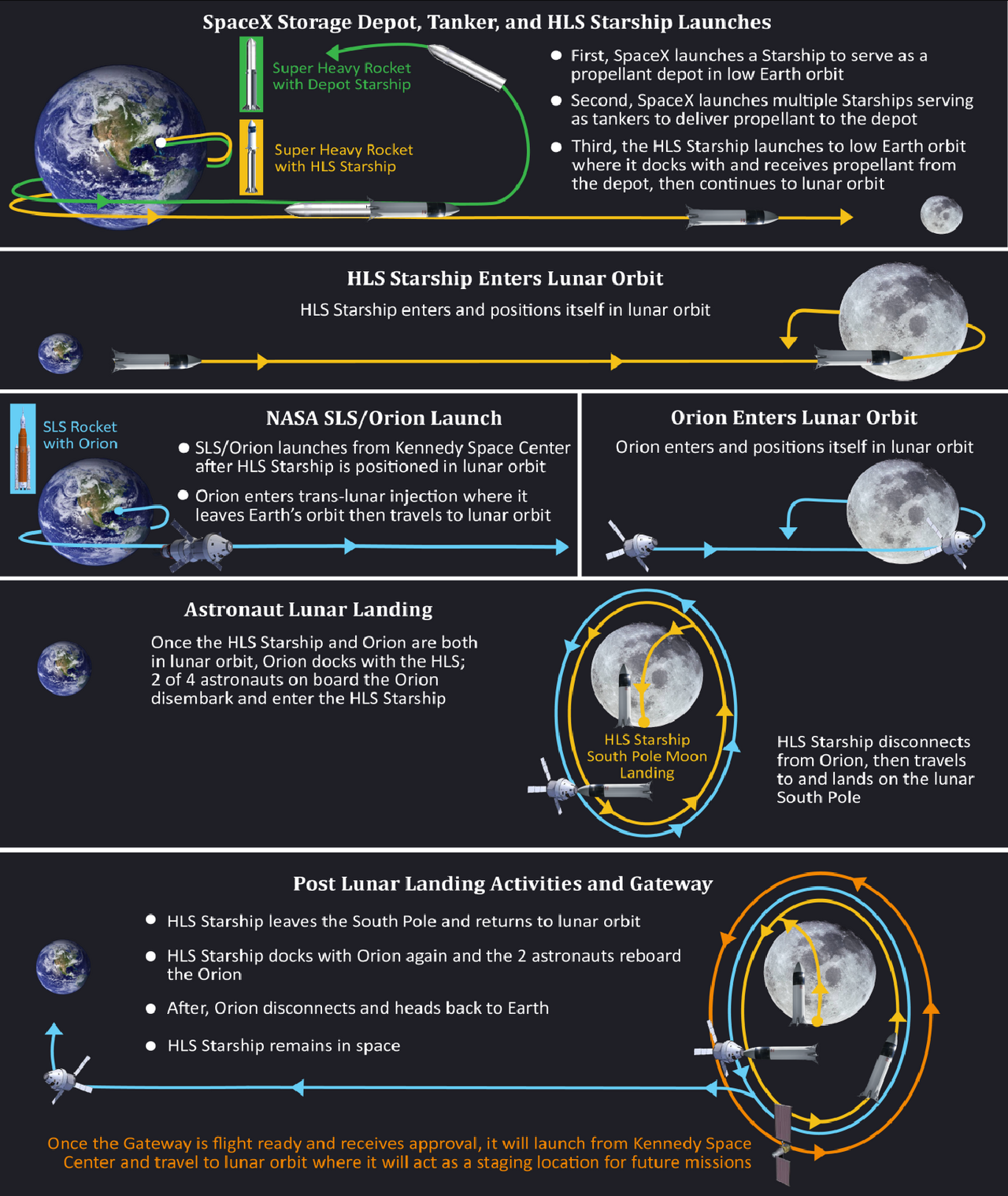
That dependency was baked in early. When NASA selected SpaceX in April 2021 to build the Human Landing System for Artemis III, the basic concept already required the HLS to launch separately from the crew, get refueled in orbit, and travel on to the Moon alone1,8. From that point on, orbital refueling was not a side experiment. If the depot could not be filled or the HLS could not safely take on propellant, there was no landing.
What was never settled, even inside NASA, was how many flights that would actually take. In 2021 Elon Musk said four to eight tanker launches would do it, while the Government Accountability Office that same year put SpaceX's total campaign, including the depot and HLS, at 16 launches8. In April 2024, NASA officials described SpaceX's then-current estimate as roughly 10 refueling flights, with uncertainty acknowledged on both sides of that number5. A NASA official in 2023 had already put the real figure 'in the high teens'8. By 2026, reporting tied to court filings described an architecture with one depot, 14 tankers, and the HLS, for 16 launches total6, while a separate 2026 report attributed an estimate of more than 40 tanker flights to NASA Johnson Space Center engineers relayed by a former NASA official speaking anonymously7.
Those numbers are not necessarily contradictions so much as snapshots of a design still in motion: they depend on how much propellant each tanker can actually deliver, how much boils off waiting on orbit, how efficient the transfer turns out to be, and whether tankers can be reused quickly enough to fly something close to one every six days, which is the later cadence NASA has described for a real campcampaign9. The 40-plus figure, notably, was never tied in public reporting to a released NASA calculation, which makes it a reported internal estimate rather than an adopted mission requirement7. What is certain is that the easy part, moving liquid oxygen from one tank to another inside a single Starship on a quiet March morning in 2024, was never the hard part at all.
Why Apollo Didn't Need Any of This
The Saturn V was built to do everything in one shot: launch the crew, the lunar module, and enough propellant for the trip out, the landing, the ascent, and in most mission designs the trip home8. That brute-force approach worked because the rocket itself was enormous and nothing needed to be built or fueled once it left the pad.

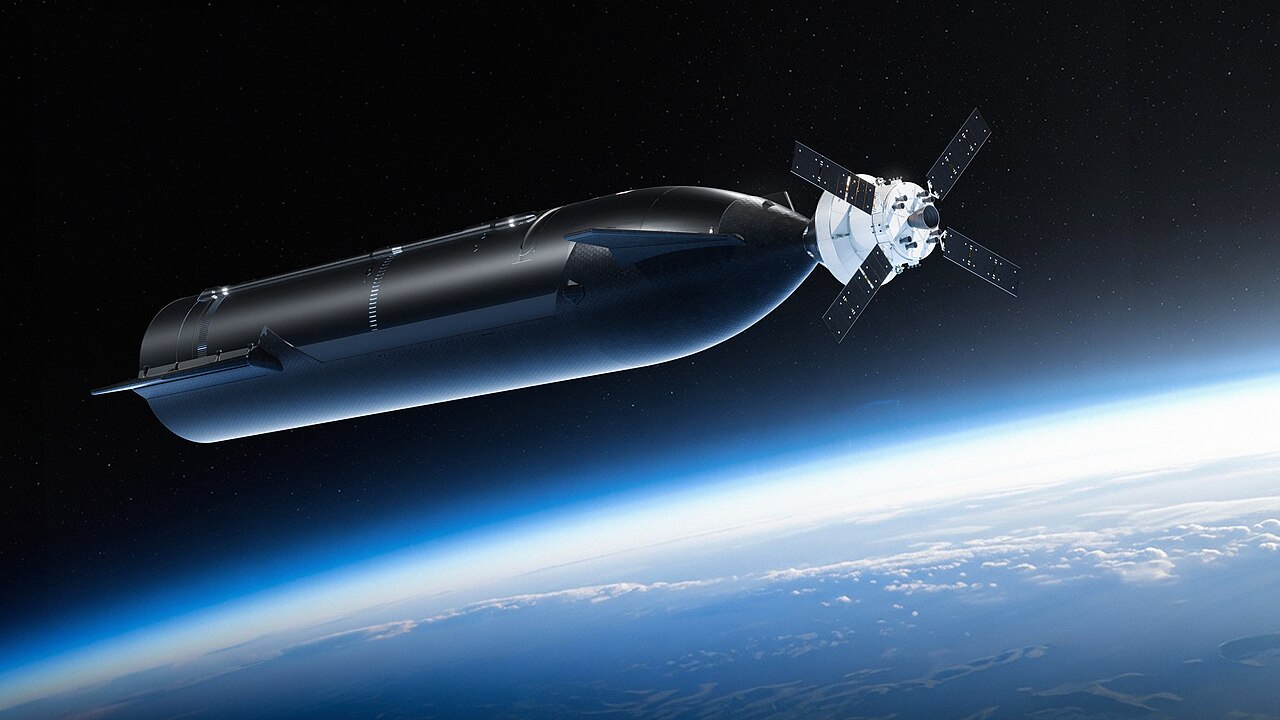
Starship HLS inverts that logic. Because the vehicle cannot launch with a full load of propellant and still make it to the Moon, NASA and SpaceX moved the hard problem from the launch pad to low Earth orbit, where cryogenic liquid methane and liquid oxygen have to be transferred between spacecraft that are both moving and both losing propellant to boiloff the whole time1,2. NASA has called large-scale Starship-to-Starship cryogenic transfer a capability 'critical' to the HLS mission10.
The comparison matters for understanding the current debate over launch counts: it is not that SpaceX's rocket is weaker than the Saturn V, it is that the mission is structured completely differently, trading one giant, simple launch for a sequence of smaller, repeatable, and so far unproven orbital operations8,1.
The Competing Launch Counts
- About 10: SpaceX's 2024 estimate for tanker launches needed for one Artemis landing, described by NASA officials as approximate5
- 4 to 8: Elon Musk's 2021 estimate for required tanker flights8
- 16 total: The Government Accountability Office's 2021 estimate of SpaceX's overall launch requirement, and a figure later echoed in 2026 reporting as one depot, 14 tankers, and the HLS8,6
- 'High teens': A NASA official's 2023 estimate of total Starship launches needed for one lunar landing8
- More than 40: A 2026 estimate attributed to NASA Johnson Space Center engineers, relayed anonymously by a former NASA official, and not publicly tied to a released NASA calculation7
Who's Running the Supply Chain
- NASA: Owns the Artemis program and the Human Landing System contract; sets mission requirements and has given shifting public estimates of the launch count needed1,5
- SpaceX: Builds and flies Starship HLS, the depot, and the tankers; gave the original 'roughly 10-ish' estimate later disputed by other reporting5,7
- Starship HLS: The lunar-landing variant that docks with the depot, fills its tanks, and carries astronauts to and from the lunar surface11,2
- Lisa Watson-Morgan: HLS Program Manager at NASA's Marshall Space Flight Center, who spoke publicly about the March 2024 test flight's objectives3
- Apollo program / Saturn V: The historical point of comparison, a single-launch architecture that needed none of this orbital assembly8
What's Actually Settled, and What Isn't
The basic architecture, depot first, then tankers, then HLS, is confirmed across NASA's own materials1,2. What remains unsettled is the exact number of flights, because that number depends on engineering assumptions (transfer efficiency, boiloff rates, tanker reuse speed) that were still being refined as of the sources available here9,5.
The higher figure of more than 40 tanker flights should be treated cautiously. It came from a 2026 report that attributed the number to NASA Johnson Space Center engineers, passed along by a former NASA official speaking anonymously, and it was not shown to be tied to any released NASA calculation7. That does not mean the number is wrong, only that it has not been confirmed as an official mission requirement the way the 'roughly 10' and '14 tanker' figures have been described in NASA presentations and reporting tied to planning documents5,6,2.
Timeline
- 2020-05NASA selects SpaceX for an Artemis III lander design study, 'Option A'8
- 2021-04-16NASA awards SpaceX the Human Landing System contract, worth $2.89 billion8
- 2021GAO estimates SpaceX will need 16 launches overall; Musk estimates 4 to 8 tanker flights8
- 2024-03-14SpaceX's IFT-3 demonstrates internal cryogenic propellant transfer between tanks on a single Starship3,4
- 2024-04NASA officials describe SpaceX's estimate of roughly 10 refueling launches for one landing5
- 2026Reporting describes a 16-launch architecture (1 depot, 14 tankers, 1 HLS) tied to court filings, alongside a separate report of an internal NASA estimate exceeding 40 tanker flights6,7
Pictures




Sources
- Artemis III: NASA’s First Human Mission to Lunar South Pole - NASANASA · 2023
- Update on NASA’s Human Landing System (HLS) Program: Public ...NASA
- NASA Artemis Mission Progresses with SpaceX Starship Test Flight - NASANASA · 2024
- SpaceX's 2026 Orbital Refueling Demonstration: The 'Gas Station in ...programming-helper.com
- arstechnica.com · space · 2024NASA lays out how SpaceX will refuel Starships in low-Earth ...Ars Technica
- Analysis: Narrowing In – Artemis III, HLS and NASA's Journey to Todayspacescout.info
- Is NASA losing the moon race? All eyes are on the megarocket ...krgv.com
- Starship HLSWikipedia
- Why we need in-orbit refueling to return to the Moonastronomy.com
- April 26, 2023NASA
- IAC-26-B3.1 NASA'S Human Landing SystemNASA
Researched and written by Lorelet from the sources above. It cites as it goes, but it can still get things wrong, so check the sources for anything that matters.
Report a problem
More featured lorelets
See all
Today · Mystery
The Satellite Photo That Looked Exactly Like a Plane Wing
A blurry shape in a Pacific lagoon convinced researchers they had finally found Amelia Earhart's lost aircraft. A seventeen-person expedition sailed…

Today · Mystery
The Voynich Manuscript Might Have Been Bound Backward
Codebreakers have failed to read the world's most famous undeciphered book for over a century. A 2026 study asks whether anyone was ever reading it i…

Oct 22 · History
Finding the Spot Where Photography First Saw a Person
A night out near a Paris square sent three filmmakers chasing a nearly two-century-old shadow, back to the exact patch of pavement where an anonymous…